Upgrade & Secure Your Future with DevOps, SRE, DevSecOps, MLOps!
We spend hours scrolling social media and waste money on things we forget, but won’t spend 30 minutes a day earning certifications that can change our lives.
Master in DevOps, SRE, DevSecOps & MLOps by DevOps School!
Learn from Guru Rajesh Kumar and double your salary in just one year.
Introduction
Candidate Assessment Tools help companies evaluate job applicants using structured tests, skill checks, coding challenges, cognitive assessments, personality tests, video interviews, job simulations, and role-based evaluations. In simple words, these tools help recruiters and hiring managers understand whether a candidate has the right skills, behavior, problem-solving ability, and job readiness before making a hiring decision.
In the hiring environment, candidate assessment tools matter because companies are dealing with remote hiring, high application volume, AI-written resumes, skill-based hiring, and stronger compliance expectations. A good assessment platform helps reduce guesswork, improve hiring quality, and make candidate evaluation more consistent.
Real-world use cases include technical hiring, sales hiring, customer support screening, graduate recruitment, leadership assessment, language testing, personality evaluation, and remote interview evaluation.
Buyers should evaluate:
- Assessment library depth
- Role-based test customization
- Candidate experience
- Anti-cheating and proctoring controls
- ATS and HRIS integrations
- Reporting and scorecards
- AI usage transparency
- Security and data privacy
- Scalability for hiring volume
- Pricing flexibility
Best for: recruiters, HR teams, talent acquisition leaders, staffing agencies, technical hiring teams, enterprise HR departments, and companies that want structured, skills-based candidate evaluation.
Not ideal for: teams hiring only occasionally, roles where assessment adds unnecessary friction, or companies that do not have clear evaluation criteria. In such cases, structured interviews, work samples, or simple screening questions may be enough.
Key Trends in Candidate Assessment Tools
Skills-first hiring is becoming mainstream: Companies are moving away from relying only on degrees, resumes, and previous job titles. Candidate assessment tools help evaluate real ability through job-relevant tests.
- AI-assisted assessment creation: Many platforms now use AI to help generate role-based questions, evaluate responses, summarize candidate performance, and recommend interview focus areas.
- Higher focus on assessment fairness: Employers are becoming more careful about bias, accessibility, adverse impact, and explainability in assessment design.
- Remote proctoring and anti-cheating controls: With remote hiring and AI tools widely available, companies need plagiarism detection, browser monitoring, webcam proctoring, identity checks, and question randomization.
- Job simulation assessments: Instead of generic tests, companies are using realistic simulations that mirror actual job tasks, such as coding, customer support, sales calls, case studies, and writing assignments.
- ATS-first integration: Assessment tools are expected to connect smoothly with Applicant Tracking Systems, HRIS platforms, calendars, interview tools, and analytics dashboards.
- Shorter candidate-friendly tests: Long assessments can increase candidate drop-off. Many modern platforms now focus on shorter, more relevant, and mobile-friendly evaluations.
- Data-driven hiring decisions: Hiring leaders want dashboards showing candidate performance, benchmark scores, funnel quality, pass rates, and hiring outcomes.
- Custom assessment workflows: Companies want different assessment paths based on role, seniority, location, hiring stage, and candidate type.
- Security and privacy expectations are rising: Candidate data is sensitive, so buyers expect encryption, access controls, consent management, audit logs, and clear data retention policies.
How We Selected These Tools
The top candidate assessment tools in this guide were selected using a practical evaluation model focused on hiring outcomes, platform maturity, and real-world usability. The selection considered:
- Market adoption and recognition among recruiting and HR teams
- Assessment coverage across technical, cognitive, behavioral, and role-based skills
- Feature completeness for test creation, delivery, scoring, reporting, and candidate communication
- Reliability for remote hiring and high-volume recruitment
- Security posture signals such as proctoring, permissions, auditability, and identity controls
- Integration ecosystem with ATS, HRIS, video interview, and productivity tools
- Fit for different company sizes, from startups to enterprises
- Candidate experience and test accessibility
- Analytics depth and hiring manager usability
- Practical trade-offs such as pricing, setup effort, and customization complexity
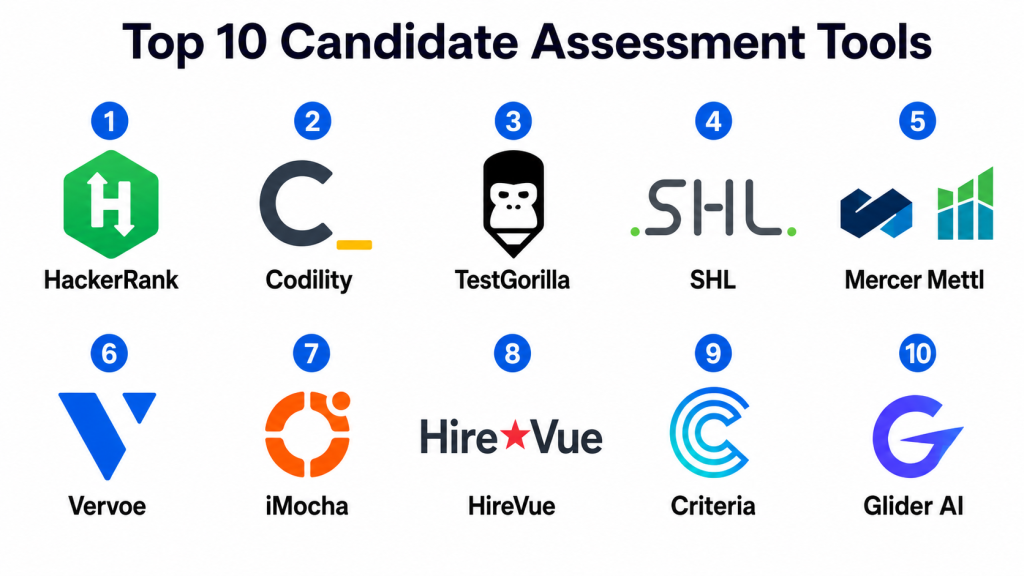
Top 10 Candidate Assessment Tools
#1 — HackerRank
Short description: HackerRank is a technical assessment platform used for evaluating developers, engineers, data professionals, and technical candidates. It is best suited for companies that need coding tests, technical screening, and structured developer hiring workflows.
Key Features
- Coding assessments for multiple programming languages
- Role-based technical test templates
- Live coding interview environment
- Plagiarism detection and proctoring controls
- Developer skill benchmarking
- Interview scorecards and evaluation workflows
- ATS and recruiting tool integrations
Pros
- Strong platform for software engineering and technical hiring.
- Large library of coding challenges and role-based tests.
- Useful for both screening and live technical interviews.
Cons
- Less suitable for non-technical roles.
- Candidates may feel pressured by timed coding tests.
- Test quality depends on how well assessments match real job tasks.
Platforms / Deployment
Web
Cloud
Security & Compliance
Supports common enterprise security expectations such as role-based access, proctoring-related controls, plagiarism detection, and identity-related features. Specific compliance details should be validated during procurement.
Integrations & Ecosystem
HackerRank integrates with common ATS, recruiting, and interview workflows. It is typically used as part of a technical hiring stack.
- Applicant Tracking Systems
- Calendar and interview scheduling tools
- HR and recruiting platforms
- Developer hiring workflows
- Reporting and analytics systems
- API-based integrations
Support & Community
HackerRank provides documentation, customer support, implementation resources, and a strong brand presence among technical recruiters and engineering hiring teams.
#2 — Codility
Short description: Codility is a technical hiring and assessment platform focused on coding tests, engineering skill evaluation, and developer interviews. It is useful for companies that need structured technical screening at scale.
Key Features
- Coding tests and programming assessments
- Technical screening workflows
- Live technical interview tools
- Anti-cheating and plagiarism detection
- Role-based technical assessment templates
- Candidate performance reporting
- ATS integrations
Pros
- Strong for developer and engineering assessments.
- Good fit for companies hiring technical talent at scale.
- Helps standardize technical screening across hiring teams.
Cons
- Mostly focused on technical roles.
- Can be less useful for broader behavioral or soft-skill assessment.
- Requires careful test design to avoid overly academic challenges.
Platforms / Deployment
Web
Cloud
Security & Compliance
Supports common security and test integrity features such as access controls, plagiarism detection, and proctoring-related capabilities. Specific compliance details should be confirmed with the vendor.
Integrations & Ecosystem
Codility connects with recruiting workflows and ATS platforms to help teams move candidates through technical screening and interviews.
- Applicant Tracking Systems
- Interview scheduling workflows
- Recruiting platforms
- HR systems
- Analytics tools
- API-based workflows
Support & Community
Codility provides product documentation, customer support, onboarding help, and resources for technical hiring teams. Its community is strong among engineering recruiters and hiring managers.
#3 — TestGorilla
Short description: TestGorilla is a broad candidate assessment platform that offers tests for cognitive ability, job skills, personality, language, software skills, and role-specific hiring. It is useful for SMBs, mid-market teams, and companies moving toward skills-based hiring.
Key Features
- Large library of pre-built assessments
- Cognitive, personality, language, and job-skill tests
- Custom question support
- Anti-cheating features
- Candidate comparison dashboards
- Video response questions
- ATS integrations
Pros
- Broad assessment coverage for many job roles.
- Easy to use for small and mid-sized hiring teams.
- Good option for companies that want quick skills-based screening.
Cons
- Enterprise customization may be limited compared with larger assessment suites.
- Some tests may need validation for specific job contexts.
- Buyers should review assessment relevance before using default templates.
Platforms / Deployment
Web
Cloud
Security & Compliance
Supports common candidate assessment controls such as access permissions, anti-cheating features, and data protection practices. Specific compliance certifications should be validated during procurement.
Integrations & Ecosystem
TestGorilla integrates with recruiting tools and ATS workflows, making it practical for teams that want to add assessments into existing hiring pipelines.
- Applicant Tracking Systems
- HR tools
- Email and candidate communication workflows
- Video response workflows
- Reporting dashboards
- API or integration connectors where available
Support & Community
TestGorilla provides documentation, help resources, support options, and onboarding materials. It is commonly used by SMBs and growing hiring teams.
#4 — SHL
Short description: SHL is an established talent assessment platform used for cognitive ability testing, personality assessment, leadership evaluation, graduate hiring, and workforce insights. It is often used by large enterprises and organizations with formal assessment programs.
Key Features
- Cognitive ability assessments
- Personality and behavioral assessments
- Leadership and potential evaluation
- Role-based assessment solutions
- Graduate and campus hiring support
- Benchmarking and analytics
- Enterprise assessment workflows
Pros
- Strong assessment science and enterprise credibility.
- Suitable for large-scale hiring and talent evaluation.
- Good coverage beyond technical skills, including behavior and leadership.
Cons
- May be too complex or expensive for small businesses.
- Implementation may require assessment expertise.
- Candidate experience depends on test type and configuration.
Platforms / Deployment
Web
Cloud
Security & Compliance
Supports enterprise assessment security expectations such as controlled access, data protection, reporting controls, and candidate privacy features. Specific compliance details should be confirmed during vendor review.
Integrations & Ecosystem
SHL is commonly used in enterprise HR and talent ecosystems. It can support hiring, leadership development, internal mobility, and workforce planning use cases.
- Applicant Tracking Systems
- HRIS and HCM platforms
- Talent management systems
- Leadership development programs
- Reporting and analytics tools
- Enterprise integration workflows
Support & Community
SHL provides enterprise support, consulting resources, documentation, assessment expertise, and customer success services. It has a strong presence in enterprise talent assessment.
#5 — Mercer Mettl
Short description: Mercer Mettl is an assessment platform used for hiring, campus recruitment, skill testing, certification exams, proctored assessments, and talent development. It is suitable for enterprises, education providers, and organizations managing high-volume assessments.
Key Features
- Technical, cognitive, behavioral, and role-based assessments
- Online proctoring and test integrity controls
- Coding and skill-based assessments
- Psychometric assessments
- Campus hiring and large-scale testing support
- Custom assessment creation
- Reporting and analytics
Pros
- Broad assessment coverage across many roles and industries.
- Strong fit for high-volume and remote assessments.
- Useful for hiring, certification, and internal talent evaluation.
Cons
- Platform depth may require setup and planning.
- Candidate experience can vary depending on assessment length and proctoring settings.
- Some features may be more than needed for smaller hiring teams.
Platforms / Deployment
Web
Cloud
Security & Compliance
Supports proctoring, access controls, test monitoring, and candidate data protection features. Specific compliance certifications and regional controls should be validated by buyers.
Integrations & Ecosystem
Mercer Mettl integrates into hiring, learning, certification, and HR workflows. It is often used where large-scale online testing and assessment security are important.
- Applicant Tracking Systems
- Learning management systems
- HR platforms
- Proctoring workflows
- Certification systems
- Analytics and reporting platforms
Support & Community
Mercer Mettl provides enterprise support, implementation guidance, assessment consulting, documentation, and customer enablement resources.
#6 — Vervoe
Short description: Vervoe is a skills assessment platform focused on job simulations and practical candidate evaluation. It helps companies assess how candidates perform job-related tasks rather than relying only on resumes or interviews.
Key Features
- Job simulation assessments
- AI-assisted candidate grading
- Role-based assessment templates
- Custom assessment builder
- Candidate ranking and reporting
- Video, text, multiple-choice, and task-based questions
- ATS integrations
Pros
- Strong focus on practical, job-relevant skills.
- Useful for reducing reliance on resume screening.
- Good fit for customer support, sales, operations, and other role-based hiring.
Cons
- AI scoring should be reviewed carefully by humans.
- Requires thoughtful assessment design for best results.
- May not be ideal for roles needing deep technical coding evaluation.
Platforms / Deployment
Web
Cloud
Security & Compliance
Supports common security and access control features for assessment workflows. Specific compliance details are not publicly stated for every package and should be verified.
Integrations & Ecosystem
Vervoe fits into modern recruiting workflows and connects with ATS platforms and hiring systems to help teams screen candidates based on skills.
- Applicant Tracking Systems
- Recruiting platforms
- Candidate communication tools
- Reporting workflows
- HR systems
- Workflow automation tools
Support & Community
Vervoe provides documentation, support resources, onboarding assistance, and guidance for building effective assessments. It is recognized among teams adopting skills-based hiring.
#7 — iMocha
Short description: iMocha is a skills intelligence and assessment platform used for technical, business, language, cognitive, and role-based assessments. It supports hiring, upskilling, internal mobility, and workforce skill measurement.
Key Features
- Large skills assessment library
- Technical and non-technical tests
- Coding assessments
- AI-enabled skills intelligence
- Proctoring and anti-cheating controls
- Skill gap analysis
- Integrations with HR and learning systems
Pros
- Broad skills coverage across technical and business roles.
- Useful for both hiring and employee skill development.
- Strong fit for companies building skills-based workforce strategies.
Cons
- Large test library may require careful selection.
- Advanced workforce intelligence use cases may need planning.
- Buyers should validate role relevance and assessment quality.
Platforms / Deployment
Web
Cloud
Security & Compliance
Supports common assessment security features such as access controls, proctoring, and anti-cheating capabilities. Specific compliance details should be validated with the vendor.
Integrations & Ecosystem
iMocha integrates with HR, recruiting, learning, and workforce planning systems. It is useful for companies connecting hiring assessments with internal skill development.
- Applicant Tracking Systems
- HRIS and HCM platforms
- Learning management systems
- Talent management tools
- Analytics dashboards
- API-based integrations
Support & Community
iMocha provides support, documentation, onboarding resources, and customer guidance. Its ecosystem is strong among technical hiring, learning, and talent development teams.
#8 — HireVue
Short description: HireVue is a hiring platform known for video interviewing, structured interviews, assessments, and candidate evaluation workflows. It is commonly used by enterprise and high-volume hiring teams.
Key Features
- On-demand and live video interviews
- Structured interview workflows
- Candidate assessments
- Interview scheduling support
- Hiring team collaboration
- Candidate evaluation dashboards
- Enterprise recruiting integrations
Pros
- Strong fit for high-volume and distributed hiring.
- Useful for standardizing interview evaluation.
- Supports remote candidate screening and structured interviews.
Cons
- Video assessment may not fit every role or candidate preference.
- Enterprise setup may require planning.
- Buyers should carefully review AI and evaluation settings for fairness and transparency.
Platforms / Deployment
Web / iOS / Android
Cloud
Security & Compliance
Supports enterprise security expectations such as access controls, candidate data protection, and audit-related workflows. Specific compliance and AI governance details should be reviewed during procurement.
Integrations & Ecosystem
HireVue connects with enterprise recruiting systems and ATS platforms. It is often part of large-scale hiring workflows where video screening and structured evaluation are important.
- Applicant Tracking Systems
- HR platforms
- Interview scheduling tools
- Candidate communication workflows
- Reporting systems
- Enterprise recruiting ecosystems
Support & Community
HireVue provides enterprise support, documentation, implementation resources, and customer success services. It has strong visibility among enterprise recruiting teams.
#9 — Criteria
Short description: Criteria is a candidate assessment platform focused on cognitive ability, personality, emotional intelligence, skills, and job-fit assessments. It is useful for companies that want structured, research-based screening for a variety of roles.
Key Features
- Cognitive ability tests
- Personality and behavioral assessments
- Emotional intelligence assessments
- Skills and role-based tests
- Structured candidate reports
- Benchmarking and score comparison
- ATS integrations
Pros
- Strong for cognitive and behavioral assessment.
- Useful across many non-technical and business roles.
- Helps improve consistency in early-stage screening.
Cons
- Less specialized for deep coding assessments.
- Test selection requires careful alignment with job needs.
- Some candidates may need context on why assessments are required.
Platforms / Deployment
Web
Cloud
Security & Compliance
Supports standard security practices for assessment delivery and candidate data protection. Specific compliance details should be confirmed during buyer evaluation.
Integrations & Ecosystem
Criteria integrates with recruiting and HR workflows, making it useful for companies that want to add structured assessment data into hiring decisions.
- Applicant Tracking Systems
- HR platforms
- Reporting workflows
- Candidate communication tools
- Recruiting operations tools
- Assessment reporting dashboards
Support & Community
Criteria offers support, documentation, onboarding materials, and assessment guidance. It is known among HR teams looking for structured pre-employment testing.
#10 — Glider AI
Short description: Glider AI is a candidate assessment and interview platform focused on technical screening, skill validation, coding assessments, video interviews, and proctoring. It is useful for companies hiring technical, professional, and remote talent.
Key Features
- Technical and role-based assessments
- Coding tests and skill validation
- Video interviews
- AI-assisted evaluation workflows
- Proctoring and fraud detection controls
- Candidate reporting and scorecards
- ATS integrations
Pros
- Strong fit for remote and technical hiring workflows.
- Combines assessments, interviews, and proctoring.
- Useful for validating candidate skills before final interviews.
Cons
- Advanced capabilities may require configuration.
- Buyers should validate assessment quality for specific roles.
- May be more platform than needed for simple hiring needs.
Platforms / Deployment
Web
Cloud
Security & Compliance
Supports common security expectations such as test monitoring, access control, proctoring features, and candidate data protection. Specific compliance details should be verified.
Integrations & Ecosystem
Glider AI integrates with recruiting workflows and ATS systems to support structured candidate screening, interviews, and skills validation.
- Applicant Tracking Systems
- HR platforms
- Interview workflows
- Technical hiring tools
- Reporting dashboards
- Workflow automation tools
Support & Community
Glider AI provides customer support, documentation, onboarding help, and product guidance. It is commonly used by recruiting teams focused on remote and technical assessments.
Comparison Table
| Tool Name | Best For | Platform(s) Supported | Deployment | Standout Feature | Public Rating |
|---|---|---|---|---|---|
| HackerRank | Technical hiring and developer assessments | Web | Cloud | Coding assessments and live technical interviews | N/A |
| Codility | Engineering screening at scale | Web | Cloud | Developer skill evaluation and coding tests | N/A |
| TestGorilla | Broad skills-based hiring for SMB and mid-market teams | Web | Cloud | Large multi-role assessment library | N/A |
| SHL | Enterprise cognitive, behavioral, and leadership assessment | Web | Cloud | Established assessment science and benchmarking | N/A |
| Mercer Mettl | High-volume testing and remote proctored assessments | Web | Cloud | Broad assessment plus online proctoring | N/A |
| Vervoe | Job simulation and practical skills assessment | Web | Cloud | Realistic task-based candidate evaluation | N/A |
| iMocha | Skills intelligence and workforce skill assessment | Web | Cloud | Large skills library and skill gap insights | N/A |
| HireVue | Video interviews and structured enterprise screening | Web, iOS, Android | Cloud | On-demand video interviewing and assessment workflows | N/A |
| Criteria | Cognitive, personality, and job-fit assessments | Web | Cloud | Structured cognitive and behavioral testing | N/A |
| Glider AI | Remote technical assessments and interview validation | Web | Cloud | Proctoring, coding, and skill validation | N/A |
Evaluation & Scoring of Candidate Assessment Tools
| Tool Name | Core (25%) | Ease (15%) | Integrations (15%) | Security (10%) | Performance (10%) | Support (10%) | Value (15%) | Weighted Total (0–10) |
|---|---|---|---|---|---|---|---|---|
| HackerRank | 9.2 | 8.0 | 8.8 | 8.5 | 8.8 | 8.3 | 7.8 | 8.48 |
| Codility | 9.0 | 8.0 | 8.5 | 8.5 | 8.7 | 8.2 | 7.8 | 8.38 |
| TestGorilla | 8.5 | 8.8 | 8.0 | 8.0 | 8.3 | 8.0 | 8.5 | 8.33 |
| SHL | 9.0 | 7.5 | 8.5 | 8.8 | 8.8 | 8.5 | 7.5 | 8.37 |
| Mercer Mettl | 8.8 | 7.8 | 8.3 | 8.7 | 8.7 | 8.3 | 8.0 | 8.36 |
| Vervoe | 8.3 | 8.5 | 8.0 | 8.0 | 8.2 | 8.0 | 8.3 | 8.24 |
| iMocha | 8.7 | 8.0 | 8.3 | 8.3 | 8.5 | 8.2 | 8.0 | 8.31 |
| HireVue | 8.5 | 7.8 | 8.5 | 8.5 | 8.5 | 8.3 | 7.5 | 8.24 |
| Criteria | 8.2 | 8.3 | 7.8 | 8.0 | 8.2 | 8.0 | 8.2 | 8.11 |
| Glider AI | 8.4 | 8.0 | 8.0 | 8.3 | 8.4 | 8.0 | 8.0 | 8.18 |
These scores are comparative and should be used for shortlisting, not as a final buying decision. A platform with a high technical hiring score may not be the best fit for behavioral or leadership assessment. Similarly, an enterprise-grade assessment suite may be too complex for a small business. Buyers should validate role fit, candidate experience, integrations, pricing, proctoring settings, and privacy controls before final selection.
Which Candidate Assessment Tool Is Right for You?
Solo / Freelancer
Solo professionals usually do not need a full candidate assessment platform unless they are hiring frequently or working as recruitment consultants. For occasional hiring, simple work samples, structured interview questions, or small practical assignments may be enough.
If a freelancer manages hiring for clients, TestGorilla, Criteria, or Zoho-style lightweight assessment workflows may be more practical than enterprise platforms.
SMB
Small and mid-sized businesses should focus on ease of use, affordability, candidate experience, and broad test coverage. TestGorilla, Vervoe, Criteria, and Glider AI can be useful depending on the roles being hired.
For technical roles, HackerRank or Codility may be better. For general business roles, TestGorilla or Criteria may be easier to adopt. For job simulation-based hiring, Vervoe is a strong option.
Mid-Market
Mid-market companies usually need better reporting, integrations, assessment customization, test security, and structured workflows. HackerRank, Codility, TestGorilla, iMocha, Vervoe, and Glider AI are strong options.
If the company hires engineers regularly, HackerRank and Codility should be evaluated. If the company wants broad skills intelligence across multiple job families, iMocha may be useful.
Enterprise
Enterprise buyers usually need scalability, compliance controls, security review, global availability, support, analytics, and integration with ATS and HR systems. SHL, Mercer Mettl, HireVue, HackerRank, iMocha, and Codility are strong starting points.
For leadership, cognitive, and behavioral assessment, SHL and Criteria are useful. For high-volume remote testing and proctoring, Mercer Mettl and Glider AI are practical options. For video-based structured hiring, HireVue is worth evaluating.
Budget vs Premium
Budget-conscious teams should consider TestGorilla, Vervoe, Criteria, or Glider AI depending on assessment needs. Premium enterprise buyers should evaluate SHL, Mercer Mettl, HireVue, HackerRank, Codility, and iMocha.
The cheapest platform is not always the best value. If a test creates poor candidate experience or does not measure job-relevant skills, it can hurt hiring quality and employer brand.
Feature Depth vs Ease of Use
For deep technical evaluation, HackerRank and Codility are strong. For broad and easy assessment setup, TestGorilla and Criteria are practical. For realistic job simulations, Vervoe is useful. For enterprise assessment depth, SHL and Mercer Mettl are stronger.
Buyers should avoid choosing only by feature count. A smaller, well-designed assessment workflow often performs better than a large library of tests that are not aligned with the role.
Integrations & Scalability
Candidate assessment tools should connect with ATS platforms, HR systems, calendars, interview tools, email workflows, and reporting dashboards. For high-volume hiring, integration becomes critical because recruiters should not manually move scores or candidate data between systems.
Enterprise teams should test integrations before purchase. SMBs should check whether the platform connects with their existing hiring tools or at least supports simple exports and workflows.
Security & Compliance Needs
Candidate assessments involve sensitive personal data, test scores, video responses, resumes, and sometimes identity verification. Buyers should review access controls, encryption, audit logs, data retention, consent workflows, and proctoring settings.
For regulated industries or global hiring, legal, privacy, and security teams should be involved before deployment. Companies should also review how AI is used in scoring and whether human review remains part of the decision process.
Frequently Asked Questions
1. What are candidate assessment tools?
Candidate assessment tools are platforms that help employers test candidate skills, abilities, personality traits, job readiness, and role fit. They are used before or during the interview process to support better hiring decisions.
2. Why do companies use candidate assessment tools?
Companies use these tools to reduce guesswork, improve hiring consistency, screen large candidate pools, validate skills, and support fairer evaluation. They are especially useful when resumes alone do not show real ability.
3. What types of assessments are available?
Common assessment types include coding tests, cognitive ability tests, personality tests, language tests, sales simulations, customer support exercises, writing tasks, video interviews, and role-specific job simulations.
4. How much do candidate assessment tools cost?
Pricing varies by vendor, number of users, number of candidates, test volume, features, and enterprise support needs. Some platforms offer package-based pricing, while larger vendors usually provide custom pricing.
5. Are candidate assessment tools suitable for small businesses?
Yes, but small businesses should choose simple tools that are easy to set up and do not create unnecessary candidate friction. TestGorilla, Criteria, Vervoe, and similar platforms can be practical for smaller teams.
6. What are common mistakes when using assessment tools?
Common mistakes include using tests that are too long, testing irrelevant skills, relying only on automated scores, ignoring candidate experience, and not training hiring managers on how to interpret results.
7. Can assessment tools integrate with ATS platforms?
Yes, many assessment tools integrate with Applicant Tracking Systems. This helps recruiters send assessments, receive scores, track candidate progress, and keep hiring data inside the main recruiting workflow.
8. Are AI-based assessments reliable?
AI can help with scoring, summarization, question generation, and candidate ranking, but it should not replace human judgment. Buyers should review AI transparency, fairness, explainability, and compliance implications.
9. How can companies reduce cheating in online assessments?
Companies can use question randomization, time limits, plagiarism detection, browser monitoring, webcam proctoring, identity verification, and follow-up live interviews. The right approach depends on the role and risk level.
10. Which assessment tool is best for technical hiring?
HackerRank and Codility are strong choices for developer and engineering assessments. iMocha and Glider AI are also useful for technical skill validation and broader skills testing.
Conclusion
Candidate assessment tools help hiring teams make more structured, skill-focused, and evidence-based decisions. They are especially valuable when companies need to screen large candidate pools, validate technical ability, evaluate soft skills, improve interview consistency, or reduce reliance on resumes alone. However, the best tool depends on the role, company size, hiring volume, budget, candidate experience goals, and compliance requirements.
