Upgrade & Secure Your Future with DevOps, SRE, DevSecOps, MLOps!
We spend hours scrolling social media and waste money on things we forget, but won’t spend 30 minutes a day earning certifications that can change our lives.
Master in DevOps, SRE, DevSecOps & MLOps by DevOps School!
Learn from Guru Rajesh Kumar and double your salary in just one year.
Introduction
Contact Center Platforms help businesses manage customer conversations across phone, email, live chat, SMS, social messaging, and other support channels. In simple English, these platforms give support and service teams one system to receive customer requests, route them to the right agents, track conversations, monitor performance, and improve customer experience.
Contact center platforms matter because customers expect fast, consistent, and helpful support across multiple channels. A business may receive calls, chats, emails, and social messages at the same time, and managing all of that manually can create delays, missed requests, and poor customer experience. A strong contact center platform helps teams manage queues, automate routing, record conversations, support agents, analyze service quality, and scale support operations.
Common real-world use cases include inbound customer support, outbound calling, help desk routing, sales support, technical support, appointment support, complaint handling, customer retention, service analytics, and omnichannel customer communication.
Buyers should evaluate:
- Voice, chat, email, SMS, and social channel support
- IVR, routing, and queue management
- Agent desktop experience
- AI chatbot and automation features
- Call recording and quality monitoring
- Workforce management and performance analytics
- CRM and help desk integrations
- Security, permissions, and compliance controls
- Reporting dashboards and real-time monitoring
- Scalability, pricing, and implementation support
Best for: customer support teams, service centers, sales teams, technical support teams, healthcare service desks, financial service teams, eCommerce support teams, SaaS companies, BPOs, and enterprises that handle high customer interaction volume.
Not ideal for: very small teams with low customer support volume may not need a full contact center platform. In such cases, a simple help desk, live chat tool, business phone system, shared inbox, or CRM communication tool may be enough.
Key Trends in Contact Center Platforms
- AI-assisted customer service: Contact center platforms are adding AI agents, suggested replies, call summaries, sentiment detection, automated classification, and agent coaching tools.
- Omnichannel customer support: Customers expect support across phone, email, chat, SMS, WhatsApp-style messaging, social channels, and self-service portals.
- Agent experience improvement: Businesses are focusing on better agent desktops, faster context retrieval, reduced tool switching, and workflow automation.
- Cloud contact centers: More companies are choosing cloud-based contact center systems instead of traditional on-premise call center infrastructure.
- Self-service automation: Knowledge bases, chatbots, voice bots, IVR automation, and customer portals are being used to reduce repetitive tickets and calls.
- Real-time analytics: Managers want live dashboards for queue volume, wait time, call abandonment, resolution time, agent performance, and customer satisfaction.
- CRM-connected service: Contact center platforms are becoming more valuable when customer history, orders, tickets, deals, and account data are visible during conversations.
- Quality monitoring and coaching: Teams are using recordings, transcripts, scorecards, coaching workflows, and conversation analytics to improve service quality.
- Security and privacy focus: Contact centers handle sensitive customer data, so access control, recording permissions, encryption, audit logs, and data retention matter.
- Flexible workforce support: Remote agents, hybrid teams, outsourced support, and distributed service centers need cloud access, secure login, and centralized monitoring.
How We Selected These Tools
The following contact center platforms were selected using practical buyer-focused evaluation logic:
- Market adoption and recognition: Tools widely used by support teams, enterprises, BPOs, SMBs, and customer experience teams were prioritized.
- Feature completeness: Platforms with voice, digital channels, IVR, routing, analytics, recording, automation, and integrations were considered stronger.
- Customer fit across segments: The list includes enterprise contact centers, SMB-friendly platforms, sales-focused tools, cloud-native systems, and support-first solutions.
- Agent experience: Tools with cleaner agent workspaces, customer context, collaboration, and reduced switching between systems were favored.
- AI and automation capability: Platforms with AI routing, bots, summaries, suggested replies, and quality insights received stronger consideration.
- Reliability and performance: Contact center systems must handle live customer conversations, so stability, call quality, and queue performance were important.
- Integration ecosystem: CRM, help desk, workforce management, analytics, identity, payment, and productivity integrations were considered.
- Security posture: Platforms suitable for sensitive customer data, recordings, permissions, and compliance-oriented operations were prioritized.
- Reporting and analytics: Real-time dashboards, historical reports, quality monitoring, and customer satisfaction insights were evaluated.
- Scalability and implementation: Tools that can support more agents, more channels, more regions, and complex workflows were considered stronger.
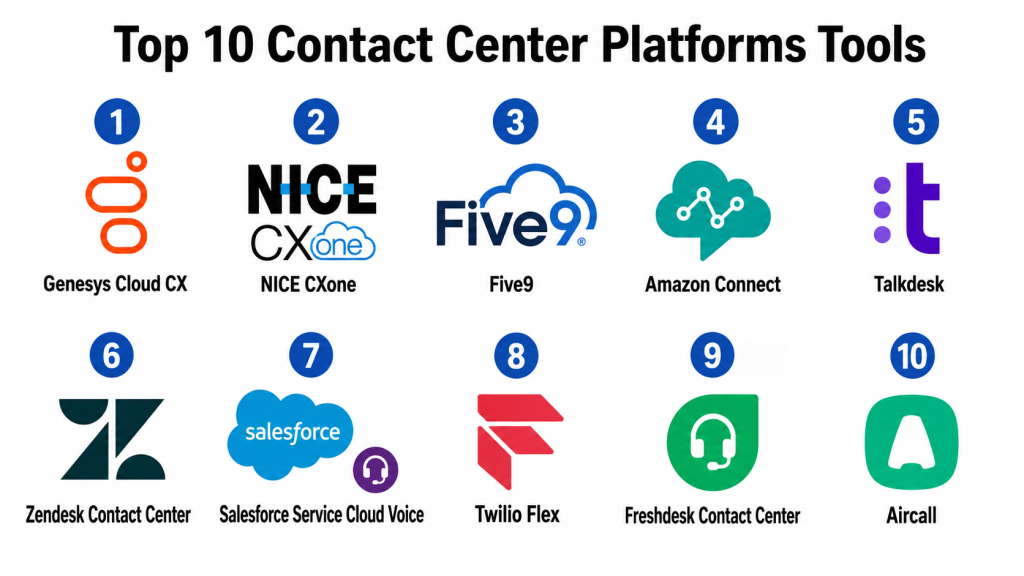
Top 10 Contact Center Platforms Tools
#1 — Genesys Cloud CX
Short description: Genesys Cloud CX is a cloud contact center platform built for customer service, omnichannel engagement, workforce optimization, routing, analytics, and AI-assisted support. It is best suited for mid-market and enterprise organizations with complex customer experience needs.
Key Features
- Omnichannel voice and digital support
- Intelligent routing and queue management
- IVR and self-service workflows
- AI-assisted agent support
- Workforce engagement management
- Real-time and historical analytics
- Quality monitoring and performance insights
Pros
- Strong enterprise-grade contact center capabilities.
- Good fit for complex customer journeys and large service teams.
- Broad support for voice, digital channels, routing, and analytics.
Cons
- Implementation can require careful planning.
- May be more complex than smaller teams need.
- Pricing and configuration depend on business requirements.
Platforms / Deployment
Web / Windows / macOS / iOS / Android
Cloud
Security & Compliance
Genesys Cloud CX supports enterprise contact center administration, access controls, and customer data handling. Specific details such as SSO/SAML, MFA, encryption, audit logs, RBAC, SOC 2, ISO 27001, GDPR, or HIPAA should be confirmed during vendor review.
SOC 2 / ISO 27001 / GDPR / HIPAA: Not publicly stated.
Integrations & Ecosystem
Genesys Cloud CX fits into enterprise customer experience, CRM, workforce, and analytics ecosystems.
- CRM platforms
- Workforce management tools
- Help desk systems
- Identity providers
- Analytics platforms
- Customer experience tools
Support & Community
Genesys provides enterprise documentation, implementation resources, partner support, training, and customer success options. Support depth may vary by contract and deployment complexity.
#2 — NICE CXone
Short description: NICE CXone is a cloud contact center platform focused on omnichannel routing, workforce engagement, analytics, automation, quality management, and AI-powered customer experience operations. It is often used by larger customer service organizations.
Key Features
- Voice and digital customer engagement
- Automatic call distribution and IVR
- Workforce management and scheduling
- Quality monitoring and call recording
- AI analytics and automation
- Real-time reporting dashboards
- Omnichannel routing and customer journey support
Pros
- Strong fit for enterprise contact centers.
- Deep workforce optimization and quality management capabilities.
- Useful for organizations needing analytics-heavy service operations.
Cons
- Can be complex for smaller teams.
- Implementation may need experienced administrators.
- Full value depends on proper configuration and process design.
Platforms / Deployment
Web / Windows / macOS / iOS / Android
Cloud
Security & Compliance
NICE CXone supports enterprise contact center controls, access management, recording governance, and data security workflows. Specific certifications and compliance claims should be validated during procurement.
SOC 2 / ISO 27001 / GDPR / HIPAA: Not publicly stated.
Integrations & Ecosystem
NICE CXone integrates with customer service, CRM, analytics, workforce, and communication systems.
- CRM platforms
- Workforce management systems
- Help desk tools
- Analytics platforms
- Identity providers
- Quality management systems
Support & Community
NICE provides documentation, professional services, customer support, training, and partner resources. Support quality may vary by contract and implementation model.
#3 — Five9
Short description: Five9 is a cloud contact center platform for inbound, outbound, blended, and omnichannel customer service operations. It is useful for support teams, sales teams, BPOs, and enterprises that need scalable cloud contact center capabilities.
Key Features
- Inbound and outbound calling
- Predictive and power dialing options
- IVR and intelligent routing
- Omnichannel support
- Agent desktop tools
- Reporting and analytics
- CRM integrations
Pros
- Strong for voice-heavy contact centers.
- Useful for outbound, inbound, and blended operations.
- Good fit for teams that need CRM-connected calling workflows.
Cons
- Advanced configuration may require planning.
- Digital channel needs should be validated carefully.
- Pricing and feature access may vary by package.
Platforms / Deployment
Web / Windows / macOS
Cloud
Security & Compliance
Five9 supports cloud contact center security controls, user management, and customer interaction workflows. Specific compliance certifications and security controls should be confirmed directly.
SOC 2 / ISO 27001 / GDPR / HIPAA: Not publicly stated.
Integrations & Ecosystem
Five9 integrates with CRM, help desk, workforce management, and customer service tools.
- CRM platforms
- Help desk systems
- Workforce management tools
- Sales engagement systems
- Analytics platforms
- Identity providers
Support & Community
Five9 provides support resources, documentation, onboarding guidance, professional services, and customer success options. Support experience may vary by plan and deployment complexity.
#4 — Amazon Connect
Short description: Amazon Connect is a cloud contact center service from AWS designed for scalable voice and chat support. It is useful for organizations that want flexible, cloud-native contact center capabilities with strong integration into AWS services.
Key Features
- Cloud-based voice and chat contact center
- IVR and call routing
- Pay-as-you-go style usage model
- Customer profiles and contact flows
- Analytics and monitoring
- AI and automation through AWS services
- API-driven customization
Pros
- Flexible and scalable cloud-native architecture.
- Good fit for teams with AWS expertise.
- Useful for custom contact center workflows and integrations.
Cons
- Requires technical expertise for advanced setup.
- Less plug-and-play than some packaged contact center platforms.
- Non-technical teams may need implementation support.
Platforms / Deployment
Web
Cloud
Security & Compliance
Amazon Connect uses AWS security and access management patterns. Specific compliance coverage depends on AWS configuration, region, services used, and customer implementation.
SOC 2 / ISO 27001 / GDPR / HIPAA: Not publicly stated.
Integrations & Ecosystem
Amazon Connect is strongest when used with AWS services and custom cloud workflows.
- AWS services
- CRM platforms
- Data lakes and analytics tools
- AI and machine learning services
- Customer profile systems
- Custom APIs and workflows
Support & Community
Amazon Connect is supported through AWS documentation, technical resources, partner ecosystem, and AWS support plans. Implementation often benefits from cloud architecture expertise.
#5 — Talkdesk
Short description: Talkdesk is a cloud contact center platform focused on customer service, automation, AI, workforce engagement, analytics, and industry-specific contact center workflows. It is suitable for mid-market and enterprise customer service teams.
Key Features
- Cloud contact center voice and digital channels
- Intelligent routing
- AI agent assistance
- Workforce engagement tools
- Quality management
- Reporting and analytics
- CRM and help desk integrations
Pros
- Strong modern cloud contact center experience.
- Useful for service teams needing automation and analytics.
- Good fit for mid-market and enterprise customer support operations.
Cons
- May be more than small teams need.
- Full deployment requires workflow planning.
- Advanced capabilities may depend on selected modules.
Platforms / Deployment
Web / Windows / macOS / iOS / Android
Cloud
Security & Compliance
Talkdesk supports contact center user management, access controls, and customer interaction data handling. Specific certifications and compliance coverage should be verified during evaluation.
SOC 2 / ISO 27001 / GDPR / HIPAA: Not publicly stated.
Integrations & Ecosystem
Talkdesk integrates with customer service, CRM, workforce, analytics, and productivity systems.
- CRM platforms
- Help desk tools
- Workforce management systems
- Analytics tools
- Identity providers
- Collaboration platforms
Support & Community
Talkdesk provides documentation, onboarding support, customer success resources, and professional services. Support depth may depend on contract and implementation scope.
#6 — Zendesk Contact Center
Short description: Zendesk Contact Center capabilities connect voice, messaging, tickets, help center, and support workflows inside the Zendesk ecosystem. It is useful for companies already using Zendesk for customer service operations.
Key Features
- Voice support and call routing
- Ticketing and customer history
- Messaging and digital channels
- Help center integration
- Agent workspace
- Reporting and analytics
- Support automation workflows
Pros
- Strong fit for teams already using Zendesk.
- Connects calls and digital conversations with ticketing.
- Good for support teams that want customer context in one workspace.
Cons
- Best value depends on Zendesk ecosystem adoption.
- May not match specialized enterprise contact center depth in every scenario.
- Advanced workflows may require additional setup.
Platforms / Deployment
Web / iOS / Android
Cloud
Security & Compliance
Zendesk supports customer service data controls, user permissions, and access management. Specific certifications, audit controls, and compliance details should be confirmed directly.
SOC 2 / ISO 27001 / GDPR / HIPAA: Not publicly stated.
Integrations & Ecosystem
Zendesk Contact Center capabilities work best inside the broader Zendesk service ecosystem.
- Zendesk Support
- Help center tools
- CRM platforms
- Messaging channels
- Automation workflows
- Reporting tools
Support & Community
Zendesk provides documentation, community resources, customer support, training, and implementation options. Support depth depends on plan and customer requirements.
#7 — Salesforce Service Cloud Voice
Short description: Salesforce Service Cloud Voice connects phone support with Salesforce customer data, service workflows, automation, and agent productivity tools. It is useful for companies already using Salesforce as their primary CRM and service platform.
Key Features
- Voice conversations connected with CRM data
- Agent desktop inside Salesforce
- Call recording and transcription support
- Service automation workflows
- Customer history and case context
- Reporting and dashboards
- Integration with Salesforce Service Cloud
Pros
- Strong fit for Salesforce-centered service teams.
- Helps agents access customer context during calls.
- Useful for CRM-driven customer service operations.
Cons
- Best value depends on Salesforce adoption.
- Implementation may require Salesforce expertise.
- Broader contact center needs should be validated carefully.
Platforms / Deployment
Web / iOS / Android
Cloud
Security & Compliance
Salesforce Service Cloud Voice uses Salesforce security, identity, and access control patterns. Specific certifications and compliance coverage should be confirmed based on Salesforce edition, configuration, and vendor setup.
SOC 2 / ISO 27001 / GDPR / HIPAA: Not publicly stated.
Integrations & Ecosystem
Salesforce Service Cloud Voice fits naturally into Salesforce service, CRM, automation, and analytics workflows.
- Salesforce Service Cloud
- Salesforce CRM
- Case management workflows
- Knowledge base systems
- Analytics dashboards
- Telephony partner systems
Support & Community
Salesforce provides documentation, Trailhead-style learning resources, support options, implementation partners, and a large admin and developer community.
#8 — Twilio Flex
Short description: Twilio Flex is a programmable cloud contact center platform that lets businesses build customized customer communication workflows. It is best suited for organizations with development resources and custom contact center needs.
Key Features
- Programmable contact center platform
- Voice, chat, SMS, and digital channel support
- Customizable agent desktop
- APIs and developer tools
- Intelligent routing options
- Integration with Twilio communication services
- Flexible workflow design
Pros
- Highly customizable for unique business needs.
- Strong developer and API ecosystem.
- Useful for companies building tailored customer engagement workflows.
Cons
- Requires technical expertise.
- May not be ideal for teams wanting out-of-the-box simplicity.
- Implementation scope can grow if requirements are not controlled.
Platforms / Deployment
Web
Cloud
Security & Compliance
Twilio Flex uses Twilio platform security and account management controls. Specific certifications, compliance coverage, and data handling details should be confirmed based on implementation and region.
SOC 2 / ISO 27001 / GDPR / HIPAA: Not publicly stated.
Integrations & Ecosystem
Twilio Flex is built for extensibility and custom integrations.
- CRM platforms
- Custom APIs
- Messaging channels
- Data platforms
- Identity providers
- Analytics tools
Support & Community
Twilio provides developer documentation, APIs, support plans, implementation partners, and a strong developer community. Technical teams can benefit from extensive customization resources.
#9 — Freshdesk Contact Center
Short description: Freshdesk Contact Center is a cloud phone and contact center solution from Freshworks, designed for support teams that need call handling, routing, customer context, and reporting. It is useful for SMBs and mid-market teams using Freshworks tools.
Key Features
- Cloud phone support
- Call routing and queues
- IVR and call flows
- Call recording and notes
- Freshdesk integration
- Reporting and analytics
- Agent collaboration workflows
Pros
- Good fit for Freshworks and Freshdesk users.
- Practical for SMB and mid-market support teams.
- Easier to adopt than many enterprise contact center platforms.
Cons
- May not fit very complex enterprise contact center needs.
- Advanced omnichannel needs should be validated carefully.
- Best value comes when used with Freshworks ecosystem.
Platforms / Deployment
Web / iOS / Android
Cloud
Security & Compliance
Freshdesk Contact Center supports user access, support workflows, and customer communication data handling. Specific certifications and compliance details should be confirmed during vendor review.
SOC 2 / ISO 27001 / GDPR / HIPAA: Not publicly stated.
Integrations & Ecosystem
Freshdesk Contact Center works naturally with Freshworks service and customer engagement tools.
- Freshdesk
- Freshworks CRM
- Help desk workflows
- Reporting tools
- Customer support systems
- Productivity integrations
Support & Community
Freshworks provides documentation, support options, onboarding guidance, and community resources. Support experience may vary by plan and organization size.
#10 — Aircall
Short description: Aircall is a cloud-based phone and call center platform designed for sales and support teams. It is useful for teams that want CRM-connected calling, call routing, recording, analytics, and simple contact center workflows.
Key Features
- Cloud-based call center
- Call routing and queues
- Call recording and analytics
- CRM and help desk integrations
- Shared call inbox workflows
- Power dialer options
- Team performance reporting
Pros
- Strong for sales and support teams.
- Good CRM and help desk integration focus.
- Easier to adopt than heavy enterprise contact center systems.
Cons
- May not fit complex enterprise contact center requirements.
- Advanced workforce management may require other tools.
- Costs can increase with users and advanced features.
Platforms / Deployment
Web / Windows / macOS / iOS / Android
Cloud
Security & Compliance
Aircall supports call management, team access, and customer communication workflows. Specific certifications, compliance details, and data protection features should be confirmed with the vendor.
SOC 2 / ISO 27001 / GDPR / HIPAA: Not publicly stated.
Integrations & Ecosystem
Aircall connects strongly with sales and support stacks.
- CRM platforms
- Help desk systems
- Sales engagement tools
- Productivity tools
- Call analytics workflows
- Customer support systems
Support & Community
Aircall provides documentation, customer support, onboarding resources, and implementation help. It is practical for teams that want connected calling without a heavy enterprise deployment.
Comparison Table
| Tool Name | Best For | Platform(s) Supported | Deployment | Standout Feature | Public Rating |
|---|---|---|---|---|---|
| Genesys Cloud CX | Enterprise omnichannel customer experience | Web, Windows, macOS, iOS, Android | Cloud | Omnichannel routing and workforce engagement | N/A |
| NICE CXone | Large contact centers and workforce optimization | Web, Windows, macOS, iOS, Android | Cloud | Quality management and analytics depth | N/A |
| Five9 | Voice-heavy inbound and outbound contact centers | Web, Windows, macOS | Cloud | Inbound, outbound, and blended calling | N/A |
| Amazon Connect | Cloud-native custom contact centers | Web | Cloud | AWS-native scalable contact center | N/A |
| Talkdesk | Modern cloud customer service teams | Web, Windows, macOS, iOS, Android | Cloud | AI-assisted contact center workflows | N/A |
| Zendesk Contact Center | Zendesk support teams | Web, iOS, Android | Cloud | Voice connected with ticketing and support | N/A |
| Salesforce Service Cloud Voice | Salesforce-centered service operations | Web, iOS, Android | Cloud | Voice inside Salesforce customer context | N/A |
| Twilio Flex | Developer-led custom contact centers | Web | Cloud | Programmable contact center platform | N/A |
| Freshdesk Contact Center | SMB and mid-market support teams | Web, iOS, Android | Cloud | Freshdesk-connected cloud calling | N/A |
| Aircall | Sales and support calling teams | Web, Windows, macOS, iOS, Android | Cloud | CRM-connected call center workflows | N/A |
Evaluation & Scoring of Contact Center Platforms
The scoring below is comparative and based on practical contact center platform evaluation criteria. A higher score does not mean one platform is best for every organization. It means the tool performs strongly against this model for core features, ease of use, integrations, security expectations, reliability, support, and value.
| Tool Name | Core (25%) | Ease (15%) | Integrations (15%) | Security (10%) | Performance (10%) | Support (10%) | Value (15%) | Weighted Total (0–10) |
|---|---|---|---|---|---|---|---|---|
| Genesys Cloud CX | 9.5 | 7.6 | 9.0 | 8.8 | 8.9 | 8.5 | 7.4 | 8.57 |
| NICE CXone | 9.4 | 7.4 | 8.8 | 8.8 | 8.9 | 8.5 | 7.3 | 8.50 |
| Five9 | 9.0 | 8.0 | 8.6 | 8.5 | 8.7 | 8.3 | 7.8 | 8.45 |
| Amazon Connect | 8.8 | 7.0 | 9.2 | 8.8 | 9.0 | 8.0 | 8.2 | 8.42 |
| Talkdesk | 8.9 | 8.2 | 8.6 | 8.5 | 8.6 | 8.2 | 7.8 | 8.44 |
| Zendesk Contact Center | 8.2 | 8.4 | 8.6 | 8.3 | 8.5 | 8.3 | 8.0 | 8.36 |
| Salesforce Service Cloud Voice | 8.5 | 7.8 | 9.0 | 8.7 | 8.6 | 8.3 | 7.5 | 8.36 |
| Twilio Flex | 8.8 | 6.8 | 9.5 | 8.6 | 8.8 | 8.0 | 8.0 | 8.35 |
| Freshdesk Contact Center | 8.0 | 8.6 | 8.3 | 8.1 | 8.3 | 8.1 | 8.5 | 8.29 |
| Aircall | 8.2 | 8.5 | 8.8 | 8.0 | 8.4 | 8.0 | 8.1 | 8.31 |
Use these scores as a practical comparison guide, not as a final buying decision. Genesys Cloud CX and NICE CXone are stronger for enterprise-scale contact centers. Five9 is strong for voice-heavy operations. Amazon Connect and Twilio Flex are strong for customizable cloud-native deployments. Talkdesk fits modern service teams. Zendesk Contact Center and Salesforce Service Cloud Voice are strong when the business already uses those ecosystems. Freshdesk Contact Center and Aircall are practical for SMB, mid-market, sales, and support teams.
Which Contact Center Platforms Tool Is Right for You?
Solo / Freelancer
Solo professionals usually do not need a full contact center platform. If you only handle a few calls or messages per day, a business phone system, shared inbox, live chat tool, or simple help desk may be enough.
A contact center platform becomes useful when call volume, routing, customer history, recording, reporting, or agent collaboration becomes important.
SMB
Small businesses should focus on ease of use, fast setup, call routing, shared inbox workflows, CRM integration, and affordable pricing. Freshdesk Contact Center, Aircall, Zendesk Contact Center, and simpler cloud calling tools can be practical options.
SMBs should avoid heavy enterprise contact center platforms unless they clearly need advanced routing, workforce management, compliance controls, or large-scale service analytics.
Mid-Market
Mid-market companies usually need stronger routing, call recording, support analytics, CRM integration, omnichannel service, agent performance reporting, and automation. Talkdesk, Five9, Zendesk Contact Center, Aircall, Freshdesk Contact Center, and Salesforce Service Cloud Voice can be strong options depending on the existing software stack.
At this stage, the contact center should connect with CRM, help desk, knowledge base, customer success, workforce management, and analytics systems.
Enterprise
Enterprises need scale, governance, omnichannel routing, workforce optimization, quality monitoring, compliance controls, real-time dashboards, global operations, and deep integrations. Genesys Cloud CX, NICE CXone, Five9, Amazon Connect, Talkdesk, Salesforce Service Cloud Voice, and Twilio Flex may be suitable depending on technical and operational needs.
Enterprise buyers should involve IT, security, legal, service operations, workforce management, customer experience leaders, and data teams before selecting a platform.
Budget vs Premium
Budget-focused teams should start with core needs: voice routing, call queues, recordings, basic analytics, CRM sync, and agent workflows. Freshdesk Contact Center, Aircall, or Zendesk-style solutions may be practical.
Premium platforms make sense when the organization needs omnichannel engagement, workforce optimization, AI automation, quality monitoring, advanced analytics, compliance controls, and large-scale routing.
Feature Depth vs Ease of Use
Feature-rich contact center platforms provide deep routing, automation, analytics, workforce management, quality monitoring, and governance. However, they require configuration, training, and ongoing administration.
Easy-to-use platforms are better when the business wants fast deployment and simpler support workflows. Choose depth when customer service is mission-critical and high-volume.
Integrations & Scalability
Contact center platforms should connect with CRM, help desk, workforce management, knowledge base, identity, analytics, payments, communication, and customer data platforms.
Scalability matters when the business has many agents, queues, regions, products, channels, languages, and customer segments. Choose a platform that can grow without forcing a major migration too early.
Security & Compliance Needs
Contact centers often handle personal information, billing questions, health-related conversations, financial details, complaints, recordings, and sensitive customer history. Security must be reviewed carefully.
Look for SSO, MFA, RBAC, encryption, audit logs, recording controls, data retention policies, privacy settings, access permissions, and compliance documentation. Regulated businesses should involve legal, security, and compliance teams before rollout.
Frequently Asked Questions
1. What is a contact center platform?
A contact center platform is software that helps businesses manage customer conversations across phone, email, chat, SMS, social messaging, and other channels. It supports routing, queues, agent workflows, reporting, and customer service operations.
2. How is a contact center different from a call center?
A call center mainly focuses on phone calls. A contact center is broader and can include voice, email, live chat, SMS, social messaging, self-service, automation, and omnichannel customer support.
3. Who should use a contact center platform?
Contact center platforms are useful for support teams, sales teams, service teams, BPOs, healthcare teams, financial service teams, eCommerce businesses, SaaS companies, and enterprises with high customer interaction volume.
4. How much does a contact center platform cost?
Pricing varies by vendor, number of agents, channels, call volume, AI features, workforce tools, integrations, compliance needs, and support level. Some platforms offer packaged plans, while others use custom pricing.
5. What is the biggest mistake when choosing a contact center platform?
The biggest mistake is choosing a platform before mapping real customer journeys, call flows, support channels, agent roles, reporting needs, and integration requirements.
6. Can contact center platforms support remote agents?
Yes, cloud contact center platforms are well suited for remote and hybrid agents. They provide browser-based or app-based access, centralized monitoring, routing, reporting, and supervisor visibility.
7. Do contact center platforms include AI features?
Many contact center platforms include AI features such as chatbots, voice bots, call summaries, agent assist, sentiment analysis, intent detection, and automated routing. Feature depth varies by vendor.
8. Can contact center platforms integrate with CRM tools?
Yes, most major contact center platforms integrate with CRM tools so agents can see customer history, cases, deals, notes, and account context during conversations.
9. Are contact center platforms secure?
Business-grade contact center platforms usually include access controls and security features. Buyers should review SSO, MFA, encryption, audit logs, recording permissions, data retention, and compliance documentation.
10. What are alternatives to contact center platforms?
Alternatives include business phone systems, help desk software, live chat tools, shared inboxes, CRM communication tools, UCaaS platforms, and simple call center software.
Conclusion
Contact Center Platforms help businesses deliver faster, more consistent, and more measurable customer service across voice and digital channels. A strong platform can improve routing, reduce wait times, support remote agents, provide customer context, automate repetitive tasks, monitor quality, and give leaders better visibility into service performance. For businesses where customer conversations directly affect revenue, retention, and trust, the right contact center platform becomes a core operating system for customer experience.There is no single best contact center platform for every organization. Genesys Cloud CX and NICE CXone are strong for large enterprise operations. Five9 is useful for voice-heavy and blended contact centers. Amazon Connect and Twilio Flex are strong for cloud-native and customizable environments. Talkdesk fits modern service teams that want automation and analytics. Zendesk Contact Center, Salesforce Service Cloud Voice, Freshdesk Contact Center, and Aircall are practical when the company already uses those ecosystems or needs easier adoption.
