Upgrade & Secure Your Future with DevOps, SRE, DevSecOps, MLOps!
We spend hours scrolling social media and waste money on things we forget, but won’t spend 30 minutes a day earning certifications that can change our lives.
Master in DevOps, SRE, DevSecOps & MLOps by DevOps School!
Learn from Guru Rajesh Kumar and double your salary in just one year.
Introduction
Cloud Backup Tools help businesses copy, store, protect, and restore important data using cloud-based storage and backup systems. In simple words, these tools create safe backup copies of files, servers, endpoints, databases, SaaS apps, and cloud workloads so organizations can recover quickly after accidental deletion, system failure, cyberattack, or outage.
Cloud backup matters because business data is now spread across laptops, mobile teams, cloud platforms, SaaS tools, virtual machines, and hybrid infrastructure. A weak backup setup can create serious risks such as data loss, downtime, compliance gaps, ransomware impact, and customer trust issues.
Common use cases include endpoint backup, server backup, SaaS data protection, ransomware recovery, disaster recovery, long-term retention, cloud workload protection, and remote workforce data protection.
Buyers should evaluate workload coverage, restore speed, storage cost, security controls, encryption, retention policies, ransomware protection, automation, compliance reporting, scalability, and support quality.
Best for: IT teams, cloud teams, security teams, MSPs, SMBs, enterprises, healthcare, finance, education, SaaS companies, and any business that needs reliable offsite data protection.
Not ideal for: Users who only need basic file sync, teams with non-critical data only, or companies that already have a complete backup and disaster recovery platform covering all required workloads.
Key Trends in Cloud Backup Tools
- Ransomware-ready backup is now a core buying need, with immutable backup, clean recovery points, and protected restore workflows becoming more important.
- SaaS backup demand is increasing, because teams depend heavily on cloud productivity, CRM, collaboration, and communication platforms.
- Hybrid cloud backup is becoming common, especially for companies protecting both on-premises systems and cloud workloads.
- Automation is reducing manual backup work, including scheduled backups, retention rules, alerting, and policy-based protection.
- Cloud cost control is now a key decision factor, especially for storage growth, long-term retention, data transfer, and archive usage.
- Security and backup are merging, with vendors adding threat detection, anomaly alerts, encryption, access control, and recovery validation.
- Fast recovery is more important than backup completion alone, because businesses need to restore files, apps, and systems quickly.
- Compliance reporting is becoming expected, especially for regulated sectors that need audit trails, retention visibility, and policy control.
- Endpoint and remote workforce backup remain important, because users often work from different locations and store data on multiple devices.
- Multi-cloud support is becoming valuable, especially for companies that do not want to depend on one cloud provider only.
How We Selected These Tools
The tools below were selected using practical buyer-focused evaluation logic:
- Market recognition in cloud backup, recovery, disaster recovery, and data protection.
- Feature completeness across files, endpoints, servers, SaaS apps, cloud workloads, and virtual environments.
- Reliability signals such as backup consistency, restore options, scalability, and monitoring.
- Security posture signals such as encryption, immutable storage, MFA, RBAC, and audit visibility.
- Integration strength with cloud platforms, identity tools, SaaS applications, storage systems, and endpoint environments.
- Fit for different organization sizes, including freelancers, SMBs, mid-market companies, enterprises, and MSPs.
- Ease of setup, policy management, reporting, and restore workflows.
- Flexibility across cloud-only, hybrid, and self-managed environments.
- Support quality, documentation depth, partner ecosystem, and onboarding resources.
- Practical value based on capability depth, operational simplicity, and long-term manageability.
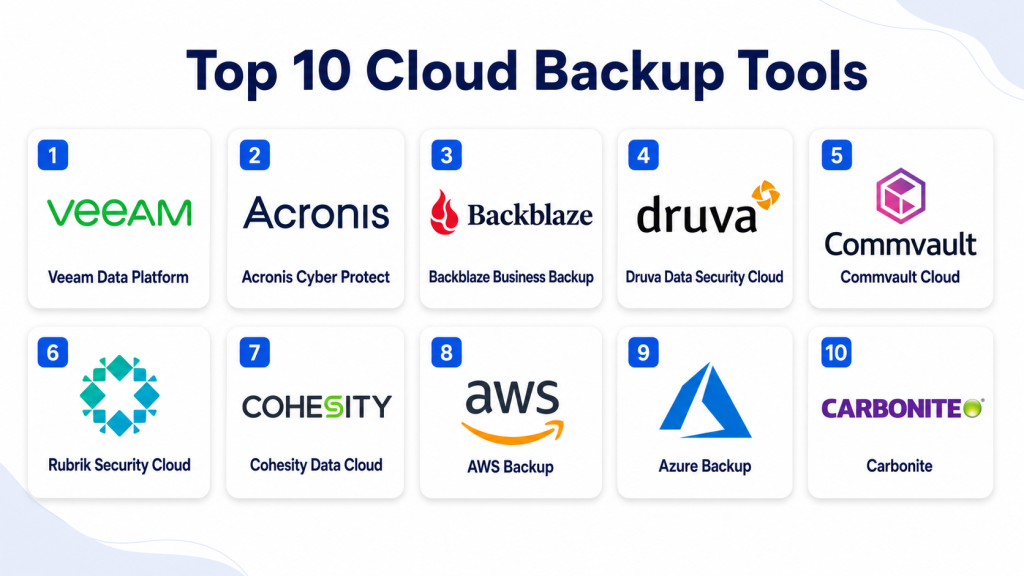
Top 10 Cloud Backup Tools
#1 — Veeam Data Platform
Short description: Veeam Data Platform is a widely used backup and recovery solution for cloud, virtual, physical, SaaS, and hybrid workloads. It is best suited for IT teams that need strong recovery options across complex environments.
Key Features
- Cloud, virtual, physical, and SaaS workload backup.
- Backup replication and recovery orchestration.
- Immutable backup options for ransomware resilience.
- Policy-based backup management.
- Instant recovery for supported workloads.
- Monitoring and reporting dashboards.
- Hybrid and multi-cloud support.
Pros
- Strong for hybrid and virtualized environments.
- Flexible recovery options for critical workloads.
- Large ecosystem and strong admin familiarity.
Cons
- Advanced setup may require backup expertise.
- Licensing and storage planning need careful review.
- May be more than small teams need.
Platforms / Deployment
Web / Windows / Linux
Cloud / Self-hosted / Hybrid
Security & Compliance
Supports encryption, RBAC, audit logs, immutable backup options, MFA options, and ransomware recovery features. Specific compliance certifications should be verified with the vendor.
Integrations & Ecosystem
Veeam fits well into mixed infrastructure environments where cloud, virtualization, storage, and backup operations need to work together.
- VMware
- Microsoft Hyper-V
- Public cloud platforms
- Object storage
- SaaS protection workflows
- Storage systems
Support & Community
Veeam has strong documentation, enterprise support, partner support, training resources, and a large technical community.
#2 — Acronis Cyber Protect
Short description: Acronis Cyber Protect combines cloud backup, endpoint protection, anti-malware, recovery, and cyber protection in one platform. It is useful for SMBs, MSPs, and endpoint-heavy teams.
Key Features
- Cloud backup for endpoints, servers, and workloads.
- Integrated anti-malware and cyber protection.
- Disk imaging and file-level recovery.
- Ransomware protection capabilities.
- Centralized management console.
- Cloud storage options.
- MSP-friendly multi-tenant management.
Pros
- Combines backup and security features.
- Good fit for SMBs and service providers.
- Useful for endpoint and remote worker protection.
Cons
- May feel broad for teams needing only basic backup.
- Advanced enterprise workload coverage should be validated.
- Pricing can vary by feature set and storage usage.
Platforms / Deployment
Web / Windows / macOS / Linux / iOS / Android
Cloud / Hybrid
Security & Compliance
Supports encryption, access controls, backup protection, anti-malware features, and ransomware-related defenses. Specific compliance certifications should be verified directly.
Integrations & Ecosystem
Acronis is practical for managed service environments, endpoint-heavy teams, and businesses that want backup and cyber protection together.
- Endpoint security workflows
- Cloud storage
- MSP management tools
- Virtualization platforms
- Business applications
- Remote management workflows
Support & Community
Acronis provides documentation, partner resources, support plans, onboarding materials, and MSP-focused resources.
#3 — Backblaze Business Backup
Short description: Backblaze Business Backup is a simple cloud backup tool for business computers and endpoint data. It is best for freelancers, small businesses, and teams that need easy cloud backup without complex administration.
Key Features
- Automatic cloud backup for business computers.
- File-level backup and restore.
- Centralized business administration.
- Simple deployment for endpoints.
- Cloud storage-based protection.
- Easy restore workflows.
- Low-complexity backup management.
Pros
- Simple and easy to use.
- Good for small teams and endpoint backup.
- Lower administration effort than enterprise platforms.
Cons
- Not designed for complex server or database recovery.
- Limited compared with full disaster recovery platforms.
- May not fit highly regulated or large enterprise environments.
Platforms / Deployment
Web / Windows / macOS
Cloud
Security & Compliance
Supports encryption and account security features. Advanced compliance details are not publicly stated in all contexts and should be verified with the vendor.
Integrations & Ecosystem
Backblaze is best for simple cloud backup and storage-focused workflows rather than deep enterprise integrations.
- Endpoint backup workflows
- Cloud storage
- File recovery
- Business admin console
- User management
- Storage-focused operations
Support & Community
Backblaze provides documentation, customer support resources, help articles, and a user-friendly knowledge base.
#4 — Druva Data Security Cloud
Short description: Druva Data Security Cloud is a cloud-delivered backup and data protection platform for endpoints, SaaS applications, cloud workloads, and enterprise data. It is strong for organizations that want cloud-native backup management.
Key Features
- SaaS-based backup and recovery.
- Cloud workload and endpoint protection.
- Centralized policy management.
- Long-term retention support.
- Ransomware recovery capabilities.
- Data governance and visibility features.
- Simplified cloud administration.
Pros
- Reduces backup infrastructure management.
- Strong for distributed and cloud-first teams.
- Good fit for SaaS and endpoint data protection.
Cons
- Not ideal for teams requiring full self-hosted control.
- Pricing should be reviewed based on data volume.
- Internet connectivity and cloud architecture matter.
Platforms / Deployment
Web / Windows / macOS / Linux / Varies by workload
Cloud
Security & Compliance
Supports encryption, access controls, RBAC, audit visibility, and cloud-based data protection features. Specific compliance certifications should be verified with the vendor.
Integrations & Ecosystem
Druva works well for companies that want cloud-delivered backup without heavy backup hardware or complex infrastructure.
- SaaS applications
- Cloud platforms
- Endpoint systems
- Identity providers
- Security workflows
- Reporting tools
Support & Community
Druva provides documentation, onboarding resources, customer support, and customer success services.
#5 — Commvault Cloud
Short description: Commvault Cloud is an enterprise-grade cloud backup, recovery, and data protection platform. It is suitable for complex environments that need broad workload coverage, policy control, and cyber resilience.
Key Features
- Cloud backup and recovery for enterprise workloads.
- SaaS, database, virtual, and cloud workload protection.
- Disaster recovery and recovery orchestration.
- Ransomware resilience features.
- Policy-based retention and automation.
- Reporting and compliance visibility.
- Broad infrastructure and cloud support.
Pros
- Strong enterprise feature depth.
- Broad workload and cloud support.
- Useful for large regulated environments.
Cons
- Can be complex for small teams.
- Implementation may require skilled planning.
- Licensing and architecture should be carefully reviewed.
Platforms / Deployment
Web / Windows / Linux / Varies by workload
Cloud / Self-hosted / Hybrid
Security & Compliance
Supports encryption, access controls, RBAC, audit logs, ransomware recovery features, and compliance-oriented reporting. Specific compliance certifications should be verified with the vendor.
Integrations & Ecosystem
Commvault has a wide ecosystem across enterprise infrastructure, cloud platforms, storage systems, SaaS applications, and databases.
- Public cloud platforms
- Virtualization platforms
- Databases
- SaaS applications
- Object storage
- Enterprise identity tools
Support & Community
Commvault provides enterprise support, professional services, documentation, partner expertise, and onboarding resources.
#6 — Rubrik Security Cloud
Short description: Rubrik Security Cloud focuses on cloud backup, cyber recovery, ransomware resilience, and data security. It is designed for organizations that want backup deeply connected with security operations.
Key Features
- Cloud backup and enterprise data protection.
- Immutable backup architecture.
- Ransomware investigation and recovery.
- SaaS and cloud workload protection.
- Policy-driven backup automation.
- Data risk visibility.
- Recovery orchestration for critical systems.
Pros
- Strong cyber recovery focus.
- Good fit for security-led backup strategies.
- Useful for enterprise and regulated environments.
Cons
- May be more advanced than smaller teams need.
- Cost and implementation should be evaluated carefully.
- Best value is usually in larger environments.
Platforms / Deployment
Web / Windows / Linux / Varies by workload
Cloud / Hybrid
Security & Compliance
Supports encryption, RBAC, audit logs, access controls, immutable backup, and ransomware recovery features. Specific compliance certifications should be verified with the vendor.
Integrations & Ecosystem
Rubrik works well in enterprise environments where backup, recovery, and cyber resilience need to connect with cloud and security operations.
- Public cloud platforms
- SaaS applications
- Virtualization platforms
- Identity providers
- Security operations tools
- Storage systems
Support & Community
Rubrik provides enterprise support, documentation, customer success resources, and professional services.
#7 — Cohesity Data Cloud
Short description: Cohesity Data Cloud provides cloud backup, recovery, ransomware resilience, and data security across hybrid and cloud environments. It is useful for organizations that need scalable data protection.
Key Features
- Cloud and hybrid workload backup.
- Ransomware detection and recovery support.
- Immutable backup options.
- SaaS and enterprise workload protection.
- Centralized policy management.
- Disaster recovery capabilities.
- Data visibility and management features.
Pros
- Strong for large-scale data protection.
- Good mix of backup, recovery, and security capabilities.
- Suitable for hybrid and cloud-first environments.
Cons
- May require planning for complex environments.
- Smaller teams may not need all capabilities.
- Storage and licensing should be reviewed carefully.
Platforms / Deployment
Web / Windows / Linux / Varies by workload
Cloud / Hybrid
Security & Compliance
Supports encryption, role-based access, audit logs, immutable backup options, and ransomware-focused recovery capabilities. Specific compliance certifications should be verified directly.
Integrations & Ecosystem
Cohesity fits cloud, hybrid, storage, SaaS, and enterprise workload environments where centralized protection is important.
- Public cloud platforms
- Virtualization systems
- SaaS applications
- Databases
- Object storage
- Security tools
Support & Community
Cohesity offers documentation, enterprise support, partner resources, and customer success services.
#8 — AWS Backup
Short description: AWS Backup is a managed cloud backup service for protecting supported workloads inside Amazon Web Services. It is best for cloud teams that already run infrastructure and applications on AWS.
Key Features
- Centralized backup policy management for AWS services.
- Automated backup scheduling.
- Backup vaults and retention controls.
- Cross-account and cross-region backup options.
- Restore support for supported workloads.
- Audit and reporting capabilities.
- Integration with AWS identity and governance controls.
Pros
- Strong fit for AWS-native workloads.
- Reduces need for separate backup tooling for supported services.
- Works naturally with AWS governance and identity systems.
Cons
- Mainly focused on AWS environments.
- Not a full hybrid backup solution by itself.
- Coverage depends on supported AWS services.
Platforms / Deployment
Web
Cloud
Security & Compliance
Supports AWS identity controls, encryption options, access policies, backup vault controls, and audit visibility. Compliance coverage depends on AWS service configuration and customer requirements.
Integrations & Ecosystem
AWS Backup is tightly connected to the AWS ecosystem and fits teams that want native cloud backup operations.
- AWS compute services
- AWS storage services
- AWS databases
- AWS identity services
- AWS monitoring
- AWS governance tools
Support & Community
AWS provides documentation, support plans, partner resources, and a large cloud practitioner community.
#9 — Azure Backup
Short description: Azure Backup is a Microsoft cloud backup service for Azure workloads, hybrid environments, and supported on-premises systems. It is useful for organizations already using Microsoft cloud services.
Key Features
- Backup for Azure virtual machines and supported workloads.
- Centralized backup policy management.
- Recovery vault-based protection.
- Long-term retention options.
- Hybrid backup support through supported agents.
- Integration with Azure monitoring and security.
- Restore support for cloud and supported on-premises workloads.
Pros
- Strong fit for Azure-first organizations.
- Good integration with Microsoft cloud services.
- Useful for hybrid Microsoft environments.
Cons
- Best value is usually in Azure-based environments.
- May not cover all workloads without additional tools.
- Storage and retention cost planning is important.
Platforms / Deployment
Web / Windows / Linux support varies by workload
Cloud / Hybrid
Security & Compliance
Supports encryption, RBAC, Azure identity controls, audit visibility, and recovery vault controls. Specific compliance details should be verified through Microsoft cloud documentation.
Integrations & Ecosystem
Azure Backup works well with Microsoft cloud, identity, infrastructure, monitoring, and hybrid workloads.
- Azure virtual machines
- Azure storage
- Microsoft identity services
- Azure monitoring
- On-premises agents
- Hybrid cloud workflows
Support & Community
Microsoft provides documentation, support plans, partner services, and a large cloud administrator community.
#10 — Carbonite
Short description: Carbonite provides cloud backup solutions for endpoints, small businesses, and selected business workloads. It is useful for teams that want simple cloud backup without building complex backup infrastructure.
Key Features
- Cloud backup for business computers.
- File and folder backup.
- Automatic backup scheduling.
- Restore options for lost or deleted files.
- Centralized management options.
- Endpoint-focused protection.
- Business continuity support depending on plan.
Pros
- Simple for basic business backup needs.
- Good fit for small teams and endpoint protection.
- Easier to manage than larger enterprise backup platforms.
Cons
- Not ideal for complex cloud-native environments.
- Advanced server and disaster recovery needs may require stronger tools.
- Feature depth depends on selected plan.
Platforms / Deployment
Web / Windows / macOS
Cloud
Security & Compliance
Supports encryption and account-level security features. Advanced compliance details are not publicly stated in all contexts and should be verified with the vendor.
Integrations & Ecosystem
Carbonite is strongest for simple cloud backup and endpoint data protection, rather than deep enterprise infrastructure integration.
- Endpoint backup
- File restore workflows
- Cloud storage
- Business admin console
- User management
- Small business backup operations
Support & Community
Carbonite provides documentation, support resources, help articles, and customer support options. It is practical for teams that want simple backup administration.
Comparison Table (Top 10)
| Tool Name | Best For | Platform(s) Supported | Deployment | Standout Feature | Public Rating |
|---|---|---|---|---|---|
| Veeam Data Platform | Hybrid and virtualized environments | Windows, Linux, cloud workloads | Cloud / Self-hosted / Hybrid | Broad backup and fast recovery | N/A |
| Acronis Cyber Protect | SMBs, MSPs, endpoint-heavy teams | Windows, macOS, Linux, iOS, Android | Cloud / Hybrid | Backup combined with cyber protection | N/A |
| Backblaze Business Backup | Small business endpoint backup | Windows, macOS | Cloud | Simple cloud backup for business computers | N/A |
| Druva Data Security Cloud | Cloud-first backup teams | Windows, macOS, Linux, SaaS, cloud workloads | Cloud | SaaS-delivered backup management | N/A |
| Commvault Cloud | Complex enterprise environments | Windows, Linux, SaaS, cloud workloads | Cloud / Self-hosted / Hybrid | Broad enterprise workload coverage | N/A |
| Rubrik Security Cloud | Enterprise cyber recovery | Windows, Linux, cloud workloads | Cloud / Hybrid | Security-focused cloud backup | N/A |
| Cohesity Data Cloud | Large-scale cloud data protection | Windows, Linux, SaaS, cloud workloads | Cloud / Hybrid | Scalable data protection and recovery | N/A |
| AWS Backup | AWS-native workloads | AWS-supported services | Cloud | Native AWS backup policy control | N/A |
| Azure Backup | Azure and Microsoft environments | Azure workloads, Windows, Linux | Cloud / Hybrid | Native Azure backup and recovery | N/A |
| Carbonite | Small business cloud backup | Windows, macOS | Cloud | Simple endpoint and file backup | N/A |
Evaluation & Scoring of Cloud Backup Tools
| Tool Name | Core (25%) | Ease (15%) | Integrations (15%) | Security (10%) | Performance (10%) | Support (10%) | Value (15%) | Weighted Total (0–10) |
|---|---|---|---|---|---|---|---|---|
| Veeam Data Platform | 9 | 8 | 9 | 8 | 9 | 9 | 8 | 8.55 |
| Acronis Cyber Protect | 8 | 8 | 7 | 8 | 8 | 8 | 8 | 7.85 |
| Backblaze Business Backup | 6 | 9 | 6 | 7 | 7 | 7 | 9 | 7.10 |
| Druva Data Security Cloud | 8 | 9 | 8 | 8 | 8 | 8 | 8 | 8.15 |
| Commvault Cloud | 10 | 7 | 9 | 9 | 9 | 9 | 7 | 8.65 |
| Rubrik Security Cloud | 9 | 8 | 8 | 9 | 9 | 8 | 7 | 8.30 |
| Cohesity Data Cloud | 9 | 8 | 8 | 9 | 9 | 8 | 7 | 8.30 |
| AWS Backup | 8 | 8 | 8 | 8 | 8 | 8 | 8 | 8.00 |
| Azure Backup | 8 | 8 | 8 | 8 | 8 | 8 | 8 | 8.00 |
| Carbonite | 6 | 8 | 6 | 7 | 7 | 7 | 8 | 6.90 |
These scores are comparative and should be used as a decision-support guide, not a final universal ranking. A small business may get better value from Backblaze or Carbonite, while an enterprise may need Commvault, Veeam, Rubrik, or Cohesity. Cloud-native teams may prefer AWS Backup or Azure Backup when workloads are already inside those cloud environments.
Which Cloud Backup Tool Is Right for You?
Solo / Freelancer
Solo professionals usually need simple, automatic cloud backup for laptops and desktops. Backblaze Business Backup and Carbonite are practical options because they focus on easy file backup and restore. Acronis Cyber Protect may be useful if endpoint security is also important.
For technical freelancers running workloads in public cloud environments, AWS Backup or Azure Backup may be enough if all critical workloads are inside those platforms.
SMB
SMBs should prioritize ease of use, predictable cost, endpoint protection, restore simplicity, and basic ransomware protection. Acronis Cyber Protect, Backblaze Business Backup, Carbonite, Druva, and Veeam can be strong options depending on workload type.
If the business only needs file backup, a simpler cloud backup tool may be enough. If the business runs servers, databases, or virtual machines, Veeam, Acronis, or Druva may be better suited.
Mid-Market
Mid-market companies usually need better policy management, stronger security, multi-workload support, reporting, and cloud storage control. Veeam, Druva, Acronis, Rubrik, Cohesity, and Commvault are strong options for this segment.
Mid-market buyers should test real recovery workflows, not only backup completion. The tool should restore files, systems, and workloads quickly enough for business needs.
Enterprise
Enterprises should focus on governance, workload coverage, immutable backup, audit logs, role-based access, recovery orchestration, compliance reporting, and hybrid cloud support. Commvault, Veeam, Rubrik, Cohesity, and Veritas-style enterprise alternatives are commonly considered in this type of environment.
Large organizations should also validate support quality, deployment architecture, data sovereignty, cloud storage design, and recovery testing.
Budget vs Premium
Budget-focused teams may prefer Backblaze Business Backup, Carbonite, AWS Backup, Azure Backup, or a carefully scoped Acronis deployment. Premium buyers with complex enterprise workloads may prefer Commvault, Rubrik, Cohesity, Veeam, or Druva.
Cloud backup cost should include storage, retention, restore cost, data transfer, support, and admin time.
Feature Depth vs Ease of Use
For feature depth, Commvault, Veeam, Rubrik, and Cohesity are strong choices. For ease of use, Backblaze, Carbonite, Druva, Acronis, AWS Backup, and Azure Backup may feel more approachable depending on the use case.
A tool should not be selected only because it has more features. The best tool is the one your team can configure, monitor, and restore from correctly.
Integrations & Scalability
Veeam works well across virtual, cloud, and hybrid environments. Commvault fits complex enterprises. Rubrik and Cohesity are strong for cyber recovery and data security. Druva is practical for cloud-delivered backup. AWS Backup and Azure Backup are ideal when the organization is deeply tied to those cloud ecosystems.
Scalability should be tested using real backup volumes, restore scenarios, retention rules, and cloud storage costs.
Security & Compliance Needs
Security-focused buyers should evaluate immutable backup, encryption, MFA, RBAC, audit logs, clean recovery points, anomaly detection, retention controls, and backup isolation. Regulated organizations should request vendor documentation and validate whether the tool fits internal governance requirements.
Frequently Asked Questions (FAQs)
1. What is a cloud backup tool?
A cloud backup tool copies data to cloud storage so it can be restored after deletion, hardware failure, cyberattack, or system outage. It helps protect files, endpoints, servers, SaaS data, and cloud workloads.
2. How is cloud backup different from file sync?
File sync keeps files updated across devices, but it may also sync accidental deletions or corrupted files. Cloud backup is designed for recovery, retention, versioning, and protection against data loss.
3. How much does cloud backup cost?
Pricing varies by users, devices, workloads, storage volume, retention period, and support level. Some tools charge per device, per workload, per user, or based on storage usage.
4. Is cloud backup safe?
Cloud backup can be safe when it uses encryption, strong access controls, MFA, audit logs, and proper retention policies. Security also depends on how the customer configures the tool.
5. What is immutable cloud backup?
Immutable cloud backup means backup data cannot be changed or deleted for a defined period. It helps protect backup copies from ransomware, accidental deletion, and unauthorized changes.
6. Can cloud backup protect SaaS applications?
Yes, many cloud backup tools protect SaaS applications such as email, collaboration platforms, CRM systems, and productivity suites. Buyers should confirm exact SaaS app support before purchase.
7. What are common cloud backup mistakes?
Common mistakes include not testing restores, backing up only some workloads, ignoring retention rules, using weak access controls, and assuming file sync is the same as backup.
8. How often should cloud backups run?
Backup frequency depends on how much data the business can afford to lose. Critical systems may require frequent backups, while less important data may need less frequent protection.
9. What is recovery time?
Recovery time is how long it takes to restore data or systems after failure. Businesses should test recovery time before relying on any backup solution.
10. What is recovery point?
Recovery point is the amount of data that may be lost between the last backup and the failure event. Shorter recovery points usually require more frequent backups.
Conclusion
Cloud Backup Tools help organizations protect data, reduce downtime, and recover from mistakes, outages, ransomware, and system failures. The best tool depends on workload type, company size, security needs, cloud strategy, budget, and recovery expectations. Veeam, Commvault, Rubrik, and Cohesity are strong for complex and enterprise-grade environments. Druva is useful for cloud-first teams, while Acronis works well for SMBs and MSPs that want backup with security features. AWS Backup and Azure Backup are strong native choices for workloads already running inside those cloud platforms. Backblaze Business Backup and Carbonite are practical for simple endpoint and file backup. The best next step is to shortlist two or three tools, test them with real workloads, validate restore speed, review security controls, and compare long-term storage costs before making a final decision.
