Upgrade & Secure Your Future with DevOps, SRE, DevSecOps, MLOps!
We spend hours scrolling social media and waste money on things we forget, but won’t spend 30 minutes a day earning certifications that can change our lives.
Master in DevOps, SRE, DevSecOps & MLOps by DevOps School!
Learn from Guru Rajesh Kumar and double your salary in just one year.
Introduction
Unit testing frameworks help developers test small pieces of code, such as functions, methods, classes, modules, and components, before the full application is deployed. In simple words, unit testing checks whether each small part of the software works correctly on its own.
Unit testing matters because modern software changes quickly. Developers add new features, refactor old code, fix bugs, update dependencies, and release applications more frequently. Without unit tests, small code changes can silently break existing functionality and create production issues.
Common use cases include testing business logic, validating API helper functions, checking edge cases, verifying calculations, testing components, preventing regression bugs, and improving code confidence before merge or deployment.
Buyers and teams should evaluate language support, test speed, mocking features, assertions, coverage support, CI/CD integration, IDE support, community adoption, documentation, reporting, and learning curve.
Best for: developers, QA automation engineers, DevOps teams, engineering managers, backend teams, frontend teams, mobile teams, SaaS companies, enterprise software teams, and any organization that wants cleaner, safer, and more maintainable code.
Not ideal for: teams that only need manual testing, projects with no stable codebase, throwaway prototypes, or cases where full end-to-end testing is more important than isolated code-level validation.
Key Trends in Unit Testing Frameworks
- Developer-first testing is becoming the default: Unit testing is now mostly owned by developers because tests are written close to the code and executed during daily development.
- Fast feedback is more important than large test suites: Teams want unit tests that run quickly on local machines and inside CI/CD pipelines.
- Mocking and dependency isolation remain essential: Modern applications depend on databases, APIs, cloud services, queues, and external systems, so strong mocking support is important.
- Test coverage is used more carefully: Teams now understand that high coverage numbers do not always mean high-quality tests, so coverage is being used as a signal, not a final quality guarantee.
- CI/CD integration is standard: Unit tests are expected to run automatically during pull requests, builds, merges, and release workflows.
- Component-level testing is growing: Frontend frameworks now use unit and component tests together to validate UI behavior before full browser tests.
- AI-assisted test generation is emerging: Some developer tools can suggest test cases, edge cases, and mock scenarios, but human review is still needed.
- Readable tests are becoming a quality standard: Teams prefer tests that clearly explain expected behavior, not only technical implementation.
- Language-native frameworks remain strong: Many teams prefer testing frameworks that fit naturally into their programming language and ecosystem.
- Maintainability is more important than test count: A smaller, stable, meaningful test suite is usually better than many fragile tests that developers stop trusting.
How We Selected These Tools
The tools in this list were selected using practical software engineering criteria:
- Strong adoption in popular programming language ecosystems.
- Proven usefulness for real-world unit testing and code-level validation.
- Support for assertions, test runners, setup/teardown, mocking, or fixtures.
- Fit for modern development workflows such as CI/CD, Git, and pull requests.
- Documentation quality, community strength, and long-term ecosystem maturity.
- Ease of use for individual developers and engineering teams.
- Integration with IDEs, code coverage tools, build systems, and test reporting.
- Support for fast execution and repeatable local testing.
- Suitability for different environments such as backend, frontend, mobile, and enterprise software.
- Overall value based on reliability, flexibility, maintainability, and developer experience.
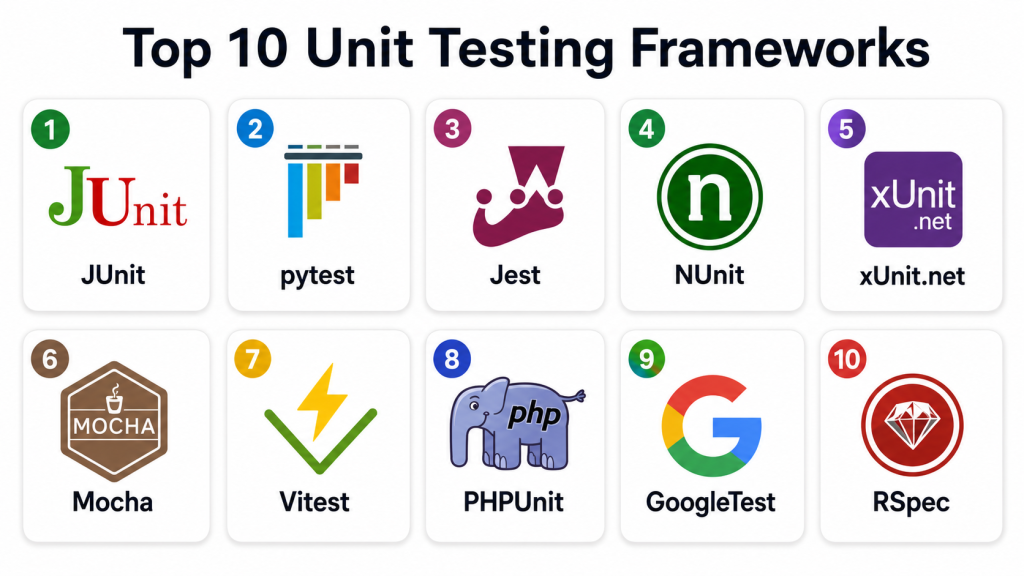
Top 10 Unit Testing Frameworks
#1 — JUnit
Short description: JUnit is a widely used unit testing framework for Java applications. It is best for Java developers, backend teams, enterprise application teams, and organizations using JVM-based development practices.
Key Features
- Test annotations for defining and organizing test cases.
- Assertions for validating expected results.
- Setup and teardown lifecycle methods.
- Parameterized test support.
- Integration with Java build tools.
- Works with mocking libraries and coverage tools.
- Strong IDE and CI/CD support.
Pros
- Mature and widely adopted in Java ecosystems.
- Strong integration with Maven, Gradle, and IDEs.
- Good for backend, enterprise, and service-level unit testing.
Cons
- Requires Java testing knowledge for clean test design.
- Mocking usually depends on additional libraries.
- Poorly structured tests can become verbose in large projects.
Platforms / Deployment
Web / Windows / macOS / Linux
Self-hosted / Hybrid
Security & Compliance
Security and compliance depend on the development environment, CI/CD pipeline, source control, and test data handling. Formal certifications are not publicly stated for the open-source framework itself.
Integrations & Ecosystem
JUnit is deeply connected with the Java ecosystem and works well in enterprise development workflows.
- Maven
- Gradle
- IntelliJ IDEA
- Eclipse
- Jenkins and CI/CD tools
- Mockito and mocking libraries
- Code coverage tools
Support & Community
JUnit has strong documentation, broad community support, long-term adoption, and extensive learning resources. It remains a standard choice for Java unit testing.
#2 — pytest
Short description: pytest is a popular Python testing framework known for simple syntax, powerful fixtures, and flexible plugin support. It is best for Python developers, data teams, backend teams, automation engineers, and API-heavy projects.
Key Features
- Simple test function syntax.
- Powerful fixture system.
- Rich assertion introspection.
- Parameterized testing.
- Large plugin ecosystem.
- Supports unit, integration, and functional testing.
- Works well with coverage and CI/CD tools.
Pros
- Easy to start and powerful for advanced use cases.
- Excellent fixture and plugin model.
- Strong fit for Python application, API, and automation testing.
Cons
- Large fixture-heavy test suites can become complex.
- Team conventions are important for maintainability.
- Some beginners may misuse fixtures or parameterization.
Platforms / Deployment
Web / Windows / macOS / Linux
Self-hosted / Hybrid
Security & Compliance
Security depends on the CI/CD environment, test data, secrets handling, and dependency management. Formal certifications are not publicly stated for the open-source framework itself.
Integrations & Ecosystem
pytest integrates with Python tooling, automation workflows, and modern CI/CD systems.
- Python applications
- Django and Flask projects
- FastAPI projects
- Coverage tools
- CI/CD pipelines
- API testing utilities
- Plugin ecosystem
Support & Community
pytest has strong documentation, active community usage, many plugins, and broad adoption among Python teams. It is one of the most practical options for Python unit testing.
#3 — Jest
Short description: Jest is a JavaScript testing framework commonly used for frontend, backend, and React application testing. It is best for JavaScript and TypeScript teams that want a fast, developer-friendly testing experience.
Key Features
- Built-in test runner and assertion library.
- Snapshot testing support.
- Mocking capabilities.
- Code coverage reporting.
- Watch mode for fast feedback.
- Works well with React and frontend projects.
- Supports JavaScript and TypeScript workflows.
Pros
- Easy setup for many JavaScript projects.
- Strong frontend and React testing ecosystem.
- Built-in mocking and coverage features.
Cons
- Snapshot tests can be overused.
- Large test suites may require optimization.
- Browser behavior may require additional tools or environments.
Platforms / Deployment
Web / Windows / macOS / Linux
Self-hosted / Hybrid
Security & Compliance
Security depends on source control, package management, test data handling, and CI/CD execution. Formal certifications are not publicly stated for the open-source framework itself.
Integrations & Ecosystem
Jest fits modern JavaScript and TypeScript testing workflows.
- React projects
- Node.js applications
- TypeScript projects
- Babel and build tools
- CI/CD pipelines
- Code coverage tools
- Testing Library ecosystem
Support & Community
Jest has strong documentation, large community adoption, active ecosystem support, and broad usage in frontend and full-stack JavaScript projects.
#4 — NUnit
Short description: NUnit is a unit testing framework for .NET applications. It is useful for C# developers and teams working with backend services, desktop software, APIs, and enterprise applications in the .NET ecosystem.
Key Features
- Attribute-based test definitions.
- Assertions for expected results.
- Parameterized tests.
- Setup and teardown lifecycle methods.
- Test fixtures and test case organization.
- Integration with .NET build tools.
- Compatible with CI/CD and reporting workflows.
Pros
- Mature framework for .NET testing.
- Flexible test structure and parameterization.
- Good fit for C# and enterprise .NET teams.
Cons
- Some teams may prefer xUnit or MSTest depending on standards.
- Requires good test organization in large projects.
- Mocking typically needs separate libraries.
Platforms / Deployment
Web / Windows / macOS / Linux
Self-hosted / Hybrid
Security & Compliance
Security depends on the .NET development environment, CI/CD pipeline, source control, and test data usage. Formal certifications are not publicly stated for the open-source framework itself.
Integrations & Ecosystem
NUnit fits well into .NET development and testing environments.
- .NET applications
- Visual Studio
- JetBrains Rider
- CI/CD tools
- Code coverage tools
- Mocking libraries
- Test reporting systems
Support & Community
NUnit has strong documentation, community support, and broad usage among .NET developers. It remains a practical option for teams that prefer its test structure and style.
#5 — xUnit.net
Short description: xUnit.net is a modern testing framework for .NET applications. It is popular among C# teams that prefer cleaner test lifecycle patterns and strong integration with modern .NET development workflows.
Key Features
- Attribute-based tests.
- Fact and theory test styles.
- Parameterized testing through theories.
- Strong integration with .NET tooling.
- Supports parallel test execution.
- Clean test lifecycle design.
- Works with mocking and coverage tools.
Pros
- Modern and clean .NET testing style.
- Good support for parameterized tests.
- Strong fit for modern C# projects.
Cons
- Developers coming from NUnit or MSTest may need adjustment.
- Some lifecycle patterns differ from traditional frameworks.
- Mocking and advanced reporting need additional tools.
Platforms / Deployment
Web / Windows / macOS / Linux
Self-hosted / Hybrid
Security & Compliance
Security depends on development workflows, CI/CD configuration, test data, and dependency handling. Formal certifications are not publicly stated for the open-source framework itself.
Integrations & Ecosystem
xUnit.net fits modern .NET and C# development practices.
- .NET projects
- Visual Studio
- Rider
- Git-based workflows
- CI/CD pipelines
- Mocking libraries
- Coverage reporting tools
Support & Community
xUnit.net has good documentation, strong community adoption, and broad support across modern .NET development teams.
#6 — Mocha
Short description: Mocha is a flexible JavaScript testing framework for Node.js and browser-based projects. It is best for teams that want a customizable testing setup with their preferred assertion and mocking libraries.
Key Features
- Flexible test runner for JavaScript.
- Supports asynchronous testing.
- Works in Node.js and browser environments.
- Allows custom assertion libraries.
- Supports hooks for setup and teardown.
- Good integration with coverage tools.
- Works with multiple reporting formats.
Pros
- Highly flexible and customizable.
- Strong fit for Node.js testing.
- Works well with many JavaScript libraries.
Cons
- Requires assembling supporting tools for assertions and mocks.
- Less all-in-one than Jest.
- Project setup may take more decisions and conventions.
Platforms / Deployment
Web / Windows / macOS / Linux
Self-hosted / Hybrid
Security & Compliance
Security depends on package management, test data, environment configuration, and CI/CD execution. Formal certifications are not publicly stated for the open-source framework itself.
Integrations & Ecosystem
Mocha fits flexible JavaScript and Node.js testing workflows.
- Node.js applications
- Browser testing setups
- Chai assertions
- Sinon mocks and spies
- CI/CD tools
- Coverage tools
- Custom reporters
Support & Community
Mocha has strong documentation, long-standing community usage, and broad compatibility with JavaScript tooling. It is best for teams that want flexibility over an all-in-one framework.
#7 — Vitest
Short description: Vitest is a fast unit testing framework designed for modern JavaScript and TypeScript projects, especially those using Vite. It is best for frontend teams that want speed, modern tooling, and developer-friendly testing.
Key Features
- Fast test execution for modern JavaScript projects.
- Strong TypeScript support.
- Jest-compatible style for many workflows.
- Watch mode and instant feedback.
- Built-in mocking capabilities.
- Snapshot testing support.
- Good integration with Vite-based projects.
Pros
- Very developer-friendly for modern frontend stacks.
- Fast feedback loop.
- Good choice for Vite and TypeScript projects.
Cons
- Ecosystem is newer compared with Jest.
- Best value appears in modern JavaScript projects.
- Legacy projects may need migration effort.
Platforms / Deployment
Web / Windows / macOS / Linux
Self-hosted / Hybrid
Security & Compliance
Security depends on dependency management, source control, CI/CD configuration, and test data practices. Formal certifications are not publicly stated for the open-source framework itself.
Integrations & Ecosystem
Vitest fits modern frontend, TypeScript, and Vite-centered development.
- Vite projects
- Vue applications
- React applications
- TypeScript projects
- CI/CD pipelines
- Coverage tools
- Component testing workflows
Support & Community
Vitest has growing documentation, active community adoption, and strong support in modern JavaScript ecosystems. It is a strong choice for teams building with Vite-based tooling.
#8 — PHPUnit
Short description: PHPUnit is a widely used unit testing framework for PHP applications. It is best for PHP developers working with Laravel, Symfony, WordPress-related projects, custom PHP applications, and backend services.
Key Features
- Unit testing for PHP code.
- Assertions and test case classes.
- Test fixtures and setup methods.
- Mock object support.
- Code coverage support with related tooling.
- Integration with PHP frameworks.
- CI/CD compatibility.
Pros
- Standard choice for PHP unit testing.
- Strong ecosystem support across PHP frameworks.
- Good for backend business logic testing.
Cons
- Requires good PHP testing practices.
- Test setup can become complex in legacy PHP applications.
- Coverage tooling may require extra configuration.
Platforms / Deployment
Web / Windows / macOS / Linux
Self-hosted / Hybrid
Security & Compliance
Security depends on test data, dependency management, CI/CD configuration, and application environment. Formal certifications are not publicly stated for the open-source framework itself.
Integrations & Ecosystem
PHPUnit is deeply connected with PHP development workflows.
- Laravel
- Symfony
- Composer
- PHPStan and quality tools
- CI/CD pipelines
- Code coverage tools
- IDE integrations
Support & Community
PHPUnit has strong documentation, broad community adoption, and deep integration with PHP frameworks. It remains a standard testing framework for PHP teams.
#9 — GoogleTest
Short description: GoogleTest is a C++ testing framework used for unit testing, assertions, fixtures, and test organization in C++ projects. It is best for systems programming, embedded software, performance-sensitive applications, and C++ backend systems.
Key Features
- C++ unit testing framework.
- Assertions and test fixtures.
- Test discovery and filtering.
- Parameterized testing.
- Mocking support through related tools.
- Works with build systems.
- Suitable for low-level and systems code.
Pros
- Strong fit for C++ development.
- Useful for systems, embedded, and performance-sensitive projects.
- Mature and widely used in C++ ecosystems.
Cons
- Requires C++ testing knowledge.
- Setup can depend heavily on build system.
- Mocking and large project organization need careful design.
Platforms / Deployment
Windows / macOS / Linux
Self-hosted / Hybrid
Security & Compliance
Security depends on build environment, test data, source control, and CI/CD practices. Formal certifications are not publicly stated for the open-source framework itself.
Integrations & Ecosystem
GoogleTest fits modern C++ development workflows and build systems.
- CMake
- Bazel
- C++ build pipelines
- CI/CD systems
- Embedded test workflows
- Code coverage tools
- Static analysis tools
Support & Community
GoogleTest has strong community adoption, documentation, and ecosystem support among C++ developers. It is a common choice for serious C++ unit testing.
#10 — RSpec
Short description: RSpec is a testing framework for Ruby that supports behavior-driven development style. It is best for Ruby teams, Rails developers, and projects that value readable test specifications.
Key Features
- Behavior-driven test style.
- Readable specification syntax.
- Expectations and matchers.
- Test doubles and mocks.
- Rails integration.
- Shared examples and contexts.
- Strong reporting and documentation-style output.
Pros
- Very readable test structure.
- Strong fit for Ruby and Rails projects.
- Good support for behavior-focused testing.
Cons
- Style can become overly complex if misused.
- Requires Ruby and RSpec conventions.
- Large suites need careful organization and performance tuning.
Platforms / Deployment
Web / Windows / macOS / Linux
Self-hosted / Hybrid
Security & Compliance
Security depends on Ruby dependency management, test data handling, CI/CD setup, and application environment. Formal certifications are not publicly stated for the open-source framework itself.
Integrations & Ecosystem
RSpec fits Ruby and Rails testing workflows.
- Ruby applications
- Rails projects
- CI/CD pipelines
- Code coverage tools
- Mocking and test double workflows
- Factory libraries
- Test reporting systems
Support & Community
RSpec has strong documentation, community adoption, and long-term usage in Ruby and Rails ecosystems. It remains one of the most popular choices for Ruby testing.
Comparison Table
| Tool Name | Best For | Platform(s) Supported | Deployment | Standout Feature | Public Rating |
|---|---|---|---|---|---|
| JUnit | Java unit testing | Web, Windows, macOS, Linux | Self-hosted / Hybrid | Mature Java testing ecosystem | N/A |
| pytest | Python testing | Web, Windows, macOS, Linux | Self-hosted / Hybrid | Powerful fixtures and simple syntax | N/A |
| Jest | JavaScript and React testing | Web, Windows, macOS, Linux | Self-hosted / Hybrid | Built-in mocks, coverage, and watch mode | N/A |
| NUnit | .NET testing | Web, Windows, macOS, Linux | Self-hosted / Hybrid | Flexible .NET test fixtures | N/A |
| xUnit.net | Modern .NET testing | Web, Windows, macOS, Linux | Self-hosted / Hybrid | Clean fact and theory test style | N/A |
| Mocha | Flexible JavaScript testing | Web, Windows, macOS, Linux | Self-hosted / Hybrid | Customizable Node.js test runner | N/A |
| Vitest | Modern frontend testing | Web, Windows, macOS, Linux | Self-hosted / Hybrid | Fast Vite-friendly testing | N/A |
| PHPUnit | PHP unit testing | Web, Windows, macOS, Linux | Self-hosted / Hybrid | Standard PHP testing framework | N/A |
| GoogleTest | C++ unit testing | Windows, macOS, Linux | Self-hosted / Hybrid | C++ fixtures and assertions | N/A |
| RSpec | Ruby and Rails testing | Web, Windows, macOS, Linux | Self-hosted / Hybrid | Readable behavior-driven specs | N/A |
Evaluation & Scoring of Unit Testing Frameworks
The scoring below is comparative and based on common unit testing needs such as core testing capability, ease of use, integrations, security practices, speed, community support, and value. These scores should be used as a practical starting point, not a final technical decision.
| Tool Name | Core (25%) | Ease (15%) | Integrations (15%) | Security (10%) | Performance (10%) | Support (10%) | Value (15%) | Weighted Total (0–10) |
|---|---|---|---|---|---|---|---|---|
| JUnit | 9 | 8 | 10 | 7 | 9 | 10 | 10 | 9.00 |
| pytest | 9 | 9 | 9 | 7 | 9 | 9 | 10 | 8.95 |
| Jest | 9 | 9 | 9 | 7 | 8 | 9 | 10 | 8.80 |
| NUnit | 8 | 8 | 8 | 7 | 8 | 8 | 10 | 8.15 |
| xUnit.net | 8 | 8 | 8 | 7 | 9 | 8 | 10 | 8.25 |
| Mocha | 8 | 7 | 9 | 7 | 8 | 8 | 10 | 8.05 |
| Vitest | 8 | 9 | 8 | 7 | 9 | 8 | 10 | 8.35 |
| PHPUnit | 8 | 8 | 8 | 7 | 8 | 9 | 10 | 8.25 |
| GoogleTest | 8 | 6 | 8 | 7 | 9 | 8 | 10 | 7.95 |
| RSpec | 8 | 8 | 8 | 7 | 7 | 8 | 10 | 8.00 |
JUnit, pytest, and Jest score strongly because they are mature, widely adopted, and well integrated into their ecosystems. Vitest is strong for modern frontend projects, while xUnit.net and NUnit are practical for .NET teams. GoogleTest is valuable for C++ but requires stronger technical setup. RSpec is excellent for readable Ruby tests when used with clear team conventions.
Which Unit Testing Framework Is Right for You?
Solo / Freelancer
Solo developers should usually choose the framework that matches their programming language and project ecosystem. Java developers can use JUnit, Python developers can use pytest, JavaScript developers can use Jest or Vitest, and PHP developers can use PHPUnit.
The best option is usually the one that is easy to run locally, integrates with the project’s build tool, and produces clear test failures without heavy setup.
SMB
Small and mid-sized teams should focus on frameworks that are simple, well documented, and easy to add to CI/CD. JUnit, pytest, Jest, Vitest, PHPUnit, and xUnit.net are practical choices depending on the language stack.
SMBs should avoid overengineering test infrastructure early. A clean set of meaningful unit tests is more useful than a large suite that is slow, fragile, or hard to understand.
Mid-Market
Mid-market teams usually need standard test conventions, coverage reports, CI/CD integration, mocking patterns, and maintainable test suites. JUnit, pytest, Jest, xUnit.net, NUnit, PHPUnit, and GoogleTest are strong candidates based on language needs.
The right decision should be made per codebase. A company may use JUnit for Java services, Jest for frontend code, pytest for Python automation, and GoogleTest for C++ components.
Enterprise
Enterprises need reliable testing standards, policy-driven CI/CD execution, reporting, coverage visibility, stable test data, access controls, and long-term maintainability. The best framework depends on the language ecosystem and engineering standards.
Enterprises should define testing guidelines, naming rules, mocking practices, minimum test coverage expectations, CI/CD gates, and code review standards around the selected frameworks.
Budget vs Premium
Most unit testing frameworks are open-source and cost-effective. JUnit, pytest, Jest, NUnit, xUnit.net, Mocha, Vitest, PHPUnit, GoogleTest, and RSpec can be used without traditional license costs.
Premium spending usually appears around CI/CD platforms, test reporting dashboards, code coverage services, developer tools, IDEs, or enterprise support, not the unit testing framework itself.
Feature Depth vs Ease of Use
pytest, Jest, Vitest, and RSpec are often easier to read and start with in their ecosystems. JUnit, NUnit, xUnit.net, and PHPUnit are highly practical for structured backend development.
GoogleTest and Mocha are powerful but require more setup discipline. They are strong when teams want customization and are comfortable managing supporting tools.
Integrations & Scalability
JUnit integrates naturally with Java build tools. pytest fits Python projects and automation workflows. Jest and Vitest work well with modern JavaScript and TypeScript projects. PHPUnit fits PHP frameworks, while GoogleTest fits C++ build systems.
Scalability should include test speed, CI/CD execution, test organization, reporting, parallel runs, mocking standards, and developer trust in the test suite.
Security & Compliance Needs
Security-focused teams should avoid using real production secrets or sensitive customer data in unit tests. They should use safe test fixtures, mock external systems, and protect test environments.
Compliance-focused teams should maintain test evidence through CI/CD logs, code review history, coverage reports, and release records. The framework alone does not create compliance; the engineering process around it matters.
Frequently Asked Questions
What is a unit testing framework?
A unit testing framework helps developers test small parts of code, such as functions, classes, or modules. It checks whether each unit behaves correctly in isolation.
How is unit testing different from integration testing?
Unit testing checks small code units independently. Integration testing checks whether multiple parts of the system work together, such as APIs, databases, and services.
Which unit testing framework is best for Java?
JUnit is one of the most widely used choices for Java unit testing. It works well with Maven, Gradle, IDEs, mocking libraries, and CI/CD tools.
Which unit testing framework is best for Python?
pytest is a strong choice for Python because it is simple to start, powerful for advanced use cases, and supported by a large plugin ecosystem.
Which unit testing framework is best for JavaScript?
Jest is strong for many JavaScript and React projects, while Vitest is a strong option for modern Vite and TypeScript projects. Mocha is useful when teams want more customization.
Which unit testing framework is best for .NET?
NUnit and xUnit.net are both strong choices for .NET teams. The best option depends on team preference, existing standards, and project style.
Are unit testing frameworks free?
Most popular unit testing frameworks are open-source. Costs usually come from CI/CD infrastructure, reporting tools, coverage platforms, and developer time.
What are common unit testing mistakes?
Common mistakes include testing implementation details, writing brittle tests, using real external systems, ignoring edge cases, writing unclear test names, and not maintaining tests after code changes.
How much test coverage is enough?
There is no universal number. Teams should focus on meaningful coverage for business logic, edge cases, error handling, and critical code paths instead of chasing a number only.
Can unit tests run in CI/CD pipelines?
Yes. Unit tests are commonly run in CI/CD pipelines because they are usually fast and help catch issues before code is merged or deployed.
Should unit tests use real databases?
Usually no. Unit tests should isolate small pieces of code. Databases are better tested through integration tests, while unit tests can use mocks, fakes, or in-memory substitutes.
When should a team switch unit testing frameworks?
A team should consider switching when the current framework does not fit the language ecosystem, lacks integration support, slows development, or creates too much maintenance burden.
Conclusion
Unit testing frameworks help developers build safer, cleaner, and more maintainable software by validating small pieces of code before they become larger problems. The best framework depends mostly on the programming language, team skill, project structure, and engineering workflow. JUnit is strong for Java, pytest is excellent for Python, Jest and Vitest are strong for JavaScript and TypeScript, NUnit and xUnit.net fit .NET projects, PHPUnit supports PHP teams, GoogleTest is valuable for C++, and RSpec remains a strong option for Ruby teams.
