Upgrade & Secure Your Future with DevOps, SRE, DevSecOps, MLOps!
We spend hours scrolling social media and waste money on things we forget, but won’t spend 30 minutes a day earning certifications that can change our lives.
Master in DevOps, SRE, DevSecOps & MLOps by DevOps School!
Learn from Guru Rajesh Kumar and double your salary in just one year.
Introduction
Test Data Management Tools help software teams create, manage, protect, refresh, mask, and deliver test data for development, QA, automation, performance testing, and user acceptance testing. In simple words, these tools make sure testers and developers have the right data at the right time without exposing sensitive customer or business information.
Test data management matters because modern applications depend on databases, APIs, cloud services, microservices, analytics systems, and third-party integrations. If test data is missing, outdated, unsafe, or unrealistic, testing becomes slow and unreliable. Poor test data can also create privacy risk when production data is copied into non-production environments without proper masking.
Common use cases include data masking, synthetic data generation, test data provisioning, database subsetting, test environment refresh, compliance-safe testing, automation test data creation, and performance testing data preparation.
Buyers should evaluate data masking, synthetic data generation, database support, API support, automation integration, compliance controls, role permissions, data refresh speed, scalability, reporting, ease of use, and support quality.
Best for: QA teams, DevOps teams, SRE teams, data teams, security teams, compliance teams, test automation engineers, enterprise IT teams, banks, healthcare platforms, insurance companies, telecom teams, SaaS businesses, and organizations handling sensitive data.
Not ideal for: very small teams with simple test data needs, projects that use only mock data, or teams that do not handle sensitive or complex data across multiple environments.
Key Trends in Test Data Management Tools
- Privacy-safe testing is becoming a major priority, because teams must avoid exposing real customer, employee, payment, or healthcare data in test environments.
- Synthetic data generation is gaining adoption, especially when teams need realistic but non-sensitive data for QA, automation, analytics, and AI testing.
- Self-service test data provisioning is becoming important, helping testers and developers request usable data without waiting on database administrators.
- Automation integration is now expected, especially with CI/CD pipelines, automated testing frameworks, release workflows, and ephemeral test environments.
- Data masking and tokenization remain core requirements, especially for regulated industries that need production-like data without sensitive values.
- Cloud and hybrid data support is becoming essential, because test data now lives across on-premises databases, cloud databases, data warehouses, SaaS tools, and APIs.
- Subsetting is still valuable, allowing teams to create smaller but useful copies of large databases for faster testing and lower storage cost.
- Compliance reporting is becoming more important, especially where audit trails, access control, data lineage, and masking rules must be clearly documented.
- API-based test data delivery is growing, because microservices and automated tests often need data through APIs rather than direct database access.
- AI-assisted data generation and discovery are becoming useful, helping teams identify sensitive fields, generate realistic test data, and detect data quality gaps.
How We Selected These Tools
The tools below were selected using practical buyer-focused evaluation logic:
- Market recognition and adoption across QA, DevOps, enterprise testing, data privacy, and application delivery teams.
- Feature completeness for data masking, synthetic data generation, data subsetting, provisioning, refresh, and automation.
- Reliability and performance for handling large databases, distributed systems, and repeated test environment refreshes.
- Security posture signals such as encryption, RBAC, SSO, audit logs, masking controls, and safe handling of sensitive data.
- Integration strength with databases, CI/CD tools, test automation frameworks, cloud platforms, APIs, and data pipelines.
- Fit across different customer segments, including SMBs, mid-market companies, enterprises, and regulated industries.
- Ease of use for QA engineers, data engineers, developers, database teams, and compliance users.
- Flexibility across cloud, self-hosted, hybrid, and enterprise deployment models.
- Support quality, documentation depth, onboarding resources, and ecosystem maturity.
- Practical value based on scalability, governance, data safety, automation readiness, and long-term maintainability.
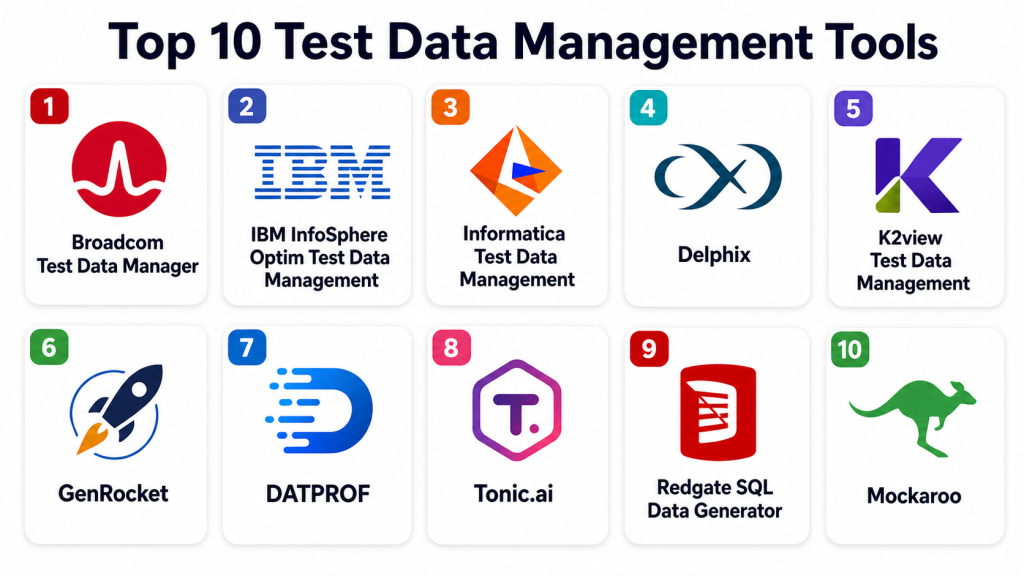
Top 10 Test Data Management Tools
#1 — Broadcom Test Data Manager
Short description: Broadcom Test Data Manager is an enterprise test data management platform designed for large organizations that need data masking, data generation, subsetting, provisioning, and compliance-safe testing. It is suitable for complex application environments and regulated industries.
Key Features
- Test data masking for sensitive data protection.
- Synthetic test data generation.
- Data subsetting for large databases.
- Test data provisioning and refresh workflows.
- Support for enterprise databases and complex systems.
- Rules-based data transformation.
- Integration with enterprise testing and DevOps workflows.
Pros
- Strong fit for large enterprise test data needs.
- Good for regulated environments requiring privacy-safe data.
- Supports complex data relationships and large-scale systems.
Cons
- May be too advanced for small teams.
- Implementation can require planning and specialist skills.
- Licensing and setup should be reviewed carefully.
Platforms / Deployment
Web / Windows / Linux support may vary
Self-hosted / Hybrid options may vary
Security & Compliance
Supports data masking, role-based access controls, auditability, secure test data handling, and privacy-focused workflows depending on configuration. Specific certifications should be verified with the vendor.
Integrations & Ecosystem
Broadcom Test Data Manager fits enterprise QA and data environments where testing, compliance, and database operations must work together.
- Enterprise databases
- CI/CD pipelines
- Test automation tools
- Mainframe and legacy systems
- DevOps platforms
- Data privacy workflows
Support & Community
Broadcom provides enterprise documentation, support plans, professional services, and onboarding resources for large-scale test data management programs.
#2 — IBM InfoSphere Optim Test Data Management
Short description: IBM InfoSphere Optim Test Data Management helps organizations create smaller, safer, and more useful test data sets while protecting sensitive information. It is widely considered for enterprise database environments and regulated data workflows.
Key Features
- Data masking for sensitive information.
- Database subsetting and archive support.
- Test data extraction and provisioning.
- Enterprise data lifecycle management.
- Support for complex relational data.
- Policy-based data management.
- Integration with enterprise database environments.
Pros
- Strong enterprise database focus.
- Useful for regulated and data-heavy organizations.
- Good for managing large and complex test data sets.
Cons
- Can be complex to implement.
- Best suited for mature enterprise environments.
- Licensing and administration effort should be evaluated.
Platforms / Deployment
Windows / Linux / Mainframe support may vary
Self-hosted / Hybrid options may vary
Security & Compliance
Supports masking, access controls, data privacy workflows, and governance-oriented test data handling. Specific compliance certifications should be verified with IBM documentation.
Integrations & Ecosystem
IBM Optim fits organizations with large database estates, legacy systems, and enterprise data governance requirements.
- IBM database environments
- Enterprise relational databases
- Mainframe systems
- Data governance tools
- QA environments
- Compliance workflows
Support & Community
IBM provides documentation, enterprise support, partner resources, and professional services for complex data management deployments.
#3 — Informatica Test Data Management
Short description: Informatica Test Data Management helps teams discover, mask, generate, subset, and provision test data across complex data environments. It is suitable for enterprises that already use data management, governance, and integration platforms.
Key Features
- Sensitive data discovery.
- Data masking and privacy controls.
- Synthetic data generation.
- Data subsetting and provisioning.
- Support for databases and enterprise systems.
- Data relationship handling.
- Integration with broader Informatica ecosystem.
Pros
- Strong data governance and privacy alignment.
- Good for enterprise test data complexity.
- Useful for teams already using Informatica products.
Cons
- May require data management expertise.
- Cost and implementation should be planned.
- Smaller teams may not need its full capability set.
Platforms / Deployment
Web / Windows / Linux support may vary
Cloud / Self-hosted / Hybrid options may vary
Security & Compliance
Supports sensitive data discovery, masking, role-based access, policy controls, and governance-focused workflows. Specific compliance certifications should be verified with the vendor.
Integrations & Ecosystem
Informatica Test Data Management works well where test data must connect with broader data governance and data integration programs.
- Enterprise databases
- Data governance platforms
- Data integration pipelines
- Cloud data platforms
- QA tools
- Compliance systems
Support & Community
Informatica provides documentation, enterprise support, training resources, partner support, and professional services.
#4 — Delphix
Short description: Delphix is a data platform used for test data delivery, data virtualization, masking, and faster environment refresh. It is especially useful for enterprises that need realistic, protected data available quickly for development and testing.
Key Features
- Data virtualization for fast provisioning.
- Data masking for privacy protection.
- Test data refresh and rollback capabilities.
- Support for enterprise databases.
- Self-service data delivery workflows.
- Version-like data environment handling.
- Integration with DevOps and CI/CD workflows.
Pros
- Strong for fast test environment provisioning.
- Useful for reducing database copy overhead.
- Good fit for DevOps and enterprise data teams.
Cons
- Requires planning for architecture and data sources.
- May be more than small teams need.
- Licensing and infrastructure fit should be reviewed.
Platforms / Deployment
Web / Linux-based environments may vary
Self-hosted / Cloud / Hybrid
Security & Compliance
Supports data masking, access controls, secure provisioning, and audit-friendly workflows depending on configuration. Specific compliance certifications should be verified with the vendor.
Integrations & Ecosystem
Delphix fits environments where QA, DevOps, and database teams need fast, controlled test data delivery.
- Enterprise databases
- CI/CD pipelines
- DevOps tools
- Cloud platforms
- Test automation tools
- Compliance workflows
Support & Community
Delphix provides enterprise documentation, support, onboarding resources, technical services, and customer success guidance.
#5 — K2view Test Data Management
Short description: K2view Test Data Management focuses on delivering test data by business entity, such as customer, account, policy, or order. It is useful for enterprises that need high-quality, compliant test data across complex distributed systems.
Key Features
- Business entity-based test data management.
- Data masking and privacy protection.
- Synthetic data generation capabilities.
- Test data provisioning across multiple systems.
- Data subsetting and environment refresh.
- Support for distributed enterprise architectures.
- API-based test data delivery.
Pros
- Strong for complex business entity data.
- Useful for distributed and multi-system environments.
- Good fit for compliance-safe testing.
Cons
- May require careful modeling and setup.
- Best suited for enterprise data complexity.
- Pricing and implementation should be reviewed carefully.
Platforms / Deployment
Web / Linux support may vary
Cloud / Self-hosted / Hybrid options may vary
Security & Compliance
Supports data masking, access controls, privacy-safe data delivery, and governance-oriented workflows depending on configuration. Specific certifications should be verified with the vendor.
Integrations & Ecosystem
K2view fits enterprise systems where test data must reflect real business entities across multiple applications and databases.
- Enterprise databases
- APIs
- CRM and core business systems
- CI/CD tools
- Test automation frameworks
- Data privacy workflows
Support & Community
K2view provides documentation, enterprise support, onboarding guidance, and professional services for complex test data programs.
#6 — GenRocket
Short description: GenRocket is a synthetic test data generation platform that helps teams create realistic test data for QA, automation, DevOps, and data testing. It is useful when teams need safe, flexible data without copying production data.
Key Features
- Synthetic test data generation.
- Data generation rules and scenarios.
- API and automation-friendly workflows.
- Support for multiple data formats.
- Test data modeling and generation logic.
- CI/CD integration capabilities.
- Privacy-safe testing support.
Pros
- Strong for synthetic data generation.
- Useful for automated testing and DevOps workflows.
- Reduces dependence on production data.
Cons
- Teams must model data carefully for realism.
- May not replace masking for all legacy environments.
- Learning curve depends on data complexity.
Platforms / Deployment
Web / Windows / macOS / Linux usage may vary
Cloud / Self-hosted / Hybrid options may vary
Security & Compliance
Supports privacy-safe synthetic data generation and secure workflow controls depending on edition. SSO, RBAC, audit logs, encryption, and compliance details should be verified with the vendor.
Integrations & Ecosystem
GenRocket fits test automation teams that need repeatable and controlled test data generation across many systems.
- CI/CD pipelines
- Test automation frameworks
- APIs
- Databases
- Data files
- DevOps workflows
Support & Community
GenRocket provides documentation, support resources, training, onboarding help, and customer guidance for data generation use cases.
#7 — DATPROF
Short description: DATPROF provides test data management, data masking, and database subsetting solutions for organizations that need secure and manageable non-production data. It is useful for teams that want practical test data refresh and privacy control.
Key Features
- Data masking for privacy-safe testing.
- Database subsetting.
- Test data provisioning.
- Synthetic data generation options may vary.
- Support for relational database environments.
- Test environment refresh workflows.
- Rule-based data transformation.
Pros
- Practical for database-focused test data management.
- Good for privacy and masking use cases.
- Useful for teams replacing manual data handling.
Cons
- Database coverage should be validated.
- Advanced enterprise workflows may require planning.
- Integration depth depends on environment needs.
Platforms / Deployment
Windows / Linux support may vary
Self-hosted / Hybrid options may vary
Security & Compliance
Supports data masking, data privacy workflows, user controls, and secure non-production data management depending on configuration. Specific compliance certifications should be verified with the vendor.
Integrations & Ecosystem
DATPROF fits QA and database teams that need masked, smaller, and more useful test databases.
- Relational databases
- QA environments
- Test automation tools
- CI/CD workflows
- Data privacy processes
- Database administration workflows
Support & Community
DATPROF provides documentation, customer support, onboarding resources, and implementation guidance.
#8 — Tonic.ai
Short description: Tonic.ai helps teams create safe, realistic test data through data de-identification, masking, and synthetic data generation workflows. It is useful for engineering and data teams that need production-like data without exposing sensitive values.
Key Features
- Data de-identification and masking.
- Synthetic data generation.
- Database and file-based data support depending on setup.
- Privacy-preserving test data creation.
- Data generation rules and transformations.
- Developer-friendly workflows.
- Support for test and development environments.
Pros
- Strong focus on safe and realistic test data.
- Useful for engineering teams needing production-like datasets.
- Helps reduce privacy risk in non-production systems.
Cons
- Supported data sources should be validated.
- Teams must define realistic masking and generation rules.
- Enterprise governance needs should be reviewed by plan.
Platforms / Deployment
Web / Linux-based environments may vary
Cloud / Self-hosted / Hybrid options may vary
Security & Compliance
Supports de-identification, masking, secure data workflows, and access controls depending on edition. Specific compliance certifications should be verified with the vendor.
Integrations & Ecosystem
Tonic.ai fits modern engineering environments where developers and QA teams need safe test data without copying raw production data.
- Databases
- Data warehouses
- Development environments
- CI/CD workflows
- QA systems
- Data privacy workflows
Support & Community
Tonic.ai provides documentation, product support, onboarding resources, and technical guidance for test data and privacy workflows.
#9 — Redgate SQL Data Generator
Short description: Redgate SQL Data Generator helps teams create realistic test data for SQL Server databases. It is useful for developers and database teams that need controlled test data for development, QA, and database testing.
Key Features
- Test data generation for SQL Server.
- Data generation based on table structure.
- Customizable generation rules.
- Support for realistic sample data.
- Integration with database development workflows.
- Useful for local and test database preparation.
- Repeatable data generation patterns.
Pros
- Good for SQL Server-focused teams.
- Simple way to generate test database content.
- Useful for development and QA database testing.
Cons
- Focused mainly on SQL Server use cases.
- Not a full enterprise TDM platform.
- Masking and multi-system provisioning needs may require other tools.
Platforms / Deployment
Windows
Self-hosted
Security & Compliance
Supports generation of non-production test data, reducing reliance on sensitive production data. Enterprise SSO, RBAC, audit logs, and compliance certifications are not publicly stated as universal tool claims.
Integrations & Ecosystem
Redgate SQL Data Generator fits database development teams using SQL Server and related tooling.
- SQL Server
- Database development workflows
- QA databases
- Local development environments
- Database comparison tools
- Release testing workflows
Support & Community
Redgate provides documentation, customer support, community resources, and strong adoption among database professionals.
#10 — Mockaroo
Short description: Mockaroo is a test data generation tool for quickly creating sample data in different formats. It is useful for developers, testers, analysts, and small teams that need quick mock data for demos, testing, and prototypes.
Key Features
- Synthetic mock data generation.
- Support for multiple output formats.
- Custom fields and data types.
- API-based data generation options.
- Useful for demos and prototypes.
- Quick test file creation.
- Simple web-based workflow.
Pros
- Very easy to start with.
- Good for quick mock data needs.
- Useful for developers, testers, and analysts.
Cons
- Not a full enterprise test data management platform.
- Limited for complex database masking and provisioning.
- Governance and compliance needs may require stronger tools.
Platforms / Deployment
Web
Cloud
Security & Compliance
Helps create synthetic data, reducing dependence on real sensitive data. Advanced enterprise controls such as SSO, RBAC, audit logs, and formal compliance details should be verified with the vendor.
Integrations & Ecosystem
Mockaroo fits lightweight test data generation, API testing, prototyping, and sample dataset creation.
- API testing tools
- Development workflows
- CSV and JSON workflows
- Prototyping tools
- Demo environments
- Manual QA workflows
Support & Community
Mockaroo provides documentation, help resources, and community familiarity among developers and testers needing quick synthetic data.
Comparison Table (Top 10)
| Tool Name | Best For | Platform(s) Supported | Deployment | Standout Feature | Public Rating |
|---|---|---|---|---|---|
| Broadcom Test Data Manager | Enterprise TDM and compliance | Web, Windows, Linux varies | Self-hosted / Hybrid options vary | Enterprise data masking and provisioning | N/A |
| IBM InfoSphere Optim Test Data Management | Enterprise database subsetting and masking | Windows, Linux, Mainframe varies | Self-hosted / Hybrid options vary | Large-scale enterprise data management | N/A |
| Informatica Test Data Management | Data governance-led TDM | Web, Windows, Linux varies | Cloud / Self-hosted / Hybrid options vary | Sensitive data discovery and masking | N/A |
| Delphix | Fast test data provisioning | Web, Linux-based environments vary | Self-hosted / Cloud / Hybrid | Data virtualization for test environments | N/A |
| K2view Test Data Management | Business entity-based test data | Web, Linux varies | Cloud / Self-hosted / Hybrid options vary | Test data by customer or business entity | N/A |
| GenRocket | Synthetic test data generation | Web, Windows, macOS, Linux varies | Cloud / Self-hosted / Hybrid options vary | Scenario-based synthetic data generation | N/A |
| DATPROF | Database masking and subsetting | Windows, Linux varies | Self-hosted / Hybrid options vary | Practical database-focused TDM | N/A |
| Tonic.ai | De-identified realistic test data | Web, Linux-based environments vary | Cloud / Self-hosted / Hybrid options vary | Privacy-safe production-like data | N/A |
| Redgate SQL Data Generator | SQL Server test data | Windows | Self-hosted | SQL Server-focused data generation | N/A |
| Mockaroo | Quick mock data generation | Web | Cloud | Simple synthetic sample data creation | N/A |
Evaluation & Scoring of Test Data Management Tools
| Tool Name | Core (25%) | Ease (15%) | Integrations (15%) | Security (10%) | Performance (10%) | Support (10%) | Value (15%) | Weighted Total (0–10) |
|---|---|---|---|---|---|---|---|---|
| Broadcom Test Data Manager | 10 | 6 | 9 | 9 | 9 | 9 | 7 | 8.50 |
| IBM InfoSphere Optim Test Data Management | 9 | 6 | 8 | 9 | 9 | 9 | 7 | 8.20 |
| Informatica Test Data Management | 9 | 7 | 9 | 9 | 8 | 9 | 7 | 8.35 |
| Delphix | 9 | 7 | 8 | 9 | 9 | 8 | 7 | 8.20 |
| K2view Test Data Management | 9 | 7 | 8 | 9 | 8 | 8 | 7 | 8.05 |
| GenRocket | 8 | 8 | 8 | 8 | 8 | 8 | 8 | 8.00 |
| DATPROF | 8 | 8 | 7 | 8 | 8 | 8 | 8 | 7.85 |
| Tonic.ai | 8 | 8 | 8 | 9 | 8 | 8 | 8 | 8.15 |
| Redgate SQL Data Generator | 6 | 9 | 6 | 7 | 8 | 8 | 9 | 7.35 |
| Mockaroo | 5 | 10 | 6 | 6 | 7 | 7 | 10 | 7.05 |
These scores are comparative and should be used as a decision-support guide, not as a universal ranking. Enterprise platforms such as Broadcom, IBM, Informatica, Delphix, and K2view are stronger for complex and regulated environments. Tools such as GenRocket, Tonic.ai, Redgate SQL Data Generator, and Mockaroo may be better for focused synthetic data or smaller testing workflows.
Which Test Data Management Tool Is Right for You?
Solo / Freelancer
Solo developers and testers usually need simple data generation rather than a full enterprise test data platform. Mockaroo is useful for quick sample data, while Redgate SQL Data Generator is practical for SQL Server-focused database testing. GenRocket may be useful if the freelancer needs more structured synthetic data.
For small projects, the goal should be speed and simplicity. A full enterprise masking and provisioning platform may be unnecessary unless client data privacy rules require it.
SMB
SMBs should prioritize ease of use, basic masking, synthetic data creation, database support, and affordable pricing. GenRocket, Tonic.ai, DATPROF, Redgate SQL Data Generator, and Mockaroo can fit different SMB scenarios depending on data complexity.
If the SMB handles real customer data, masking and de-identification should be treated as a serious requirement. If the business only needs demo or QA sample data, synthetic generation may be enough.
Mid-Market
Mid-market teams usually need stronger data governance, automation integration, repeatable refresh workflows, and support for multiple systems. Tonic.ai, GenRocket, DATPROF, Delphix, Informatica, and K2view are useful candidates depending on data structure and privacy needs.
Mid-market buyers should test real database sources, masking rules, data relationships, automation workflows, and QA environment refresh cycles before choosing a tool.
Enterprise
Enterprises should focus on data masking, compliance controls, auditability, complex database support, mainframe or legacy support, synthetic data, provisioning speed, and integration with DevOps pipelines. Broadcom Test Data Manager, IBM InfoSphere Optim, Informatica Test Data Management, Delphix, and K2view are stronger enterprise options.
Large organizations should also evaluate data lineage, sensitive data discovery, business entity modeling, access approvals, environment refresh processes, and role-based governance.
Budget vs Premium
Budget-focused teams may prefer Mockaroo, Redgate SQL Data Generator, DATPROF, or smaller synthetic data workflows. Premium buyers with complex databases, compliance needs, distributed systems, and enterprise governance may prefer Broadcom, IBM, Informatica, Delphix, or K2view.
The real cost should include licensing, implementation, data modeling, masking rule design, storage savings, compliance risk reduction, and time saved in test environment preparation.
Feature Depth vs Ease of Use
For feature depth, Broadcom, IBM, Informatica, Delphix, and K2view are strong. For ease of use, Mockaroo, Redgate SQL Data Generator, Tonic.ai, GenRocket, and DATPROF may feel more approachable depending on the use case.
The right choice depends on whether the team needs full test data governance or just realistic data for testing and automation.
Integrations & Scalability
Enterprise teams should look for database coverage, API support, CI/CD integration, test automation compatibility, cloud platform support, and data pipeline connectivity. Broadcom, Informatica, Delphix, IBM, and K2view are stronger for complex integration needs. GenRocket and Tonic.ai are strong for synthetic and privacy-safe data workflows.
Scalability should be tested with real data volumes, real schemas, referential integrity rules, environment refresh schedules, and automation pipelines.
Security & Compliance Needs
Security-focused buyers should evaluate masking strength, synthetic data controls, RBAC, SSO, MFA, audit logs, encryption, sensitive data discovery, retention rules, and export restrictions. Regulated industries should verify vendor documentation and confirm whether the tool supports internal privacy and compliance requirements.
Test data often looks harmless, but it can expose sensitive business information if not managed properly.
Frequently Asked Questions (FAQs)
1. What is a test data management tool?
A test data management tool helps teams create, mask, provision, refresh, and control test data for QA, development, automation, and performance testing.
2. Why is test data management important?
It helps teams test faster, reduce privacy risk, improve data quality, and avoid delays caused by missing, outdated, or unsafe test data.
3. What is data masking?
Data masking replaces sensitive values with safe but realistic alternatives. It allows teams to test with production-like data without exposing real personal or business information.
4. What is synthetic test data?
Synthetic test data is artificially generated data that looks realistic but does not come from real users or production systems. It is useful for safe testing and automation.
5. What is database subsetting?
Database subsetting creates a smaller copy of a larger database while keeping the needed relationships intact. It helps reduce storage, speed up testing, and simplify test environments.
6. Which tool is best for enterprise test data management?
Broadcom Test Data Manager, IBM InfoSphere Optim, Informatica Test Data Management, Delphix, and K2view are strong enterprise candidates. The best choice depends on database landscape, compliance needs, and integration requirements.
7. Which tool is best for synthetic test data?
GenRocket, Tonic.ai, Mockaroo, and Redgate SQL Data Generator are useful for synthetic or generated test data. The best option depends on data complexity and automation needs.
8. How much do test data management tools cost?
Pricing varies by vendor, deployment model, data volume, users, supported systems, enterprise features, and support level. Many enterprise tools use custom pricing.
9. What are common test data management mistakes?
Common mistakes include using unmasked production data, ignoring referential integrity, relying on manual refreshes, not documenting masking rules, and failing to integrate with automation pipelines.
10. Can test data management tools work with CI/CD?
Yes, many tools support integration with CI/CD pipelines, APIs, scripts, and automation frameworks. This helps teams provision data automatically during test execution.
Conclusion
Test Data Management Tools help teams deliver better software by making test data safer, faster, more realistic, and easier to control. The best tool depends on data complexity, privacy requirements, database landscape, automation goals, budget, and team maturity. Broadcom Test Data Manager, IBM InfoSphere Optim, Informatica, Delphix, and K2view are strong for complex enterprise environments. GenRocket and Tonic.ai are useful for synthetic and privacy-safe data workflows, while DATPROF supports practical masking and subsetting needs. Redgate SQL Data Generator is helpful for SQL Server teams, and Mockaroo is a simple option for quick mock data. The best next step is to shortlist two or three tools, test them with real schemas and workflows, validate masking quality, connect them with QA automation, and confirm that the selected platform reduces both testing delays and data privacy risk.
