Upgrade & Secure Your Future with DevOps, SRE, DevSecOps, MLOps!
We spend hours scrolling social media and waste money on things we forget, but won’t spend 30 minutes a day earning certifications that can change our lives.
Master in DevOps, SRE, DevSecOps & MLOps by DevOps School!
Learn from Guru Rajesh Kumar and double your salary in just one year.
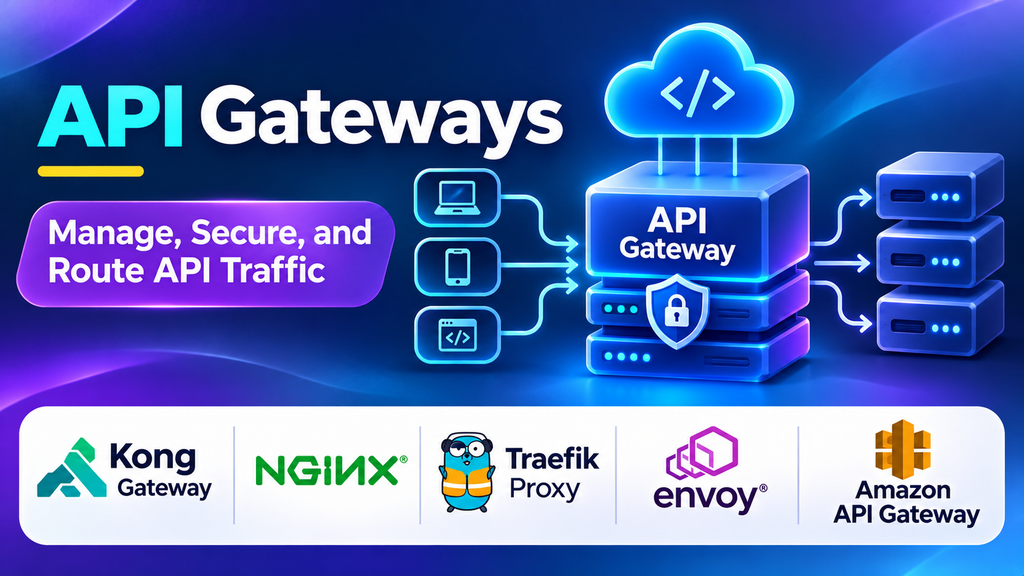
An API gateway acts as an entry point between clients and backend services. When a mobile app, website, or external system sends an API request, the gateway can route it to the appropriate service while applying security policies, traffic limits, and monitoring.
For organizations running multiple microservices, an API gateway can simplify how applications communicate with backend systems. Instead of implementing every access and routing rule separately in each service, teams can centralize many of these responsibilities.
Five API Gateway Tools to Consider
1. Kong Gateway
Kong Gateway provides traffic routing, authentication integrations, rate limiting, and plugin-based extensions. It can be deployed in different infrastructure environments, depending on the selected configuration.
Best suited for: Teams managing APIs across distributed or hybrid environments.
2. NGINX
NGINX is widely used as a web server, reverse proxy, and load balancer. It can also serve as an API gateway layer by routing requests, handling TLS termination, and applying traffic controls through its configuration and related products.
Best suited for: Teams that want flexible request routing and traffic management.
3. Traefik Proxy
Traefik Proxy is designed to route traffic to services in dynamic environments. It can discover services and update routing configurations as deployments change, making it useful in containerized and microservices architectures.
Best suited for: Teams running containerized applications and dynamically changing services.
4. Envoy Proxy
Envoy Proxy is a high-performance proxy designed for modern service architectures. It supports advanced routing, load balancing, observability, and traffic management. It is often used as a building block in service mesh and gateway architectures.
Best suited for: Engineering teams that need advanced traffic control across microservices.
5. Amazon API Gateway
Amazon API Gateway is a managed AWS service for creating, publishing, securing, and monitoring APIs. It reduces the need to operate gateway infrastructure directly and integrates with other AWS services.
Best suited for: Applications already built around Amazon Web Services.
Comparing API Gateway Tools
| Tool | Main strength | Best fit |
|---|---|---|
| Kong Gateway | Plugin-based API traffic management | Distributed services |
| NGINX | Flexible routing and load balancing | Web and API infrastructure |
| Traefik Proxy | Dynamic service discovery | Containerized applications |
| Envoy Proxy | Advanced traffic management | Microservices architectures |
| Amazon API Gateway | Managed AWS integration | AWS-based applications |
Essential Features of an API Gateway
When selecting an API gateway, evaluate the capabilities that match your architecture:
- Request routing: Direct requests to the correct backend service.
- Authentication and authorization: Control which users and applications can access APIs.
- Rate limiting: Restrict excessive requests and help protect backend services.
- Load balancing: Distribute traffic across available service instances.
- Monitoring: Track response times, errors, and traffic patterns.
- TLS termination: Manage encrypted connections at the gateway where appropriate.
Not every gateway provides every feature in the same way. Some capabilities may require plugins, additional products, or custom configuration.
API Gateway vs. API Management Platform
An API gateway primarily handles API traffic, including routing, access controls, and request processing. An API management platform typically provides broader capabilities, such as API lifecycle management, developer portals, analytics, documentation, and governance.
A gateway can be one component of a larger API management solution. The distinction matters when deciding whether you need a traffic-routing layer alone or a complete environment for managing APIs across an organization.
How to Choose the Right API Gateway
Start by identifying your infrastructure and operational needs. Teams using AWS may prefer a managed service such as Amazon API Gateway, while teams requiring flexible deployments can evaluate Kong Gateway or NGINX. Traefik Proxy is worth considering for dynamic container environments, and Envoy Proxy can suit systems requiring advanced traffic management.
Also consider configuration complexity, scalability, security requirements, monitoring integrations, and the team’s existing technical skills. Test the gateway with realistic workloads before deploying it in production.
Best Practices for API Gateway Deployment
Keep routing rules and security policies organized, apply rate limits where necessary, and avoid exposing internal services directly without appropriate controls. Monitor gateway errors and latency so that problems can be investigated quickly.
Use secure configuration practices, test changes before releasing them, and plan for gateway availability so it does not become a single point of failure. For microservices environments, ensure that the gateway complements rather than replaces security and resilience measures within individual services.
Conclusion
API gateways provide a central point for routing requests, controlling access, and monitoring communication between applications and backend services. Kong Gateway, NGINX, Traefik Proxy, Envoy Proxy, and Amazon API Gateway offer different approaches to implementing this layer.
The best option depends on your infrastructure, traffic patterns, security needs, and operational requirements. Choosing a gateway that fits your architecture can simplify API communication and help keep services reliable as applications grow.
