Upgrade & Secure Your Future with DevOps, SRE, DevSecOps, MLOps!
We spend hours scrolling social media and waste money on things we forget, but won’t spend 30 minutes a day earning certifications that can change our lives.
Master in DevOps, SRE, DevSecOps & MLOps by DevOps School!
Learn from Guru Rajesh Kumar and double your salary in just one year.
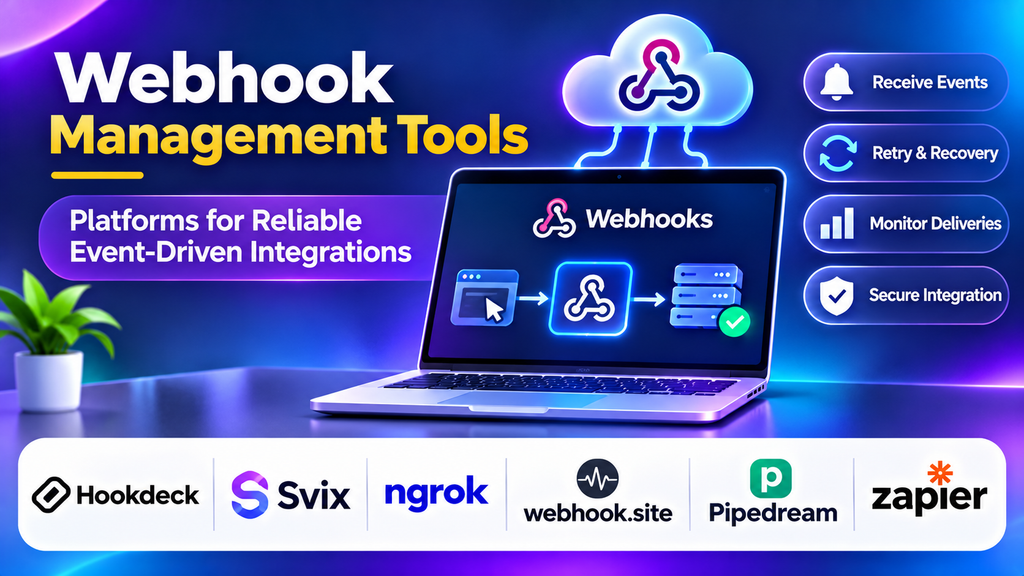
Webhooks are an essential part of modern application integration. They allow one application to notify another when an event occurs, such as a payment being completed, an order being created, or a customer updating a profile. Instead of repeatedly checking for changes, receiving applications can respond to events as they happen. However, webhooks require reliable delivery, secure endpoints, effective debugging, and appropriate retry handling. Webhook management tools help teams manage these requirements.
What Are Webhook Management Tools?
Webhook management tools help developers create, receive, inspect, test, route, and monitor HTTP event notifications. They can simplify local development, connect third-party services, troubleshoot failed requests, and improve the reliability of production integrations. Depending on the platform, features may include request inspection, event replay, retry policies, signing-secret validation, and delivery logs.
Popular Webhook Management Tools
1. Hookdeck
Hookdeck is an event delivery platform designed to help teams manage webhooks and event-driven traffic. It provides capabilities for inspecting events, handling delivery failures, retrying events, and managing high-volume webhook workflows. Its tools can help developers investigate issues between event producers and receiving applications.
Best for: Teams building production integrations that need better visibility and control over webhook delivery.
2. Svix
Svix provides webhook infrastructure for applications that send webhooks to their customers. It supports delivery management, retries, logs, and operational visibility. Using a dedicated service can reduce the effort required to build and maintain a reliable webhook delivery system.
Best for: SaaS companies that need to send webhooks reliably to customer endpoints.
3. ngrok
ngrok creates secure tunnels that expose local services through publicly reachable endpoints. Developers can use it to receive webhook requests from external platforms while working on a local application. Request inspection and related debugging capabilities can help identify issues during development.
Best for: Developers testing third-party webhooks against local applications.
4. webhook.site
webhook.site provides temporary URLs that receive HTTP requests and display the incoming request details. Developers can inspect headers, payloads, and request behavior without first building a complete backend endpoint. It is particularly useful for quickly understanding what a service sends when an event occurs.
Best for: Rapid webhook testing, payload inspection, and debugging during development.
5. Pipedream
Pipedream combines event sources, webhook triggers, and workflow automation. Developers can receive events, transform payloads, execute code, and connect services within an automated workflow. It can be useful when a webhook needs to trigger several follow-up actions across different applications.
Best for: Developers and teams automating multi-step integrations with minimal infrastructure management.
6. Zapier
Zapier offers no-code and low-code automation through triggers and actions. Webhooks by Zapier can receive requests or send data to other services, depending on the workflow configuration and plan. This makes it possible to connect applications without developing every integration from scratch.
Best for: Business teams that want to automate application workflows with limited coding.
Comparison of Webhook Tools
| Tool | Main purpose | Suitable use case |
|---|---|---|
| Hookdeck | Event delivery management | Production webhook operations |
| Svix | Outbound webhook infrastructure | SaaS customer notifications |
| ngrok | Secure local tunnels | Local development and testing |
| webhook.site | Request inspection | Quick payload debugging |
| Pipedream | Event-driven workflows | Custom multi-step integrations |
| Zapier | Workflow automation | No-code business processes |
Essential Features to Consider
When selecting a webhook platform, look for request inspection, delivery logs, retry handling, event replay, endpoint management, access controls, and monitoring. For production systems, consider throughput limits, retention policies, data residency, pricing, and integration with existing alerting tools.
Security is especially important. Platforms should support appropriate authentication and help teams validate webhook signatures when the sending service provides them. Sensitive payloads should be protected, and access to event logs should be restricted.
How to Choose the Right Tool
Start with your primary requirement. Use webhook.site for quick request inspection or ngrok when an external service needs to reach a local development environment. Consider Hookdeck or Svix when reliability and delivery visibility are important to a production integration. Pipedream is useful for developer-oriented event workflows, while Zapier can suit business users who prefer visual automation.
Before adopting a platform, test how it handles failed endpoints, duplicate events, retries, and bursts of traffic. Confirm whether it supports the required direction of delivery: receiving webhooks, sending them, or both. Also evaluate security, operational limits, and long-term costs.
Webhook Management Best Practices
- Verify webhook signatures where supported and never trust incoming payloads blindly.
- Return appropriate HTTP status codes and process events asynchronously when needed.
- Design handlers to be idempotent so duplicate deliveries do not cause duplicate actions.
- Use retries with backoff and monitor events that repeatedly fail.
- Store event identifiers and delivery outcomes for troubleshooting.
- Protect secrets, restrict endpoint access, and avoid logging sensitive data unnecessarily.
- Test delayed delivery, duplicate events, invalid payloads, and endpoint outages.
Conclusion
Webhook management tools help developers build integrations that are easier to test, monitor, and maintain. Hookdeck and Svix focus on delivery management, ngrok and webhook.site simplify development and debugging, and Pipedream and Zapier help automate event-driven workflows. The best choice depends on whether you need a testing utility, an automation platform, or production-grade delivery infrastructure. With suitable tooling and reliable event-handling practices, teams can create more resilient application integrations.
