Upgrade & Secure Your Future with DevOps, SRE, DevSecOps, MLOps!
We spend hours scrolling social media and waste money on things we forget, but won’t spend 30 minutes a day earning certifications that can change our lives.
Master in DevOps, SRE, DevSecOps & MLOps by DevOps School!
Learn from Guru Rajesh Kumar and double your salary in just one year.
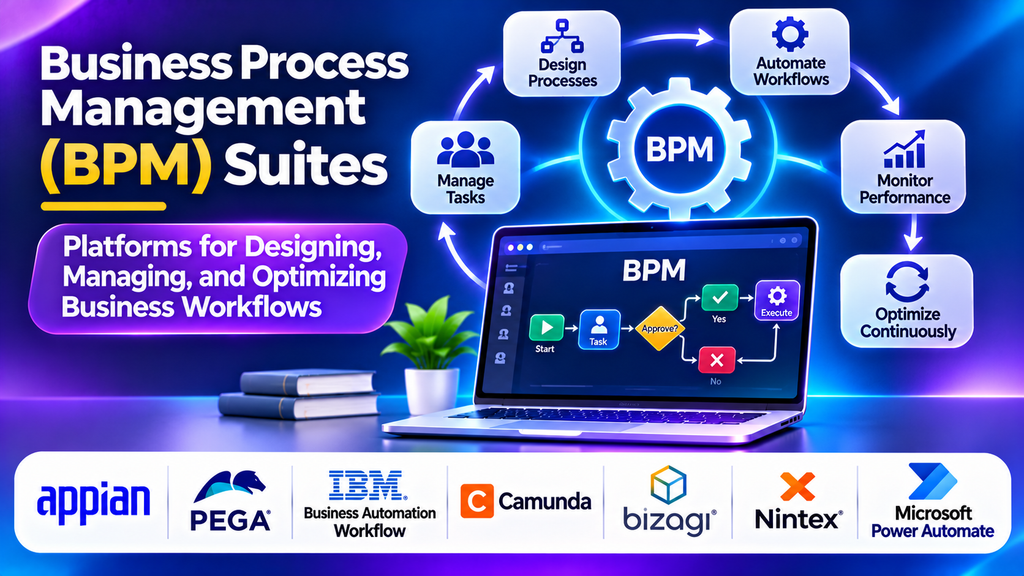
Business Process Management (BPM) Suites: Platforms for Designing, Managing, and Optimizing Business Workflows
Business Process Management (BPM) is a systematic approach to designing, executing, monitoring, and improving business processes. BPM suites provide tools that help organizations model workflows, coordinate tasks, manage approvals, track performance, and reduce operational inefficiencies.
Unlike tools designed for a single repetitive task, BPM platforms can manage entire business processes across multiple departments. Common use cases include employee onboarding, invoice approvals, customer service, procurement, and compliance management.
Popular Business Process Management Platforms
1. Appian
Appian combines process automation, low-code application development, and case management in one platform. Best for enterprises seeking low-code process applications and end-to-end workflow automation.
2. Pega Platform
Pega provides business process automation, case management, and decisioning capabilities. Best for large organizations in banking, insurance, healthcare, and customer service.
3. IBM Business Automation Workflow
IBM Business Automation Workflow supports business process management and case management. Best for enterprises with complex processes and established IBM technology environments.
4. Camunda
Camunda focuses on workflow and decision automation using standards such as BPMN. Best for technical teams building customizable, service-oriented process automation.
5. Bizagi
Bizagi offers process modeling and automation capabilities. Best for businesses seeking visual process modeling and workflow automation.
6. Nintex
Nintex provides workflow automation, forms, document generation, and process management. Best for teams digitizing business workflows with less manual development.
7. Microsoft Power Automate
Microsoft Power Automate enables workflow automation across Microsoft 365 and third-party applications. Best for organizations using Microsoft business applications.
BPM Platform Comparison
| Platform | Key Strength | Best Fit |
|---|---|---|
| Appian | Low-code process applications | Enterprise workflow automation |
| Pega Platform | Case management and decisioning | Complex customer processes |
| IBM Business Automation Workflow | Enterprise process and case workflows | Large organizations |
| Camunda | Developer-focused orchestration | Technical automation teams |
| Bizagi | Visual process modeling | Process design and improvement |
| Nintex | Workflow and document automation | Business teams |
| Microsoft Power Automate | Application integrations and approvals | Microsoft-based environments |
Capabilities and licensing vary by product edition and deployment model.
Essential Features to Look For
- Process modeling to design and document workflows.
- Workflow automation for tasks, approvals, and notifications.
- Human task management to assign responsibilities and track completion.
- Integration capabilities for applications, databases, APIs, and enterprise systems.
- Monitoring and analytics to identify bottlenecks and measure performance.
- Business rules to apply consistent decision logic.
- Governance and security, including permissions and audit trails.
- Low-code development for faster process adaptation.
How to Choose the Right BPM Suite
Start by identifying processes that need improvement. Document existing steps, stakeholders, approval requirements, exceptions, and delays. Evaluate workflow complexity, integration needs, implementation effort, training, scalability, support, and total cost of ownership. A proof of concept using a real process can help validate the platform.
Best Practices for BPM Implementation
Map and simplify processes before automating them. Involve process owners and employees. Start with a focused pilot and measurable goals. Establish baseline metrics for cycle time, error rates, cost, and user satisfaction. Maintain governance and review performance data regularly to support continuous improvement.
Conclusion
Business Process Management suites help organizations structure, automate, monitor, and improve business operations. Appian, Pega, IBM Business Automation Workflow, Camunda, Bizagi, Nintex, and Microsoft Power Automate offer different approaches to workflow design and automation. The right choice depends on process complexity, integrations, technical resources, security, and budget. A thoughtful implementation can reduce manual effort, improve visibility, and support consistent business outcomes.
