Upgrade & Secure Your Future with DevOps, SRE, DevSecOps, MLOps!
We spend hours scrolling social media and waste money on things we forget, but won’t spend 30 minutes a day earning certifications that can change our lives.
Master in DevOps, SRE, DevSecOps & MLOps by DevOps School!
Learn from Guru Rajesh Kumar and double your salary in just one year.
Introduction
SBOM generation tools help teams create a Software Bill of Materials, which is a structured list of software components used inside an application, container image, package, or system. In simple words, an SBOM shows what is inside your software, including open-source libraries, dependencies, licenses, versions, and sometimes known security risks.
SBOM tools matter because modern software is built from many third-party components. Without clear visibility, teams may struggle to identify vulnerable packages, license risks, outdated dependencies, or hidden supply chain issues.
Common use cases include:
- Tracking open-source components
- Supporting software supply chain security
- Preparing audit-ready software inventories
- Checking licenses and dependency risks
- Improving DevSecOps and compliance workflows
Buyers should evaluate:
- SBOM format support
- Dependency detection accuracy
- CI/CD integration
- Container image scanning
- License visibility
- Vulnerability mapping
- Reporting quality
- API support
- Security controls
- Ease of adoption
Best for: DevSecOps teams, security engineers, platform teams, compliance teams, software vendors, open-source maintainers, and enterprises managing complex software supply chains.
Not ideal for: very small teams with simple internal scripts, teams that do not distribute software, or teams that only need basic dependency listing from a package manager.
Key Trends in SBOM Generation Tools
- Software supply chain security is pushing more teams to generate SBOMs as part of normal development and release workflows.
- Automated SBOM creation in CI/CD pipelines is becoming common because teams want every build, image, and release to have traceable component data.
- Container and Kubernetes visibility is now important because many applications are packaged and deployed through container images.
- Standard SBOM formats such as SPDX and CycloneDX are becoming more important for interoperability across tools.
- Vulnerability correlation is becoming a key feature, where SBOM data is matched against known security issues.
- License compliance automation is helping legal, security, and engineering teams understand open-source usage.
- Developer-friendly workflows are improving as tools provide CLI options, APIs, plugins, and Git platform integrations.
- Enterprise governance is becoming more important, including audit logs, access control, policy enforcement, and reporting.
- Continuous monitoring is becoming preferred over one-time SBOM generation because dependencies change often.
- SBOM sharing and validation are becoming important for customers, vendors, and regulated software buyers.
How We Selected These Tools
The tools below were selected using practical evaluation logic for SBOM and software supply chain use cases:
- Recognition among security, DevOps, and open-source communities
- Ability to generate SBOMs in common formats
- Support for source code, packages, containers, or repositories
- Fit for developer-first and enterprise workflows
- Integration with CI/CD pipelines and security tools
- Strength of vulnerability and license visibility
- Documentation quality and community adoption
- Support for automation through CLI, APIs, or plugins
- Suitability across SMB, mid-market, and enterprise environments
- Flexibility across cloud, self-hosted, and open-source usage
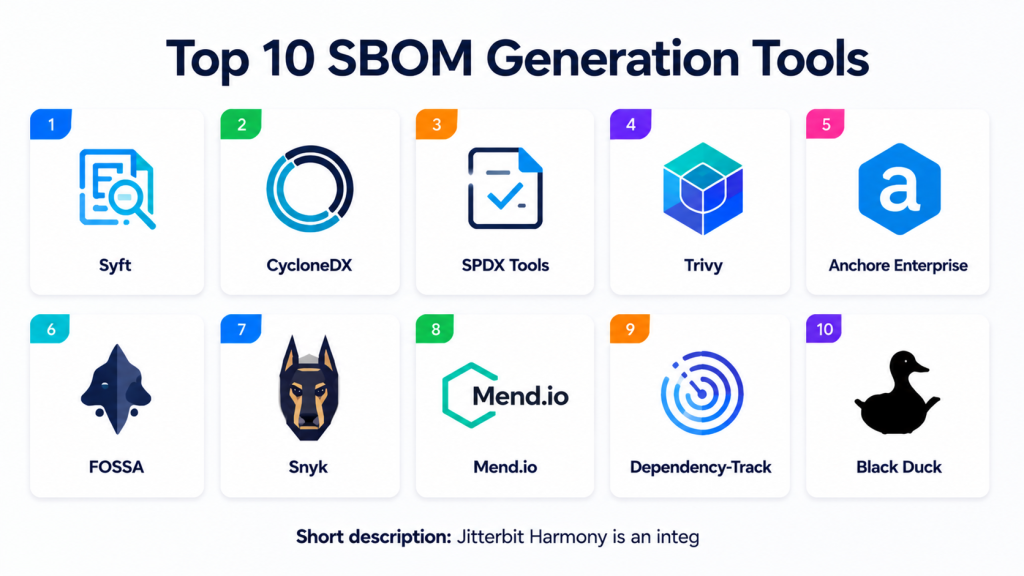
Top 10 SBOM Generation Tools
#1 — Syft
Short description: Syft is an open-source SBOM generation tool designed to identify packages and dependencies in container images, filesystems, and source code. It is popular with DevOps and security teams that need fast, developer-friendly SBOM output.
Key Features
- Generates SBOMs from container images and filesystems
- Supports common SBOM formats
- CLI-first workflow for automation
- Works well in CI/CD pipelines
- Can inspect multiple package ecosystems
- Useful for container security workflows
- Pairs well with vulnerability scanning tools
Pros
- Lightweight and easy for developers to adopt
- Strong fit for container and DevSecOps workflows
- Open-source and automation-friendly
Cons
- Requires technical knowledge for best use
- Enterprise governance features may need surrounding tools
- Not a full compliance management platform by itself
Platforms / Deployment
Linux / macOS / Windows
CLI / Self-hosted workflow
Security & Compliance
Not publicly stated for formal compliance certifications. Security depends on how it is deployed and integrated into the user’s environment.
Integrations & Ecosystem
Syft works well in automated security and DevOps workflows. It is often used with container scanners, CI pipelines, and artifact systems.
- GitHub Actions
- GitLab CI
- Jenkins
- Docker workflows
- Kubernetes pipelines
- Grype
- Container registries
Support & Community
Syft has strong open-source documentation and community adoption. Enterprise support depends on related vendor offerings or internal team capability.
#2 — CycloneDX
Short description: CycloneDX is an open SBOM standard and ecosystem with tools that help generate, validate, and exchange SBOMs. It is useful for teams that want strong interoperability and broad format support.
Key Features
- Open SBOM standard ecosystem
- Supports multiple language ecosystems
- Provides tools for SBOM generation and validation
- Strong focus on security use cases
- Supports component metadata
- Useful for vulnerability and license workflows
- Broad community and vendor adoption
Pros
- Strong interoperability across tools
- Widely recognized SBOM format
- Flexible for different software ecosystems
Cons
- Implementation depends on selected tools
- Not a single commercial platform by itself
- Teams may need additional tools for dashboards and governance
Platforms / Deployment
Varies by tool implementation
Cloud / Self-hosted / CLI depending on chosen tool
Security & Compliance
Not publicly stated as a single platform certification. Security depends on the tool or platform implementing CycloneDX.
Integrations & Ecosystem
CycloneDX has a broad ecosystem across build tools, package managers, and security platforms.
- Maven
- Gradle
- npm
- Python tooling
- CI/CD systems
- Dependency analysis tools
- Security platforms
Support & Community
CycloneDX has strong community documentation and adoption across security and software supply chain communities.
#3 — SPDX Tools
Short description: SPDX Tools support creation and validation of SBOMs using the SPDX standard. SPDX is widely used for software component and license documentation.
Key Features
- Supports SPDX SBOM format
- Helps document software components
- Strong license metadata focus
- Useful for compliance and governance
- Supports validation workflows
- Open standard ecosystem
- Works with multiple software supply chain processes
Pros
- Strong for license and compliance visibility
- Open and widely recognized format
- Useful for vendor and customer SBOM exchange
Cons
- May require process knowledge to implement well
- Tooling experience can vary
- Dashboards and enterprise workflows may require additional platforms
Platforms / Deployment
Varies by SPDX tool
CLI / Web / Self-hosted options may vary
Security & Compliance
SPDX is a standard ecosystem, not a single compliance-certified product. Specific security details depend on the selected tool.
Integrations & Ecosystem
SPDX can be used across build, compliance, and software distribution workflows.
- Open-source compliance workflows
- Package analysis tools
- Build pipelines
- Legal review workflows
- Security platforms
- Vendor documentation processes
Support & Community
SPDX has strong community and industry adoption. Support depends on the tools and vendors selected.
#4 — Trivy
Short description: Trivy is an open-source security scanner that can generate SBOMs and scan containers, repositories, filesystems, and infrastructure configurations. It is useful for DevSecOps teams needing both visibility and security checks.
Key Features
- SBOM generation support
- Container image scanning
- Filesystem and repository scanning
- Vulnerability detection
- Misconfiguration checks
- Secret scanning capabilities
- CI/CD friendly CLI
Pros
- Combines SBOM generation with security scanning
- Easy to use in pipelines
- Strong open-source adoption
Cons
- Enterprise governance may require additional tooling
- Results may need tuning for large environments
- Not only focused on SBOM generation
Platforms / Deployment
Linux / macOS / Windows
CLI / Self-hosted workflow
Security & Compliance
Formal compliance certifications are not publicly stated for the open-source tool. Security controls depend on deployment and surrounding systems.
Integrations & Ecosystem
Trivy fits well into DevSecOps pipelines and container security workflows.
- GitHub Actions
- GitLab CI
- Jenkins
- Docker
- Kubernetes
- Container registries
- CI/CD pipelines
Support & Community
Trivy has strong documentation, active open-source community support, and vendor-backed ecosystem options.
#5 — Anchore Enterprise
Short description: Anchore Enterprise is a software supply chain security platform that supports SBOM generation, vulnerability management, policy enforcement, and container security workflows.
Key Features
- SBOM generation and management
- Container image analysis
- Vulnerability detection
- Policy-based controls
- License visibility
- CI/CD integration
- Enterprise reporting and governance
Pros
- Strong fit for enterprise container security
- Combines SBOM, vulnerability, and policy workflows
- Good for regulated software environments
Cons
- May be more than small teams need
- Requires setup and process alignment
- Pricing details may vary
Platforms / Deployment
Web / Linux
Cloud / Self-hosted / Hybrid options may vary
Security & Compliance
Supports enterprise security capabilities such as access controls and policy workflows. Specific certifications are not assumed unless directly confirmed by the vendor.
Integrations & Ecosystem
Anchore Enterprise integrates with DevOps, container, and CI/CD platforms.
- Kubernetes
- Docker
- Jenkins
- GitHub
- GitLab
- Container registries
- Security workflows
Support & Community
Commercial support, documentation, onboarding resources, and enterprise assistance are available depending on plan.
#6 — FOSSA
Short description: FOSSA is a software composition analysis and license compliance platform that supports dependency visibility, SBOM workflows, and open-source risk management.
Key Features
- Open-source dependency analysis
- SBOM generation support
- License compliance management
- Vulnerability tracking
- Policy automation
- Developer workflow integrations
- Reporting for legal and security teams
Pros
- Strong for license and compliance use cases
- Useful for legal, security, and engineering collaboration
- Good visibility into open-source risk
Cons
- May require process maturity for full value
- Pricing and advanced features vary
- Not only an SBOM generation tool
Platforms / Deployment
Web
Cloud / Enterprise options may vary
Security & Compliance
Supports enterprise access and security controls depending on plan. Specific certifications are not stated here unless publicly confirmed.
Integrations & Ecosystem
FOSSA integrates with development, CI/CD, and repository workflows.
- GitHub
- GitLab
- Bitbucket
- Jira
- CI/CD pipelines
- Package ecosystems
- Developer tools
Support & Community
FOSSA provides documentation, onboarding resources, and commercial support options depending on plan.
#7 — Snyk
Short description: Snyk is a developer security platform that helps teams find vulnerabilities in open-source dependencies, containers, code, and infrastructure. It also supports SBOM-related workflows for software supply chain visibility.
Key Features
- Open-source dependency scanning
- Container security scanning
- SBOM support
- Developer-first workflow
- Pull request security feedback
- License risk visibility
- CI/CD and repository integrations
Pros
- Strong developer experience
- Wide integration ecosystem
- Useful for continuous security monitoring
Cons
- SBOM is part of a broader security platform
- Advanced features may require higher plans
- Teams may need tuning to reduce alert fatigue
Platforms / Deployment
Web / CLI
Cloud / Enterprise options may vary
Security & Compliance
Supports enterprise security controls such as SSO/SAML, RBAC, and audit-related features depending on plan. Specific certifications should be verified by buyers.
Integrations & Ecosystem
Snyk integrates across developer and DevSecOps workflows.
- GitHub
- GitLab
- Bitbucket
- Azure DevOps
- Jira
- Jenkins
- Kubernetes and container workflows
Support & Community
Snyk provides documentation, developer resources, support options, and a large security-focused community.
#8 — Mend.io
Short description: Mend.io is an application security platform focused on open-source security, license compliance, and software supply chain risk. It supports SBOM workflows for teams needing dependency visibility and governance.
Key Features
- Open-source component detection
- SBOM generation support
- Vulnerability management
- License compliance workflows
- Policy automation
- Developer workflow integration
- Enterprise reporting
Pros
- Strong for open-source risk management
- Useful for enterprise governance
- Supports security and compliance teams
Cons
- Can require implementation planning
- May be more complex for small teams
- Pricing and capabilities vary by package
Platforms / Deployment
Web
Cloud / Enterprise options may vary
Security & Compliance
Enterprise access controls and governance features are available depending on plan. Specific certifications are not stated here unless directly confirmed.
Integrations & Ecosystem
Mend.io integrates with source control, CI/CD, and issue tracking tools.
- GitHub
- GitLab
- Bitbucket
- Azure DevOps
- Jenkins
- Jira
- Package ecosystems
Support & Community
Mend.io provides documentation, customer support, onboarding resources, and enterprise assistance depending on plan.
#9 — Dependency-Track
Short description: Dependency-Track is an open-source platform for continuous component analysis. It consumes SBOMs and helps teams monitor software supply chain risk over time.
Key Features
- SBOM ingestion and analysis
- Component inventory management
- Vulnerability tracking
- Policy evaluation
- Portfolio-level visibility
- API-driven workflows
- Supports CycloneDX format
Pros
- Strong for continuous SBOM monitoring
- Open-source and self-hosted
- Useful for portfolio-level dependency visibility
Cons
- Primarily consumes and manages SBOMs rather than only generating them
- Requires hosting and administration
- Best used with SBOM generators
Platforms / Deployment
Web
Self-hosted
Security & Compliance
Supports access control and security-focused workflows. Formal compliance certifications are not publicly stated.
Integrations & Ecosystem
Dependency-Track works well with SBOM generation tools and CI/CD workflows.
- CycloneDX
- CI/CD pipelines
- API integrations
- Vulnerability databases
- Security dashboards
- Software portfolio workflows
Support & Community
Dependency-Track has open-source documentation and community support. Commercial-style support depends on internal teams or third-party providers.
#10 — Black Duck
Short description: Black Duck is a software composition analysis platform used for open-source security, license compliance, and software supply chain visibility. It supports SBOM-related workflows for enterprise environments.
Key Features
- Open-source component analysis
- License compliance management
- Vulnerability identification
- SBOM support
- Policy governance
- Enterprise reporting
- Integration with development workflows
Pros
- Strong enterprise governance capabilities
- Useful for legal, security, and engineering teams
- Mature open-source risk management workflows
Cons
- May be complex for smaller teams
- Implementation can require planning
- Pricing and packaging vary
Platforms / Deployment
Web
Cloud / Self-hosted / Hybrid options may vary
Security & Compliance
Enterprise security controls are available depending on deployment and plan. Specific certifications should be verified directly with the vendor.
Integrations & Ecosystem
Black Duck integrates with common software development and security workflows.
- GitHub
- GitLab
- Bitbucket
- Jenkins
- Jira
- CI/CD systems
- Package and build tools
Support & Community
Black Duck provides enterprise documentation, onboarding, support options, and professional services depending on plan.
Comparison Table
| Tool Name | Best For | Platform(s) Supported | Deployment | Standout Feature | Public Rating |
|---|---|---|---|---|---|
| Syft | Developer-first SBOM generation | Linux / macOS / Windows | Self-hosted workflow | Fast CLI-based SBOM generation | N/A |
| CycloneDX | SBOM standardization and interoperability | Varies / N/A | Cloud / Self-hosted / CLI varies | Widely used SBOM format ecosystem | N/A |
| SPDX Tools | License and component documentation | Varies / N/A | Varies / N/A | Strong license metadata support | N/A |
| Trivy | DevSecOps scanning and SBOM workflows | Linux / macOS / Windows | Self-hosted workflow | Security scanning plus SBOM support | N/A |
| Anchore Enterprise | Enterprise container security | Web / Linux | Cloud / Self-hosted / Hybrid varies | Policy-based SBOM and image analysis | N/A |
| FOSSA | License compliance and open-source risk | Web | Cloud / Enterprise options vary | Compliance-focused dependency visibility | N/A |
| Snyk | Developer-first security teams | Web / CLI | Cloud / Enterprise options vary | Continuous developer security workflows | N/A |
| Mend.io | Enterprise open-source governance | Web | Cloud / Enterprise options vary | Policy-driven dependency risk management | N/A |
| Dependency-Track | Continuous SBOM monitoring | Web | Self-hosted | Portfolio-level SBOM analysis | N/A |
| Black Duck | Enterprise SCA and compliance | Web | Cloud / Self-hosted / Hybrid varies | Mature open-source risk governance | N/A |
Evaluation & Scoring of SBOM Generation Tools
| Tool Name | Core (25%) | Ease (15%) | Integrations (15%) | Security (10%) | Performance (10%) | Support (10%) | Value (15%) | Weighted Total (0–10) |
|---|---|---|---|---|---|---|---|---|
| Syft | 9 | 8 | 8 | 7 | 9 | 7 | 9 | 8.20 |
| CycloneDX | 8 | 7 | 9 | 7 | 8 | 8 | 9 | 8.05 |
| SPDX Tools | 8 | 6 | 8 | 7 | 7 | 7 | 8 | 7.30 |
| Trivy | 9 | 8 | 9 | 8 | 9 | 8 | 9 | 8.65 |
| Anchore Enterprise | 9 | 7 | 9 | 9 | 8 | 8 | 7 | 8.30 |
| FOSSA | 8 | 8 | 8 | 8 | 8 | 8 | 7 | 7.90 |
| Snyk | 8 | 9 | 9 | 8 | 8 | 8 | 7 | 8.15 |
| Mend.io | 8 | 7 | 8 | 8 | 8 | 8 | 7 | 7.75 |
| Dependency-Track | 8 | 7 | 8 | 8 | 8 | 7 | 9 | 7.90 |
| Black Duck | 9 | 7 | 8 | 9 | 8 | 8 | 7 | 8.05 |
These scores are comparative and should be used as a starting point, not as a final buying decision. A tool with a higher score may not be ideal for every organization. Open-source tools may score strongly on value and automation, while enterprise platforms may score higher on governance, support, and compliance workflows. The best selection depends on team size, security requirements, deployment model, and integration needs.
Which SBOM Generation Tool Is Right for You?
Solo / Freelancer
Solo developers usually need a simple, low-friction tool that can generate SBOMs without heavy setup. Syft and Trivy are strong choices because they are CLI-friendly, open-source, and easy to add to local development or small automation workflows.
CycloneDX tools can also be useful if the developer needs a standard SBOM format for sharing with clients or customers.
SMB
Small and medium businesses need tools that balance ease of use, cost, and security value. Trivy, Syft, FOSSA, Snyk, and Dependency-Track are practical options depending on the team’s maturity.
A simple SMB setup may use Syft or Trivy for SBOM generation and Dependency-Track for ongoing monitoring. Teams that want a managed platform may consider Snyk, FOSSA, or Mend.io.
Mid-Market
Mid-market companies usually need better reporting, team workflows, policy enforcement, and integration with CI/CD systems. Snyk, FOSSA, Mend.io, Anchore Enterprise, Trivy, and Dependency-Track are strong options.
For teams using containers heavily, Anchore Enterprise and Trivy are especially relevant. For teams focused on open-source compliance, FOSSA, Mend.io, and Black Duck are worth evaluating.
Enterprise
Enterprises need strong governance, reporting, access controls, auditability, and integration with security operations. Anchore Enterprise, Black Duck, Mend.io, Snyk, and Dependency-Track are strong candidates.
Enterprises may also combine tools. For example, Syft or Trivy may generate SBOMs in pipelines, while Dependency-Track or an enterprise SCA platform manages risk over time.
Budget vs Premium
Budget-focused teams can start with Syft, Trivy, CycloneDX tooling, SPDX Tools, and Dependency-Track. These options are useful for teams that have technical skills and can manage setup internally.
Premium-focused teams may prefer Snyk, FOSSA, Mend.io, Anchore Enterprise, or Black Duck because they provide broader governance, dashboards, support, and policy workflows.
Feature Depth vs Ease of Use
For ease of use, Snyk, FOSSA, Trivy, and Syft are practical options. For feature depth, Black Duck, Anchore Enterprise, Mend.io, and Dependency-Track may provide stronger governance and monitoring capabilities.
Teams should avoid selecting a complex platform before defining their SBOM process. Start with core needs: generation, storage, monitoring, sharing, and policy enforcement.
Integrations & Scalability
Trivy, Syft, Snyk, Anchore Enterprise, Mend.io, FOSSA, and Black Duck offer strong integration potential with repositories, CI/CD pipelines, and container workflows.
Scalability depends on how many repositories, applications, containers, and teams need to be covered. Larger organizations should evaluate API quality, automation support, user roles, reporting, and policy management.
Security & Compliance Needs
Security-focused teams should prioritize tools that support vulnerability mapping, dependency tracking, policy rules, audit-ready reporting, access controls, and CI/CD enforcement.
Compliance-focused teams should look closely at SPDX, CycloneDX, FOSSA, Black Duck, Mend.io, and Dependency-Track because these tools or ecosystems support structured component and license visibility.
Frequently Asked Questions
What is an SBOM?
An SBOM is a Software Bill of Materials. It lists the components, packages, libraries, and dependencies used inside a software application.
Why do companies need SBOM generation tools?
Companies need SBOM tools to understand what is inside their software. This helps with security, license compliance, vulnerability tracking, and customer trust.
What is the difference between SBOM generation and vulnerability scanning?
SBOM generation creates an inventory of components. Vulnerability scanning checks whether those components have known security issues.
Which SBOM format is better, SPDX or CycloneDX?
Both are widely used. SPDX is strong for license and component documentation, while CycloneDX is often popular in security-focused workflows.
Can SBOM tools scan container images?
Yes, many SBOM tools can scan container images. Syft, Trivy, and Anchore Enterprise are common examples for container-focused SBOM workflows.
Are open-source SBOM tools enough for business use?
They can be enough for technical teams with strong internal skills. Larger organizations may need enterprise platforms for reporting, governance, and support.
How often should an SBOM be generated?
An SBOM should ideally be generated during build and release workflows. Continuous generation helps keep software inventory accurate.
Do SBOM tools help with license compliance?
Yes, many SBOM and SCA tools help identify open-source licenses. However, legal review may still be needed for high-risk or commercial use cases.
Can SBOM tools integrate with CI/CD pipelines?
Yes, most modern SBOM tools support CLI, API, or plugin-based integrations. This allows teams to generate SBOMs automatically during builds.
What are common mistakes when adopting SBOM tools?
Common mistakes include generating SBOMs but not storing them, ignoring vulnerability updates, using inconsistent formats, and not assigning ownership.
Is SBOM only useful for security teams?
No. SBOMs are useful for developers, DevOps teams, compliance teams, legal teams, procurement teams, and customers who need software transparency.
Should teams use one SBOM tool or multiple tools?
Many teams use multiple tools. One tool may generate SBOMs, another may monitor vulnerabilities, and another may manage compliance reporting.
Conclusion
SBOM generation tools are becoming an important part of secure and responsible software delivery. They help teams understand what components exist inside applications, containers, and software packages. This visibility supports better vulnerability response, stronger open-source governance, license compliance, and software supply chain transparency.Syft and Trivy are strong choices for developer-first and automation-heavy teams. CycloneDX and SPDX Tools are important for teams focused on standard SBOM formats. Dependency-Track is valuable for continuous SBOM monitoring. Enterprise-focused teams may prefer Anchore Enterprise, FOSSA, Snyk, Mend.io, or Black Duck depending on security, compliance, and governance needs.
