Upgrade & Secure Your Future with DevOps, SRE, DevSecOps, MLOps!
We spend hours scrolling social media and waste money on things we forget, but won’t spend 30 minutes a day earning certifications that can change our lives.
Master in DevOps, SRE, DevSecOps & MLOps by DevOps School!
Learn from Guru Rajesh Kumar and double your salary in just one year.
Introduction
Data Backup Tools help organizations create secure copies of important data so it can be restored after accidental deletion, hardware failure, ransomware, software corruption, cloud outage, or human error. In simple terms, these tools protect business files, databases, applications, endpoints, servers, virtual machines, SaaS data, and cloud workloads from permanent loss.
Data backup matters because modern businesses depend on digital systems for daily operations, customer records, financial data, collaboration, reporting, and compliance. If critical data disappears or becomes unusable, the impact can include downtime, lost revenue, legal risk, damaged trust, and operational disruption.
Common real-world use cases include file backup, server backup, endpoint backup, database recovery, ransomware recovery, SaaS data protection, disaster recovery, and long-term data retention.
Buyers should evaluate backup frequency, restore speed, security controls, encryption, immutable backup, workload coverage, cloud support, pricing, compliance reporting, automation, scalability, and support quality.
Best for: IT teams, cloud teams, security teams, system administrators, MSPs, SMBs, enterprises, healthcare, finance, education, SaaS companies, and any organization that needs reliable data protection.
Not ideal for: Users who only need basic file sync, teams with non-critical personal files only, or companies that already have a complete disaster recovery platform covering all important workloads.
Key Trends in Data Backup Tools
- Ransomware-resilient backup is now a core requirement, with immutable copies, clean restore points, protected storage, and controlled recovery workflows becoming essential.
- Cloud and hybrid backup adoption is growing, because companies now protect data across on-premises systems, public cloud, SaaS platforms, and remote endpoints.
- SaaS data protection is becoming more important, especially for email, collaboration tools, CRM systems, project platforms, and business productivity suites.
- Automation is reducing manual backup administration, including scheduled jobs, policy assignment, retention rules, alerts, and recovery testing.
- Fast restore is becoming as important as successful backup, because businesses need usable recovery, not just stored copies.
- Security and backup are merging, with backup tools adding anomaly detection, access control, encryption, audit logs, and recovery validation.
- Compliance reporting is a key buying factor, especially for industries with audit requirements, retention rules, and data governance responsibilities.
- Endpoint backup remains important, as employees store business data on laptops, desktops, and remote devices.
- Cost optimization is becoming critical, especially when backup storage, retention, replication, and cloud transfer costs grow over time.
- Multi-workload protection is preferred, because buyers want one platform that can protect files, applications, virtual machines, SaaS data, and cloud workloads.
How We Selected These Tools
The tools below were selected using a practical buyer-focused evaluation model:
- Market recognition and adoption across backup, recovery, cyber resilience, and data protection.
- Feature completeness for files, endpoints, servers, virtual machines, databases, SaaS platforms, and cloud workloads.
- Reliability and performance signals, including backup consistency, restore options, and scalability.
- Security posture signals such as encryption, MFA, RBAC, audit logs, immutable storage, and ransomware recovery.
- Integration strength with cloud platforms, virtualization systems, identity providers, storage tools, and SaaS applications.
- Fit across multiple customer segments, including freelancers, SMBs, mid-market teams, enterprises, and MSPs.
- Ease of deployment, daily management, monitoring, reporting, and restore workflows.
- Flexibility across cloud, self-hosted, and hybrid deployment models.
- Documentation quality, onboarding resources, partner ecosystem, and support maturity.
- Practical value based on capability depth, usability, scalability, and operational cost.
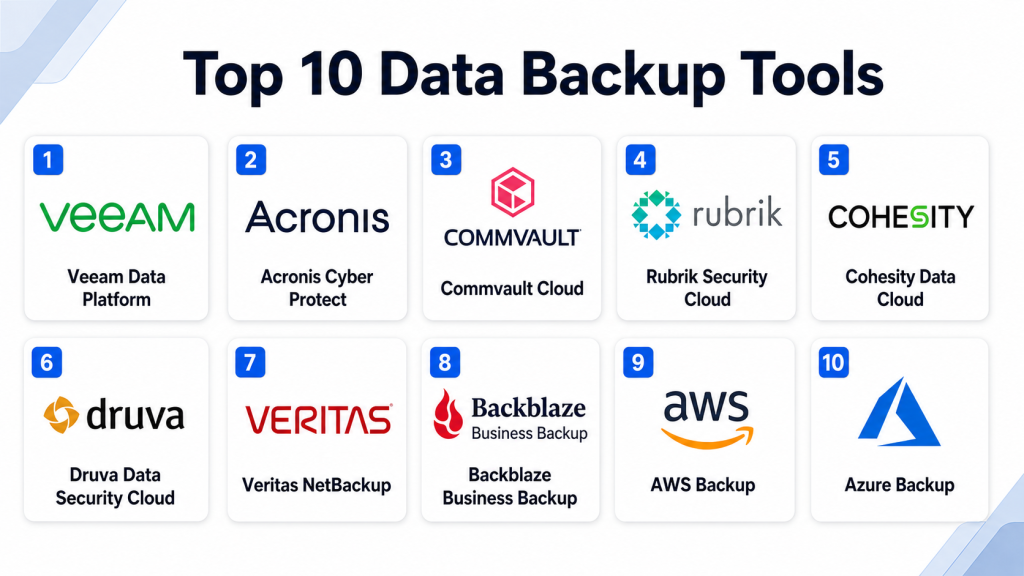
Top 10 Data Backup Tools
#1 — Veeam Data Platform
Short description: Veeam Data Platform is a widely used backup, recovery, and data protection solution for virtual machines, physical servers, cloud workloads, SaaS data, and hybrid environments. It is best suited for IT teams that need flexible restore options and broad workload coverage.
Key Features
- Backup and recovery for virtual, physical, cloud, and SaaS workloads.
- Immutable backup options for ransomware resilience.
- Instant recovery for supported workloads.
- Replication and disaster recovery support.
- Policy-based backup scheduling and retention.
- Monitoring, reporting, and alerting.
- Hybrid and multi-cloud workload protection.
Pros
- Strong for virtualized and hybrid infrastructure.
- Flexible recovery options for business-critical systems.
- Large ecosystem and strong administrator familiarity.
Cons
- Advanced architecture may require skilled backup planning.
- Licensing and storage design should be reviewed carefully.
- Smaller teams may not need the full platform depth.
Platforms / Deployment
Web / Windows / Linux
Cloud / Self-hosted / Hybrid
Security & Compliance
Supports encryption, RBAC, audit logs, immutable backup options, MFA options, and ransomware-focused recovery features. Specific compliance certifications should be verified with the vendor.
Integrations & Ecosystem
Veeam works well across cloud, virtualization, storage, and enterprise infrastructure environments. It is useful for teams managing mixed workloads and recovery requirements.
- VMware
- Microsoft Hyper-V
- Public cloud platforms
- Object storage
- SaaS workload protection
- Storage systems
Support & Community
Veeam provides strong documentation, enterprise support plans, partner support, training resources, and a large technical community.
#2 — Acronis Cyber Protect
Short description: Acronis Cyber Protect combines data backup, recovery, endpoint protection, anti-malware, and cyber protection in one platform. It is useful for SMBs, MSPs, and organizations that want backup and security in a single solution.
Key Features
- Backup for endpoints, servers, and selected workloads.
- Disk imaging and file-level recovery.
- Integrated anti-malware and cyber protection.
- Ransomware protection capabilities.
- Cloud backup storage options.
- Centralized management console.
- MSP-friendly multi-tenant administration.
Pros
- Combines backup and security features.
- Good fit for SMBs and managed service providers.
- Useful for endpoint-heavy environments.
Cons
- May feel broad for teams that only need simple backup.
- Advanced enterprise workload requirements should be validated.
- Pricing can vary based on storage, features, and deployment needs.
Platforms / Deployment
Web / Windows / macOS / Linux / iOS / Android
Cloud / Hybrid
Security & Compliance
Supports encryption, access controls, backup protection, anti-malware features, and ransomware-related defenses. Specific compliance certifications should be verified directly.
Integrations & Ecosystem
Acronis fits managed service, endpoint protection, and cloud backup environments where teams want backup and security workflows together.
- Endpoint protection tools
- Cloud storage
- MSP management workflows
- Virtualization platforms
- Business applications
- Remote management systems
Support & Community
Acronis provides documentation, partner resources, customer support, onboarding materials, and service-provider-focused enablement.
#3 — Commvault Cloud
Short description: Commvault Cloud is an enterprise data backup and recovery platform built for complex environments. It supports broad workload protection, cyber resilience, cloud backup, SaaS data protection, and disaster recovery.
Key Features
- Enterprise backup and recovery for multiple workloads.
- Cloud, SaaS, database, and virtual workload protection.
- Disaster recovery and recovery orchestration.
- Ransomware resilience features.
- Policy-based retention and automation.
- Compliance reporting and audit visibility.
- Broad integration with enterprise infrastructure.
Pros
- Strong enterprise feature depth.
- Broad workload coverage for complex environments.
- Useful for regulated and large-scale organizations.
Cons
- Can be complex for smaller teams.
- Implementation may require skilled administrators.
- Licensing and deployment architecture need careful review.
Platforms / Deployment
Web / Windows / Linux / Varies by workload
Cloud / Self-hosted / Hybrid
Security & Compliance
Supports encryption, RBAC, access controls, audit logs, ransomware recovery features, and compliance-oriented reporting. Specific compliance certifications should be verified with the vendor.
Integrations & Ecosystem
Commvault has a wide ecosystem across cloud, storage, database, virtualization, SaaS, and enterprise IT environments.
- Public cloud platforms
- Virtualization platforms
- Databases
- SaaS applications
- Object storage
- Enterprise identity tools
Support & Community
Commvault provides enterprise support, documentation, professional services, partner expertise, and onboarding resources.
#4 — Rubrik Security Cloud
Short description: Rubrik Security Cloud is a data security and backup platform focused on ransomware recovery, immutable backup, cloud data protection, and cyber resilience. It is best for organizations that treat backup as part of security strategy.
Key Features
- Enterprise backup and recovery.
- Immutable backup architecture.
- Ransomware investigation and recovery workflows.
- Cloud and SaaS workload protection.
- Data risk visibility.
- Policy-based backup automation.
- Recovery orchestration for critical workloads.
Pros
- Strong cyber recovery focus.
- Good fit for security-conscious enterprises.
- Useful for ransomware response planning.
Cons
- May be more advanced than basic backup needs.
- Cost and implementation should be evaluated carefully.
- Best value is usually in larger environments.
Platforms / Deployment
Web / Windows / Linux / Varies by workload
Cloud / Hybrid
Security & Compliance
Supports encryption, RBAC, audit logs, access controls, immutable backup, and ransomware recovery features. Specific compliance certifications should be verified directly with the vendor.
Integrations & Ecosystem
Rubrik connects backup, cloud, identity, and security operations workflows. It is useful for enterprises that need recovery aligned with cyber resilience.
- Public cloud platforms
- SaaS applications
- Virtualization platforms
- Identity providers
- Security operations tools
- Storage systems
Support & Community
Rubrik offers enterprise support, documentation, customer success resources, professional services, and partner guidance.
#5 — Cohesity Data Cloud
Short description: Cohesity Data Cloud provides data backup, recovery, cyber resilience, and data management across cloud, SaaS, and on-premises environments. It is designed for organizations that need scalable data protection.
Key Features
- Backup and recovery for enterprise workloads.
- Ransomware detection and recovery support.
- Immutable backup options.
- Cloud and SaaS workload protection.
- Centralized policy management.
- Disaster recovery capabilities.
- Data visibility and management features.
Pros
- Strong for large-scale data protection.
- Good blend of backup, recovery, and security capabilities.
- Useful for hybrid and cloud-first environments.
Cons
- May require careful deployment planning.
- Smaller teams may not need all capabilities.
- Storage design and licensing should be reviewed.
Platforms / Deployment
Web / Windows / Linux / Varies by workload
Cloud / Hybrid
Security & Compliance
Supports encryption, role-based access, audit logs, immutable backup options, and ransomware-focused recovery capabilities. Specific compliance certifications should be verified directly.
Integrations & Ecosystem
Cohesity fits organizations that need centralized backup across cloud, SaaS, storage, database, and enterprise workload environments.
- Public cloud platforms
- Virtualization systems
- SaaS applications
- Databases
- Object storage
- Security tools
Support & Community
Cohesity provides documentation, enterprise support, partner resources, customer success services, and technical guidance for complex environments.
#6 — Druva Data Security Cloud
Short description: Druva Data Security Cloud is a cloud-delivered data backup and recovery platform for endpoints, SaaS applications, cloud workloads, and enterprise data. It is useful for organizations that want simplified backup management without heavy infrastructure.
Key Features
- Cloud-native backup and recovery.
- SaaS, endpoint, and cloud workload protection.
- Centralized policy management.
- Long-term retention support.
- Ransomware recovery capabilities.
- Data visibility and governance features.
- Simplified administration through a cloud console.
Pros
- Reduces backup infrastructure management.
- Strong fit for cloud-first and distributed teams.
- Useful for SaaS and endpoint data protection.
Cons
- Not ideal for teams requiring full self-hosted control.
- Pricing should be reviewed based on data volume and retention.
- Internet connectivity and cloud design are important.
Platforms / Deployment
Web / Windows / macOS / Linux / Varies by workload
Cloud
Security & Compliance
Supports encryption, access controls, RBAC, audit visibility, and cloud-based data protection features. Specific compliance certifications should be verified with the vendor.
Integrations & Ecosystem
Druva is practical for teams that want cloud-delivered backup for endpoints, SaaS, and cloud workloads.
- SaaS applications
- Cloud platforms
- Endpoint systems
- Identity providers
- Security workflows
- Reporting tools
Support & Community
Druva offers documentation, onboarding resources, customer support, customer success services, and cloud backup guidance.
#7 — Veritas NetBackup
Short description: Veritas NetBackup is an enterprise backup and recovery platform for large organizations with complex infrastructure and strict recovery needs. It is known for broad workload support and mature enterprise capabilities.
Key Features
- Enterprise data backup and recovery.
- Support for physical, virtual, database, and cloud workloads.
- Long-term retention and archive support.
- Disaster recovery capabilities.
- Centralized policy management.
- Reporting and automation.
- Scalable architecture for large environments.
Pros
- Strong for large enterprise infrastructure.
- Broad workload coverage.
- Mature platform for complex backup needs.
Cons
- Can be complex to manage.
- May require specialized backup administrators.
- Smaller teams may find it too heavy.
Platforms / Deployment
Web / Windows / Linux / UNIX support may vary
Self-hosted / Hybrid / Cloud options may vary
Security & Compliance
Supports encryption, access controls, role-based administration, audit logs, and secure backup workflows. Specific compliance certifications should be verified directly.
Integrations & Ecosystem
Veritas NetBackup supports enterprise environments with diverse systems, databases, storage platforms, and cloud workloads.
- Enterprise databases
- Virtualization platforms
- Public cloud platforms
- Storage systems
- Operating systems
- Archive and retention systems
Support & Community
Veritas provides enterprise support, documentation, professional services, partner expertise, and a strong administrator knowledge base.
#8 — Backblaze Business Backup
Short description: Backblaze Business Backup is a cloud-based data backup tool for business computers and endpoint files. It is best for small businesses, freelancers, and teams that need simple backup without complex infrastructure.
Key Features
- Automatic backup for business computers.
- File-level backup and restore.
- Cloud-based storage model.
- Centralized business administration.
- Simple endpoint deployment.
- Easy restore workflows.
- Low-complexity backup management.
Pros
- Simple setup and administration.
- Good fit for small teams and endpoint backup.
- Lower complexity than enterprise backup platforms.
Cons
- Not designed for complex server or database recovery.
- Limited compared with full disaster recovery platforms.
- May not fit large regulated environments.
Platforms / Deployment
Web / Windows / macOS
Cloud
Security & Compliance
Supports encryption and account-level security features. Advanced compliance details are not publicly stated in all contexts and should be verified with the vendor.
Integrations & Ecosystem
Backblaze is strongest for straightforward endpoint and file backup rather than deep enterprise infrastructure integrations.
- Endpoint backup workflows
- Cloud storage
- File recovery
- Business admin console
- User management
- Storage-focused operations
Support & Community
Backblaze provides documentation, support resources, help articles, and a user-friendly knowledge base.
#9 — AWS Backup
Short description: AWS Backup is a managed backup service for protecting supported workloads inside Amazon Web Services. It is best for teams already running cloud infrastructure and applications in AWS.
Key Features
- Centralized backup policy management for AWS services.
- Automated backup scheduling.
- Backup vaults and retention controls.
- Cross-account and cross-region backup options.
- Restore support for supported workloads.
- Audit and reporting capabilities.
- Integration with AWS identity and governance controls.
Pros
- Strong fit for AWS-native environments.
- Reduces need for separate backup tools for supported AWS workloads.
- Works naturally with AWS governance and security services.
Cons
- Mainly focused on AWS workloads.
- Not a complete hybrid backup solution by itself.
- Feature coverage depends on supported AWS services.
Platforms / Deployment
Web
Cloud
Security & Compliance
Supports AWS identity controls, encryption options, access policies, backup vault controls, and audit visibility. Compliance coverage depends on AWS service configuration and customer requirements.
Integrations & Ecosystem
AWS Backup is tightly connected to AWS services and works well for cloud teams that want native backup policy control.
- AWS compute services
- AWS storage services
- AWS databases
- AWS identity services
- AWS monitoring
- AWS governance tools
Support & Community
AWS provides documentation, support plans, partner resources, and a large cloud practitioner community.
#10 — Azure Backup
Short description: Azure Backup is a Microsoft cloud backup service for Azure workloads, supported on-premises systems, and hybrid Microsoft environments. It is useful for teams already using Azure infrastructure.
Key Features
- Backup for Azure virtual machines and supported workloads.
- Centralized backup policy management.
- Recovery services vaults.
- Long-term retention options.
- Hybrid backup support through supported agents.
- Integration with Azure monitoring and security.
- Restore support for cloud and selected on-premises workloads.
Pros
- Strong fit for Azure-first organizations.
- Good integration with Microsoft cloud services.
- Useful for hybrid Microsoft environments.
Cons
- Best value is usually in Azure-based environments.
- May not cover every workload without additional tools.
- Storage and retention cost planning is important.
Platforms / Deployment
Web / Windows / Linux support varies by workload
Cloud / Hybrid
Security & Compliance
Supports encryption, RBAC, Azure identity controls, audit visibility, and recovery vault controls. Specific compliance details should be verified through Microsoft cloud documentation.
Integrations & Ecosystem
Azure Backup works well with Microsoft cloud, identity, infrastructure, monitoring, and hybrid environments.
- Azure virtual machines
- Azure storage
- Microsoft identity services
- Azure monitoring
- On-premises agents
- Hybrid cloud workflows
Support & Community
Microsoft provides documentation, support plans, partner services, and a large cloud administrator community.
Comparison Table (Top 10)
| Tool Name | Best For | Platform(s) Supported | Deployment | Standout Feature | Public Rating |
|---|---|---|---|---|---|
| Veeam Data Platform | Hybrid and virtualized environments | Windows, Linux, cloud workloads | Cloud / Self-hosted / Hybrid | Broad backup and fast recovery | N/A |
| Acronis Cyber Protect | SMBs, MSPs, endpoint-heavy teams | Windows, macOS, Linux, iOS, Android | Cloud / Hybrid | Backup combined with cyber protection | N/A |
| Commvault Cloud | Complex enterprise environments | Windows, Linux, SaaS, cloud workloads | Cloud / Self-hosted / Hybrid | Broad enterprise workload coverage | N/A |
| Rubrik Security Cloud | Enterprise cyber recovery | Windows, Linux, cloud workloads | Cloud / Hybrid | Security-focused data recovery | N/A |
| Cohesity Data Cloud | Large-scale data protection | Windows, Linux, SaaS, cloud workloads | Cloud / Hybrid | Scalable backup and data security | N/A |
| Druva Data Security Cloud | Cloud-first backup teams | Windows, macOS, Linux, SaaS, cloud workloads | Cloud | SaaS-delivered backup management | N/A |
| Veritas NetBackup | Large enterprise infrastructure | Windows, Linux, UNIX, cloud workloads | Self-hosted / Hybrid / Varies | Mature enterprise backup platform | N/A |
| Backblaze Business Backup | Small business endpoint backup | Windows, macOS | Cloud | Simple cloud backup for business computers | N/A |
| AWS Backup | AWS-native workloads | AWS-supported services | Cloud | Native AWS backup policy control | N/A |
| Azure Backup | Azure and Microsoft environments | Azure workloads, Windows, Linux | Cloud / Hybrid | Native Azure backup and recovery | N/A |
Evaluation & Scoring of Data Backup Tools
| Tool Name | Core (25%) | Ease (15%) | Integrations (15%) | Security (10%) | Performance (10%) | Support (10%) | Value (15%) | Weighted Total (0–10) |
|---|---|---|---|---|---|---|---|---|
| Veeam Data Platform | 9 | 8 | 9 | 8 | 9 | 9 | 8 | 8.55 |
| Acronis Cyber Protect | 8 | 8 | 7 | 8 | 8 | 8 | 8 | 7.85 |
| Commvault Cloud | 10 | 7 | 9 | 9 | 9 | 9 | 7 | 8.65 |
| Rubrik Security Cloud | 9 | 8 | 8 | 9 | 9 | 8 | 7 | 8.30 |
| Cohesity Data Cloud | 9 | 8 | 8 | 9 | 9 | 8 | 7 | 8.30 |
| Druva Data Security Cloud | 8 | 9 | 8 | 8 | 8 | 8 | 8 | 8.15 |
| Veritas NetBackup | 10 | 6 | 9 | 8 | 9 | 8 | 7 | 8.20 |
| Backblaze Business Backup | 6 | 9 | 6 | 7 | 7 | 7 | 9 | 7.10 |
| AWS Backup | 8 | 8 | 8 | 8 | 8 | 8 | 8 | 8.00 |
| Azure Backup | 8 | 8 | 8 | 8 | 8 | 8 | 8 | 8.00 |
These scores are comparative and should be used as a decision-support guide, not a universal ranking. A small business may prefer Backblaze for simple endpoint backup, while a large enterprise may need Commvault, Veeam, Rubrik, Cohesity, or Veritas. Cloud-native teams may prefer AWS Backup or Azure Backup when most workloads already run inside those platforms.
Which Data Backup Tool Is Right for You?
Solo / Freelancer
Solo professionals usually need simple automatic backup for laptops, files, and important project data. Backblaze Business Backup is practical for simple endpoint protection. Acronis Cyber Protect may be useful if the user also wants endpoint security features along with backup.
For technical freelancers running workloads in public cloud platforms, AWS Backup or Azure Backup may be suitable if all important workloads are already inside those environments.
SMB
SMBs should prioritize simple setup, predictable pricing, endpoint protection, file restore, ransomware resilience, and easy administration. Acronis Cyber Protect, Backblaze Business Backup, Druva, Veeam, AWS Backup, and Azure Backup can all fit different SMB scenarios.
If the business only needs file and endpoint backup, simpler tools may be enough. If it runs servers, databases, virtual machines, or customer-facing applications, Veeam, Acronis, or Druva may be better choices.
Mid-Market
Mid-market teams usually need stronger policy management, more workload coverage, reporting, monitoring, security controls, and restore testing. Veeam, Druva, Acronis, Rubrik, Cohesity, and Commvault can be strong options.
Mid-market buyers should not only test whether backups complete successfully. They should test whether the tool can restore real workloads quickly and reliably.
Enterprise
Enterprises should focus on scalability, governance, workload coverage, immutable backup, audit logs, role-based access, recovery orchestration, cloud support, and compliance reporting. Commvault, Veeam, Rubrik, Cohesity, and Veritas NetBackup are strong enterprise options.
Large organizations should also validate backup isolation, recovery testing, clean recovery points, support quality, storage architecture, and data retention controls.
Budget vs Premium
Budget-focused teams may prefer Backblaze Business Backup, native cloud backup tools, or carefully scoped Acronis and Veeam deployments. Premium buyers with complex workloads, compliance needs, cyber resilience goals, and multi-cloud infrastructure may prefer Commvault, Rubrik, Cohesity, Veritas, or enterprise-grade Veeam deployments.
The true cost should include licensing, storage, retention, restore cost, support, admin time, and downtime risk.
Feature Depth vs Ease of Use
For feature depth, Commvault, Veritas NetBackup, Veeam, Rubrik, and Cohesity are strong. For ease of use, Backblaze, Druva, Acronis, AWS Backup, and Azure Backup may feel more approachable depending on workload type.
A simpler tool is not always weaker. If it protects the right data and restores it quickly, it may be the better operational choice.
Integrations & Scalability
Veeam is strong across virtualization, cloud, and hybrid environments. Commvault and Veritas fit complex enterprises. Rubrik and Cohesity are strong for security-led recovery and scalable data protection. Druva is practical for cloud-delivered backup operations. AWS Backup and Azure Backup are best when workloads already live inside those cloud ecosystems.
Scalability should be tested using real data volumes, real restore workflows, retention policies, and backup windows.
Security & Compliance Needs
Security-focused buyers should evaluate immutable backups, encryption, MFA, RBAC, audit logs, clean recovery points, anomaly detection, backup isolation, and retention controls. Regulated organizations should request official vendor documentation and confirm whether the tool supports internal governance needs.
A strong data backup tool should protect against technical failure, human error, and malicious activity.
Frequently Asked Questions (FAQs)
1. What is a data backup tool?
A data backup tool creates copies of important files, systems, applications, databases, or cloud workloads. These copies can be restored after deletion, corruption, failure, cyberattack, or outage.
2. How is backup different from file sync?
File sync keeps files updated across devices, but it can also sync mistakes, deletions, or corrupted files. Backup is designed for recovery, retention, version history, and data protection.
3. How much do data backup tools cost?
Pricing varies by vendor, storage volume, number of users, devices, workloads, retention period, and support level. Some tools charge by device, user, workload, storage, or custom enterprise agreement.
4. What is immutable backup?
Immutable backup means backup data cannot be changed or deleted for a defined retention period. This helps protect backups from ransomware, accidental deletion, and unauthorized changes.
5. Can backup tools protect against ransomware?
Backup tools can help recover from ransomware if backups are isolated, encrypted, immutable, and tested. However, backup is only one part of a broader security strategy.
6. What are common backup mistakes?
Common mistakes include not testing restores, protecting only some workloads, using weak access controls, ignoring retention rules, relying only on file sync, and failing to monitor backup failures.
7. How often should data be backed up?
Backup frequency depends on how much data loss the business can tolerate. Critical systems may require frequent backups, while less critical data may need less frequent protection.
8. What is recovery time?
Recovery time is how long it takes to restore data, systems, or applications after a failure. Buyers should test recovery time before trusting a backup platform.
9. What is recovery point?
Recovery point is the amount of data that may be lost between the last backup and the failure event. Shorter recovery points usually require more frequent backups.
10. Can data backup tools protect SaaS apps?
Yes, many modern backup tools protect SaaS applications such as email, collaboration platforms, CRM systems, and productivity tools. Buyers should confirm exact app support before purchase.
Conclusion
Data Backup Tools are essential for protecting business continuity, reducing downtime, and recovering from accidental deletion, ransomware, system failure, cloud issues, and human error. The best tool depends on workload type, company size, security needs, cloud strategy, recovery expectations, budget, and internal technical skills. Veeam, Commvault, Rubrik, Cohesity, and Veritas are strong options for complex and enterprise-grade environments. Druva is useful for cloud-delivered backup operations, while Acronis works well for SMBs and MSPs that want backup with security features. AWS Backup and Azure Backup are practical for cloud-native workloads, while Backblaze Business Backup is suitable for simple endpoint backup. The best next step is to shortlist two or three tools, test backup and restore with real workloads, validate security controls, compare storage costs, and confirm that recovery performance matches business expectations.
