Upgrade & Secure Your Future with DevOps, SRE, DevSecOps, MLOps!
We spend hours scrolling social media and waste money on things we forget, but won’t spend 30 minutes a day earning certifications that can change our lives.
Master in DevOps, SRE, DevSecOps & MLOps by DevOps School!
Learn from Guru Rajesh Kumar and double your salary in just one year.
Introduction
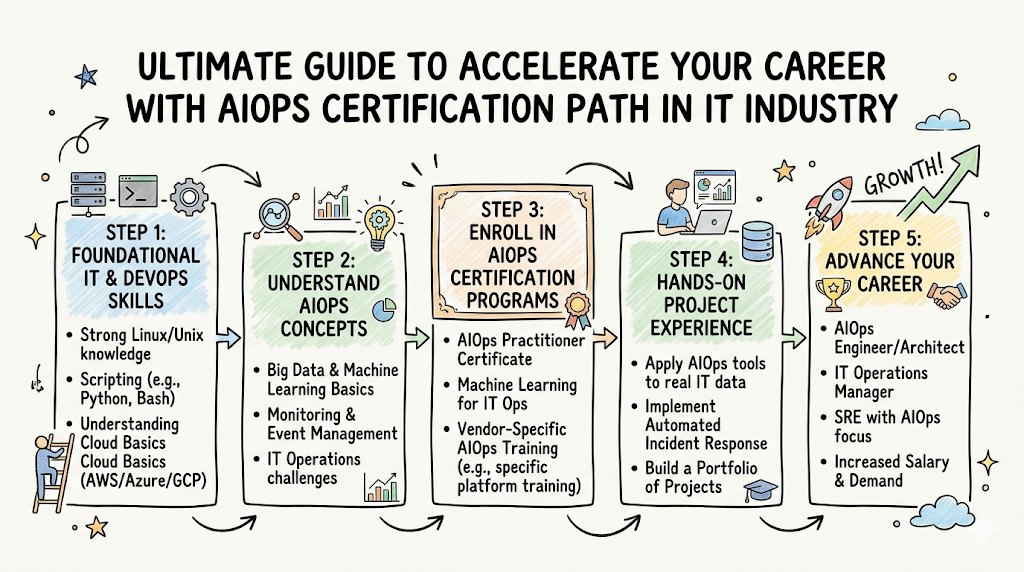
The Certified AIOps Architect program is a specialized validation designed for professionals who want to master the intersection of artificial intelligence and IT operations. This guide is built for engineers and managers who recognize that manual monitoring and traditional reactive troubleshooting are no longer sufficient for modern, hyper-scale environments. By focusing on the practical application of machine learning within the DevOps and SRE frameworks, this certification helps individuals bridge the gap between data science and infrastructure management.
Professionals moving through this guide will understand how to transition from traditional monitoring to proactive, AI-driven observability. Whether you are a cloud architect looking to optimize costs or an SRE aiming to reduce Mean Time to Recovery (MTTR), this roadmap provides the clarity needed to advance. By pursuing this track through AIOpsSchool, you are positioning yourself at the forefront of the next evolution in platform engineering, ensuring your skills remain relevant as enterprises increasingly adopt automated, self-healing systems.
What is the Certified AIOps Architect?
The Certified AIOps Architect represents a professional standard for individuals capable of designing and implementing AI-driven operational workflows. It exists because modern distributed systems generate more telemetry data than human operators can realistically analyze in real-time. This certification validates your ability to use algorithmic approaches to identify patterns, detect anomalies, and automate incident response across complex multi-cloud environments.
Unlike theoretical data science courses, this program focuses heavily on production-focused learning and real-world application. It aligns with modern engineering workflows by teaching professionals how to integrate AI models into existing CI/CD pipelines and monitoring stacks. For enterprises, having a certified architect ensures that their AIOps strategy is not just about buying tools, but about building a sustainable ecosystem that improves system reliability and reduces operational fatigue for engineering teams.
Who Should Pursue Certified AIOps Architect?
This certification is ideal for senior DevOps engineers, Site Reliability Engineers (SREs), and Cloud Architects who are responsible for the uptime and performance of large-scale applications. It is equally beneficial for Security Engineers who wish to use AI for threat detection and Data Engineers who want to understand how their models behave in a live operational environment. Engineering managers and technical leaders should pursue this to better understand the ROI of AI investments and how to restructure their teams for an AI-first operational culture.
Beginners with a strong foundation in Linux, networking, and basic automation will find this a challenging but rewarding path to leapfrog into high-demand roles. For experienced engineers in India and global tech hubs, it serves as a powerful differentiator in a crowded job market. As organizations worldwide move toward autonomous operations, being a certified architect proves you have the technical depth to lead these complex digital transformation initiatives.
Why Certified AIOps Architect is Valuable in the Current Era and Beyond
The demand for AIOps professionals is surging as enterprise adoption of cloud-native technologies hits an all-time high. Traditional monitoring tools often create alert fatigue, leading to missed critical issues; this certification teaches you how to suppress noise and focus on meaningful signals. It provides longevity to your career by teaching you the underlying principles of algorithmic operations, which remain constant even as specific software tools evolve or go out of fashion.
Furthermore, it offers a high return on time and career investment by addressing the most expensive part of IT: downtime. Organizations are willing to pay a premium for architects who can demonstrate a measurable reduction in MTTR and an increase in system availability through intelligent automation. Staying relevant in today’s market requires moving beyond keeping the lights on and toward building systems that can learn and adapt, which is exactly what this certification facilitates.
Certified AIOps Architect Certification Overview
The program is delivered via the official portal and is hosted on the AIOpsSchool platform. It is structured as a comprehensive learning journey that moves from foundational concepts to advanced architectural design. The assessment approach is practical, often requiring candidates to demonstrate their skills through lab-based scenarios or project evaluations rather than simple multiple-choice questions.
The ownership of the certification lies with industry experts who ensure the curriculum is updated to reflect the latest trends in generative AI for operations and advanced observability. It is divided into logical levels—Foundation, Professional, and Architect—allowing professionals to progress at their own pace. This tiered structure ensures that you build a solid theoretical base before moving into the complexities of model deployment, data ingestion, and automated remediation.
Certified AIOps Architect Certification Tracks & Levels
The certification is organized into three distinct levels to cater to different stages of professional growth. The Foundation level introduces the core concepts of AIOps, including data types, basic anomaly detection, and the role of machine learning in operations. It is designed for those new to the field or managers who need a high-level understanding of the technology stack and its business benefits.
The Professional level dives deeper into implementation, focusing on specific tracks such as SRE-driven AIOps or FinOps-focused optimization. At this stage, engineers learn to configure tools, manage data pipelines, and integrate AI insights into existing workflows. The Advanced or Architect level is the pinnacle, where the focus shifts to designing end-to-end autonomous systems, governance, scaling AI models across the enterprise, and leading large-scale cultural shifts toward AIOps.
Complete Certified AIOps Architect Certification Table
| Track | Level | Who it’s for | Prerequisites | Skills Covered | Recommended Order |
| AIOps Foundation | Associate | Beginners & Managers | Basic IT Knowledge | Observability basics, AI terminology | 1st |
| AIOps Implementation | Professional | SREs & DevOps Engineers | Foundation Cert | Pattern discovery, Alert correlation | 2nd |
| AIOps Architecture | Advanced | Principal Engineers | Professional Cert | Designing self-healing systems | 3rd |
| FinOps AI | Specialist | Cloud Economists | Basic Cloud Finance | AI-driven cost forecasting | Optional |
| SecOps AI | Specialist | Security Analysts | Basic Cyber Security | Anomaly-based threat hunting | Optional |
Detailed Guide for Each Certified AIOps Architect Certification
Certified AIOps Architect – Foundation Level
What it is
This certification validates a candidate’s understanding of the fundamental principles of AI-driven operations. It covers the vocabulary, the necessity of AIOps in modern infrastructure, and the high-level architecture of intelligent monitoring systems.
Who should take it
This is suitable for junior engineers, non-technical managers, and stakeholders who want to understand how AI can transform their operational efficiency without getting bogged down in deep coding.
Skills you’ll gain
- Understanding the difference between traditional monitoring and AIOps.
- Identifying different types of operational data (Logs, Metrics, Traces).
- Basic knowledge of how machine learning models assist in root cause analysis.
- Awareness of the AIOps tool landscape and vendor-neutral concepts.
Real-world projects you should be able to do
- Conduct a gap analysis of a traditional monitoring setup.
- Create a business case for adopting AIOps within a small team.
- Identify key performance indicators (KPIs) for an AI-driven operations project.
Preparation plan
- 7-14 Days: Focus on the official AIOpsSchool study guide and video modules.
- 30 Days: Supplement with reading industry whitepapers on observability.
- 60 Days: Not typically required for this level if you have a background in IT.
Common mistakes
- Overcomplicating the math behind AI instead of focusing on its application.
- Ignoring the cultural aspect of moving to automated operations.
Best next certification after this
- Same-track option: Certified AIOps Architect – Professional Level.
- Cross-track option: SRE Foundation.
- Leadership option: Digital Transformation Management.
Certified AIOps Architect – Professional Level
What it is
This certification proves that an engineer can implement and manage AIOps tools and workflows. It focuses on the technical integration of AI models into the daily tasks of an SRE or DevOps team.
Who should take it
Mid-level engineers, SREs, and Platform Engineers who are responsible for maintaining system reliability and want to automate their incident management processes.
Skills you’ll gain
- Configuring data ingestion pipelines for AI analysis.
- Implementing automated noise reduction and alert correlation.
- Setting up predictive scaling and capacity planning using AI.
- Building basic dashboards that highlight AI-driven insights.
Real-world projects you should be able to do
- Integrate an AIOps tool with a popular monitoring stack like Prometheus or ELK.
- Automate the suppression of flapping alerts in a production environment.
- Design a workflow that triggers an automated script based on an AI-detected anomaly.
Preparation plan
- 7-14 Days: Review technical documentation and hands-on lab exercises.
- 30 Days: Practice setting up sandboxed AIOps environments and data connectors.
- 60 Days: Deep dive into log aggregation and metric normalization techniques.
Common mistakes
- Failing to clean or normalize data before feeding it into AI models.
- Trusting AI suggestions blindly without setting up human-in-the-loop validation.
Best next certification after this
- Same-track option: Certified AIOps Architect – Advanced Level.
- Cross-track option: Certified MLOps Professional.
- Leadership option: Technical Program Management.
Certified AIOps Architect – Advanced (Architect) Level
What it is
The Architect level is the highest tier, certifying that the individual can design enterprise-wide AIOps strategies. It covers high-level system design, model governance, and long-term operational scaling.
Who should take it
Principal engineers, Lead Architects, and Technical Directors who are responsible for the overall technical strategy and infrastructure of an entire organization.
Skills you’ll gain
- Designing multi-tenant AIOps platforms for large enterprises.
- Establishing governance and ethical standards for autonomous operations.
- Advanced cost-benefit analysis for AI infrastructure.
- Orchestrating self-healing workflows across hybrid-cloud environments.
Real-world projects you should be able to do
- Architect a global observability platform that uses AI to manage cross-region failures.
- Develop a roadmap for transitioning an organization from manual to autonomous operations.
- Lead the evaluation and selection process for enterprise-grade AIOps vendors.
Preparation plan
- 7-14 Days: Review advanced architectural patterns and case studies.
- 30 Days: Engage in scenario-based design exercises and peer reviews.
- 60 Days: Comprehensive study of enterprise integration and security compliance in AI.
Common mistakes
- Focusing only on the technology while ignoring organizational silos.
- Designing black box systems that the ops team cannot understand or troubleshoot.
Best next certification after this
- Same-track option: None (Highest level).
- Cross-track option: Advanced FinOps Practitioner.
- Leadership option: CTO / VP Engineering Leadership programs.
Choose Your Learning Path
DevOps Path
The DevOps path focuses on integrating AI into the CI/CD pipeline to improve software delivery speed and quality. This involves using AI to predict build failures, analyze code quality trends, and automate deployment testing. Engineers on this path will use the certification to ensure that their automation is not just fast, but intelligent. The end goal is to create a NoOps environment where the pipeline can self-correct based on historical data.
DevSecOps Path
In the DevSecOps path, the emphasis is on using AI for proactive threat detection and automated security policy enforcement. By becoming a certified architect, security professionals learn to identify anomalous traffic patterns that signify a breach before it happens. This path bridges the gap between traditional security monitoring and modern AI-driven defense. It is ideal for those who want to build resilient systems that can automatically patch vulnerabilities or isolate compromised nodes.
SRE Path
The SRE path is perhaps the most direct application of AIOps principles, focusing heavily on reliability and availability. Architects in this path use AI to manage Service Level Objectives (SLOs) and Error Budgets with high precision. They focus on reducing toil by automating the remediation of repetitive incidents. This path ensures that the SRE team can manage increasingly complex microservices architectures without a linear increase in headcount.
AIOps Path
The dedicated AIOps path is for those who want to become specialists in the field of intelligent operations. This focuses on the core mechanics of operational AI, including data lake management, algorithm selection, and model training for time-series data. It is a deep dive into the technology itself, rather than its application to other fields. Professionals here often find themselves building the internal platforms that the rest of the engineering organization uses to maintain 24/7 availability.
MLOps Path
The MLOps path is designed for engineers who want to manage the lifecycle of machine learning models in production. This involves ensuring that the models used for AIOps are themselves reliable, accurate, and scalable. By taking the architect certification, MLOps professionals learn how to treat models as first-class citizens in the production environment. This path is critical for ensuring that AI-driven insights remain trustworthy over time as data patterns shift and drift occurs.
DataOps Path
DataOps focuses on the health and flow of the data that fuels the AIOps engine. A certified architect in this path ensures that the telemetry data is high-quality, delivered in real-time, and properly formatted for analysis. This involves building robust data pipelines and managing the storage costs of massive operational datasets. It is a foundational path because, without clean data, the most advanced AIOps models will fail to provide actionable value.
FinOps Path
The FinOps path uses AI to bring financial accountability to the cloud. Architects on this path focus on using machine learning to predict cloud spend, identify waste, and suggest optimizations that humans might miss. This involves analyzing complex billing data and correlating it with infrastructure utilization. It is a high-value path for organizations looking to scale their cloud presence while maintaining strict control over their operational budgets and unit economics.
Role → Recommended Certified AIOps Architect Certifications
| Role | Recommended Certifications |
| DevOps Engineer | Foundation, Professional (Implementation) |
| SRE | Foundation, Professional, Advanced (Architect) |
| Platform Engineer | Foundation, Professional (Implementation) |
| Cloud Engineer | Foundation, Professional (Implementation) |
| Security Engineer | Foundation, SecOps AI Specialist |
| Data Engineer | Foundation, Professional (DataOps focus) |
| FinOps Practitioner | Foundation, FinOps AI Specialist |
| Engineering Manager | Foundation, Digital Leadership |
Next Certifications to Take After Certified AIOps Architect
Same Track Progression
Once you have achieved the Architect level, the focus should shift toward deep specialization in emerging technologies like Generative AI for Operations (GenAIOps). You might also look into vendor-specific advanced certifications for the tools your organization uses most. Staying in this track means becoming a thought leader, contributing to open-source AIOps projects, and staying current with the latest research in anomaly detection and autonomous systems that reduce operational overhead.
Cross-Track Expansion
After mastering AIOps, broadening your skills into MLOps or FinOps is a highly strategic move. Understanding how to manage the lifecycle of models or the financial implications of cloud infrastructure makes you a multi-dimensional leader. This cross-pollination of skills allows you to speak the language of different departments, making you an invaluable asset during large-scale digital transformations where technical, financial, and data concerns intersect at the enterprise level.
Leadership & Management Track
For those looking to move into people management or executive roles, the transition involves moving from how to why. Certifications in Technical Project Management, ITIL, or executive leadership programs are excellent follow-ups. These help you translate the technical successes of AIOps—like reduced MTTR or cost savings—into business value that C-suite executives care about. It prepares you for roles like VP of Infrastructure, CTO, or Head of Reliability where strategic vision is paramount.
Training & Certification Support Providers for Certified AIOps Architect
DevOpsSchool
DevOpsSchool is a leading global training provider that offers comprehensive support for various modern engineering certifications. They provide a mix of instructor-led sessions and self-paced content designed to help professionals master the complexities of DevOps and AIOps. Their curriculum is highly practical, focusing on the tools and methodologies that are currently in high demand across the tech industry. With a strong presence in India and the US, they offer localized support and a community of learners that helps candidates stay motivated throughout their certification journey. Their trainers are often industry veterans who bring real-world scenarios into the classroom, making the learning experience both engaging and relevant to daily job functions.
Cotocus
Cotocus specializes in high-end technical training for cloud-native technologies and site reliability engineering. They provide tailored bootcamps and certification prep courses that are specifically designed for working professionals who need to upskill quickly. Their approach to AIOps training involves deep dives into observability stacks and automated remediation workflows. Cotocus is known for its intensive hands-on labs, which ensure that students don’t just learn the theory but also gain the practical experience required to pass rigorous certification exams. They offer flexible learning schedules, making it easier for engineers to balance their professional responsibilities with their educational goals. Their commitment to technical excellence makes them a preferred partner for many enterprise-level training initiatives.
Scmgalaxy
Scmgalaxy is a well-established community and training hub that focuses on Software Configuration Management, DevOps, and now AIOps. They offer an extensive library of resources, including tutorials, videos, and practice exams that are invaluable for anyone pursuing the architect certification. Their training programs are structured to take a candidate from the very basics to advanced architectural design. Scmgalaxy also hosts webinars and community events where professionals can network and share best practices. Their support system is built around a vast knowledge base that is updated regularly to reflect changes in the industry. For candidates looking for a community-driven learning experience with plenty of reference material, Scmgalaxy is an excellent choice.
BestDevOps
BestDevOps focuses on providing premium training content for the most current and relevant certifications in the IT operations space. They pride themselves on having a curriculum that is curated by industry experts to ensure it meets the needs of modern enterprises. Their AIOps training modules cover everything from data ingestion to advanced machine learning applications in infrastructure. BestDevOps offers personalized mentoring, which is particularly helpful for candidates tackling the Advanced or Architect levels of certification. Their goal is to turn engineers into architects by teaching them how to think strategically about automation and reliability. The platform is user-friendly and designed to provide a seamless learning experience across various devices and formats.
devsecopsschool.com
While specializing in security, devsecopsschool.com provides essential training for those who want to integrate AI into their security operations. They understand that AIOps is a critical component of modern security, enabling faster threat detection and automated response. Their courses are designed to show how AI can be a force multiplier for security teams. They offer specialized tracks that combine security best practices with AIOps methodologies, making them a unique provider in the market. Their certification support includes comprehensive study guides and labs that focus on securing the AI pipeline itself. This is an ideal provider for professionals who want to ensure their AIOps journey is built on a foundation of robust security.
sreschool.com
sreschool.com is dedicated entirely to the principles of Site Reliability Engineering, making it a natural partner for the AIOps certification. They focus on the practical application of AI to reduce toil, manage SLOs, and improve system availability. Their training programs are built around the SRE handbook principles but updated for the AI-driven era. Candidates will find detailed courses on observability, incident management, and capacity planning. The school provides a focused environment where SREs can learn how to apply machine learning to their specific challenges. Their certification support is highly technical and aimed at engineers who are already working in high-availability environments and need to evolve their skill sets.
As the primary host and provider of the Certified AIOps Architect program, aiopsschool.com offers the most direct and comprehensive support. They own the curriculum and ensure that all training materials are perfectly aligned with the exam objectives. Their platform provides a holistic learning experience, including interactive labs, expert-led videos, and a dedicated support forum. Because they specialize exclusively in AIOps, their depth of knowledge in this niche is unparalleled. They offer various tracks for different career paths, ensuring that every professional can find a relevant starting point. For anyone serious about this certification, aiopsschool.com is the definitive source for the most accurate and up-to-date information and training.
dataopsschool.com
dataopsschool.com addresses the critical Data component of AIOps. They provide training that helps engineers manage the massive volumes of telemetry data required for effective machine learning. Their courses cover data engineering, pipeline automation, and data quality management. By supporting the AIOps certification path, they ensure that architects understand how to build the robust data foundations necessary for any AI project. Their training is essential for those who want to specialize in the backend infrastructure that powers intelligent operations. They provide practical tools and techniques for handling real-time data streams, which is a core skill for any modern AIOps professional looking to scale insights.
finopsschool.com
finopsschool.com focuses on the intersection of cloud finance and automated operations. As organizations look to AI to help control spiraling cloud costs, the training provided here becomes increasingly vital. They offer courses that show how AIOps can be used to forecast spending and automate cost-saving measures. Their support for the AIOps certification helps professionals understand the financial impact of their technical decisions. By combining infrastructure knowledge with financial literacy, they help produce architects who can deliver both technical excellence and business value. Their curriculum is designed for both engineers and finance professionals who need to collaborate effectively in a cloud-native world where efficiency is measured in currency.
Frequently Asked Questions (General)
- How difficult is the certification exam?
The difficulty increases with each level; Foundation is accessible for most IT professionals, while the Architect level requires deep technical and strategic design knowledge.
- What is the typical time commitment for preparation?
Most professionals spend between 30 to 60 days preparing for the Professional or Architect levels, depending on their prior experience with automation and telemetry.
- Are there any mandatory prerequisites?
The Foundation level has no strict prerequisites, but higher levels usually require passing the previous tier or demonstrating equivalent industry experience in operations.
- What is the ROI of this certification for my career?
Certified architects often see significant salary increases and are eligible for senior leadership roles in platform engineering, SRE, and cloud infrastructure departments.
- Is the exam based on specific tools like Splunk or Datadog?
The certification is designed to be vendor-neutral, focusing on the core principles and methodologies that apply to any AIOps toolset available in the market.
- Does the certification expire?
Most certifications in this field are valid for two to three years, after which recertification or continuing education credits are required to ensure skills remain current.
- Can I take the exam online?
Yes, the certification exams are typically offered through secure online proctoring platforms, allowing for global accessibility from any location with a stable connection.
- Is there a focus on specific cloud providers like AWS or Azure?
While examples may use major clouds, the architectural principles taught are applicable to hybrid and multi-cloud environments common in large enterprises.
- How does this differ from a standard AI or Machine Learning course?
Standard AI courses focus on general model building, whereas this focuses specifically on applying AI to IT infrastructure, observability, and operational workflows.
- Are there practice exams available?
Yes, support providers like AIOpsSchool and Scmgalaxy provide practice tests and mock scenarios to help you gauge your readiness before the final attempt.
- What kind of background is best for this certification?
A background in Linux, networking, and at least one scripting language like Python or Bash is highly beneficial for successfully navigating the technical tracks.
- Is this certification recognized globally?
Yes, the principles of AIOps are universal, and the certification is recognized by major enterprises and technology firms across the globe as a standard for operational excellence.
FAQs on Certified AIOps Architect
- What specific machine learning techniques are covered in the curriculum?
The program covers techniques suited for time-series data and log analysis, including clustering for alert correlation, regression for capacity forecasting, and various anomaly detection algorithms.
- How does the certification address the concept of human in the loop?
It teaches how to design systems where AI provides insights and recommendations, but humans retain final decision-making power for critical actions, ensuring safety and trust in automation.
- Can this certification help me if my company is still using legacy on-prem systems?
Absolutely, as the principles are valid for any data source. You will learn to ingest and analyze data from legacy servers and networking gear to improve their reliability.
- Is Python knowledge required for the Certified AIOps Architect exam?
While you do not need to be a professional developer, a working knowledge of Python is helpful for understanding how data is manipulated and how APIs are used for remediation.
- Does the course cover the ethics and governance of AI in operations?
Yes, the Architect level specifically addresses governance, ensuring that AI-driven decisions are transparent, auditable, and free from bias to meet enterprise compliance standards.
- How does AIOps specifically help with reducing alert fatigue?
The certification teaches techniques like alert deduplication and correlation, grouping hundreds of individual alerts into a single incident with a identified root cause for faster resolution.
- What is the role of Generative AI in the current AIOps curriculum?
The curriculum is evolving to include how Large Language Models can summarize incident logs and suggest remediation steps in plain English to speed up the troubleshooting process.
- Will this certification help me transition from a traditional SysAdmin role?
Yes, it provides a structured path to move from manual server management to building intelligent, autonomous systems, which is the key to longevity in modern IT infrastructure roles.
Final Thoughts
From a mentor’s perspective, the transition to AIOps is not just a trend; it is a necessity driven by the sheer scale of modern technology. We have reached a point where systems are too complex for humans to manage with dashboards and manual alerts alone. Investing your time in becoming a certified architect is a move toward future-proofing your career. It signals to employers that you understand both the traditional world of stable infrastructure and the modern world of intelligent, self-correcting systems.
However, you should pursue this certification with a practical mindset. The value lies not in the digital badge itself, but in your ability to apply these concepts to solve real downtime and efficiency problems. If you are willing to get your hands dirty with data, experiment with new automation patterns, and lead your team through a cultural shift, then this path is absolutely worth it. It is a challenging journey, but for those who complete it, the rewards in terms of professional standing and job satisfaction are substantial.
