Upgrade & Secure Your Future with DevOps, SRE, DevSecOps, MLOps!
We spend hours scrolling social media and waste money on things we forget, but won’t spend 30 minutes a day earning certifications that can change our lives.
Master in DevOps, SRE, DevSecOps & MLOps by DevOps School!
Learn from Guru Rajesh Kumar and double your salary in just one year.
Introduction
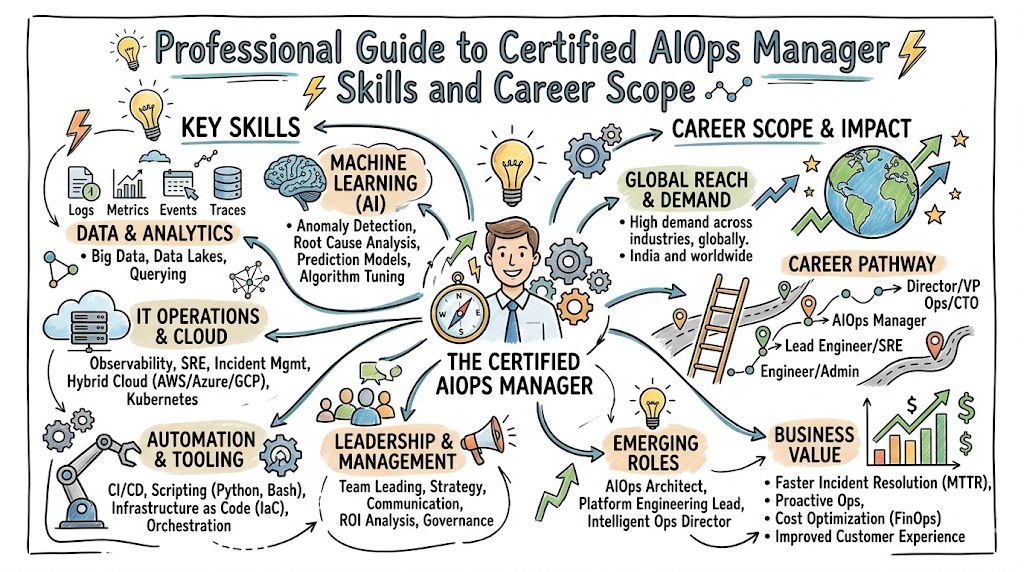
The Certified AIOps Manager program is a specialized track designed for leaders who want to master artificial intelligence in operations. This guide is built for engineers and managers who see the shift toward automated, intelligent systems and want to lead that transition. In the world of DevOps and platform engineering, manual intervention is becoming a bottleneck that only AI can solve.
By understanding this certification, you can make better decisions about where to spend your study time and how to grow your career. This guide explores how AIOps fits into the broader cloud-native ecosystem and why it is a critical skill for the next decade. Aiopsschool provides the framework needed to move from traditional monitoring to proactive, AI-driven management.
What is the Certified AIOps Manager?
The Certified AIOps Manager designation represents a professional’s ability to oversee complex IT environments using machine learning and data science. It exists because traditional rules-based systems cannot keep up with the massive volume of data generated by modern microservices. This program focuses on production-grade learning, moving beyond simple theory to focus on how AI actually keeps systems running.
It aligns perfectly with modern engineering workflows where speed and stability must coexist at scale. Instead of just reacting to alerts, an AIOps manager learns how to use data to predict and prevent outages. This focus on enterprise practices ensures that the skills learned are immediately applicable to large-scale, real-world infrastructure environments.
Who Should Pursue Certified AIOps Manager?
This path is ideal for SREs, DevOps engineers, and cloud architects who are already managing distributed systems and want to add intelligence to their stack. Security and data professionals will also find it useful as they look to automate threat detection and data pipeline health. It is not just for individual contributors; engineering managers and technical leaders need this knowledge to build future-ready teams.
In India and across the global market, companies are searching for leaders who can reduce operational noise and improve system reliability. Beginners with a strong interest in automation can use this to differentiate themselves, while experienced veterans can use it to modernize their toolkit. It provides a clear roadmap for anyone responsible for the uptime and performance of digital services.
Why Certified AIOps Manager is Valuable and Beyond
The demand for AIOps skills is growing as enterprises realize that human-only operations do not scale with cloud growth. This certification offers long-term value because it teaches the principles of data-driven operations rather than just specific tool syntax. As tools change, the underlying logic of using machine learning for operational excellence remains a constant requirement.
Investing time in this program provides a high return because it positions you at the intersection of data science and systems engineering. Companies are heavily adopting these practices to lower their operational costs and improve customer experience. Staying relevant in this field requires moving toward high-level strategy and automated decision-making frameworks.
Certified AIOps Manager Certification Overview
The program is delivered via the official training portal and is hosted on the main website. It features a tiered assessment approach that validates both conceptual understanding and practical application of AI concepts in an operational context. The ownership of the program lies with industry experts who ensure the content remains aligned with current enterprise needs.
The structure is broken down into logical phases that allow a professional to start with the basics and move toward advanced management strategies. It is designed to be practical, focusing on how to integrate AI into existing CI/CD pipelines and monitoring stacks. This ensures that the certification is viewed as a badge of real-world competence by hiring managers.
Certified AIOps Manager Certification Tracks & Levels
The certification is divided into foundation, professional, and advanced levels to cater to different career stages. The foundation level builds the base knowledge of data patterns and basic automation, while the professional level dives deep into model integration. The advanced level is reserved for those who are designing entire AI-driven operational strategies for large organizations.
These tracks align with career progression, allowing a junior engineer to eventually grow into a principal or director role. Specialization options allow professionals to focus on areas like FinOps or DevSecOps through an AI lens. Each level ensures that the learner is gaining skills that match their current responsibilities while preparing them for the next step.
Complete Certified AIOps Manager Certification Table
| Track | Level | Who it’s for | Prerequisites | Skills Covered | Recommended Order |
| Core AIOps | Foundation | Aspiring AIOps Engineers | Basic Linux & Python | Pattern recognition, Data basics | 1 |
| Management | Professional | Team Leads & Managers | Foundation level | Model selection, Noise reduction | 2 |
| Strategy | Advanced | Architects & Directors | Professional level | Strategy, ROI analysis, Governance | 3 |
Detailed Guide for Each Certified AIOps Manager Certification
Certified AIOps Manager – Foundation Level
What it is
This level validates that a professional understands the core pillars of AI-driven operations and can identify data patterns. It proves the ability to move away from legacy monitoring and toward basic algorithmic observation.
Who should take it
Junior engineers, system administrators, and those new to the field of AIOps should start here. It is for anyone who needs to understand the reasons for using AI in IT operations.
Skills you’ll gain
- Understanding of noise reduction in alerting systems.
- Basic data ingestion and normalization techniques.
- Familiarity with common machine learning algorithms used in IT.
- Ability to map traditional metrics to AI-ready data points.
Real-world projects you should be able to do
- Configure a basic anomaly detection dashboard.
- Identify and filter redundant alerts in a staging environment.
- Document a data flow for an operational machine learning model.
Preparation plan
- 7–14 days: Focus on understanding the core terminology and basic data science concepts.
- 30 days: Engage with practical labs and start mapping current company metrics to AI models.
- 60 days: Conduct a deep dive into statistical analysis and complete all practice assessments.
Common mistakes
- Ignoring the importance of data quality before applying AI models.
- Trying to automate complex tasks before mastering simple pattern recognition.
Best next certification after this
- Same-track option: Professional AIOps Manager.
- Cross-track option: Cloud Infrastructure Specialist.
- Leadership option: Team Lead Foundations.
Certified AIOps Manager – Professional Level
What it is
This certification validates the ability to implement and manage AI models within a live production environment. It focuses on the practical integration of AI tools with existing DevOps and SRE workflows.
Who should take it
Mid-level engineers and senior admins who are responsible for maintaining system uptime and improving operational efficiency. It is for those who are building the actual automation.
Skills you’ll gain
- Advanced root cause analysis using correlation engines.
- Implementing predictive scaling for cloud resources.
- Managing the lifecycle of operational machine learning models.
- Automating incident response through intelligent triggers.
Real-world projects you should be able to do
- Deploy an automated incident remediation workflow.
- Create a predictive capacity planning model for a Kubernetes cluster.
- Integrate an AI-based log analyzer into a production pipeline.
Preparation plan
- 7–14 days: Review professional-level case studies and complex architecture diagrams.
- 30 days: Focus on hands-on integration tasks and testing API connections.
- 60 days: Perform full-scale simulation exams and refine troubleshooting skills for AI models.
Common mistakes
- Over-relying on the AI without keeping human-in-the-loop safeguards.
- Failing to monitor the performance of the AI models themselves.
Best next certification after this
- Same-track option: Advanced AIOps Strategist.
- Cross-track option: Senior DevSecOps Engineer.
- Leadership option: Technical Project Manager.
Choose Your Learning Path
DevOps Path
The DevOps path focuses on integrating AI into the software delivery lifecycle to speed up releases. Professionals here use AI to predict build failures and optimize testing suites. The goal is to ensure that the CI/CD pipeline is not just fast, but also intelligent and self-correcting. This path is essential for those who want to reduce the friction between development and operations teams.
DevSecOps Path
In this path, AI is used to identify security vulnerabilities and unusual traffic patterns in real-time. It moves beyond static scanning to dynamic, behavior-based threat detection that adapts to new risks. Professionals learn how to automate the blocking of malicious actors without human intervention. This is a critical area for protecting large-scale cloud applications from sophisticated attacks.
SRE Path
The Site Reliability Engineering path uses AI to manage error budgets and improve the accuracy of Service Level Objectives. It focuses heavily on noise reduction and automated root cause analysis to keep recovery times as low as possible. Professionals on this path build systems that can heal themselves before a user even notices an issue. This leads to much higher system availability and better performance.
AIOps Path
This is the core path dedicated to the complete overhaul of traditional IT operations using data science. It covers the entire journey from data collection to automated action across all infrastructure layers. Professionals become experts in selecting the right algorithms for different operational challenges. This path is the most direct route to becoming a leader in modern, intelligent operations.
MLOps Path
The MLOps path is specifically for those managing the infrastructure required to run machine learning models. It bridges the gap between data science and production engineering, ensuring models are deployed and monitored correctly. Professionals learn how to handle model drift and manage the heavy compute resources AI requires. This is a highly specialized field that is in high demand as companies move more AI into production.
DataOps Path
DataOps focuses on the health and reliability of the data pipelines that feed into AIOps and business intelligence tools. It applies DevOps principles to data management to ensure information is accurate and available when needed. Professionals learn how to automate data quality checks and manage complex data architectures. This path is vital because AI is only as good as the data it receives.
FinOps Path
The FinOps path uses AI to predict cloud spending and identify areas where costs can be optimized. It helps organizations manage their cloud budget by identifying orphaned resources and suggesting more efficient instance types. Professionals learn how to correlate engineering activity with financial impact in real-time. This path is becoming a priority for leadership as cloud bills continue to rise.
Role → Recommended Certified AIOps Manager Certifications
| Role | Recommended Certifications |
| DevOps Engineer | Foundation AIOps + DevOps Specialist |
| SRE | Professional AIOps + Reliability Expert |
| Platform Engineer | Advanced AIOps + Infrastructure Lead |
| Cloud Engineer | Foundation AIOps + Cloud Professional |
| Security Engineer | Professional AIOps + Security Specialist |
| Data Engineer | Foundation AIOps + DataOps Expert |
| FinOps Practitioner | Professional AIOps + Cost Specialist |
| Engineering Manager | Advanced AIOps + Leadership Track |
Next Certifications to Take After Certified AIOps Manager
Same Track Progression
Once the management aspect is mastered, the natural next step is to move toward architectural and strategic roles. This involves looking at the entire enterprise landscape and designing cross-departmental AI initiatives. Deep specialization in specific AI algorithms used for infrastructure is also a viable path. This ensures a professional remains the top technical authority on intelligent operations within the organization.
Cross-Track Expansion
Broadening skills into areas like DevSecOps or FinOps allows a professional to apply AIOps knowledge to different business problems. Having a diverse portfolio makes an engineer more resilient to market changes and technology shifts. For example, applying AI to security provides a unique value proposition that few professionals possess. This expansion creates a multi-dimensional engineer who can lead various technical teams.
Leadership & Management Track
Transitioning into leadership requires moving away from the keyboard and toward people and strategy. Certifications in technical management and business strategy complement an AIOps background by helping explain the return on investment to executives. Learners find out how to build teams, manage budgets, and align technical goals with business outcomes. This is the path for those who want to reach the director or CTO level.
Training & Certification Support Providers for Certified AIOps Manager
DevOpsSchool
DevOpsSchool provides a robust platform for professionals looking to gain deep technical skills in automation and cloud technologies. They offer a wide range of courses that are structured to help learners move from basic concepts to advanced production implementation. Their trainers are experienced in the field, ensuring that the curriculum reflects the latest trends and tools used in the industry. They focus on hands-on labs, which are essential for mastering the complex workflows found in modern enterprise environments. The support team is also very responsive, helping students navigate their learning journey effectively.
Cotocus
Cotocus is known for its specialized focus on niche technologies and high-level engineering certifications. They provide tailored training programs that help organizations upskill their teams in specific areas like AIOps and cloud-native architecture. Their approach is highly practical, focusing on the real-world challenges that engineers face every day. By providing detailed project work and expert guidance, they ensure that students are ready to handle the demands of a high-pressure production environment. Their reputation for technical depth makes them a preferred choice for senior engineers and architects looking for advanced growth.
Scmgalaxy
Scmgalaxy is a comprehensive resource for the DevOps and SRE community, offering a vast library of tutorials, guides, and certification paths. They have a long history of supporting engineers through the transition to modern development and operations practices. Their training programs are designed to be accessible yet thorough, covering everything from version control to automated intelligence. They are a go-to provider for those who want to stay updated with the latest community-driven best practices. The platform fosters a strong sense of community, allowing learners to share experiences and solve problems together.
BestDevOps
BestDevOps focuses on delivering high-quality, streamlined education for those who want to fast-track their career in automation. They emphasize the most critical skills needed to succeed in the current job market, avoiding unnecessary details that do not add value. Their certification support is designed to build confidence through repeated practice and clear explanations of complex topics. Many professionals choose them for their straightforward approach to learning and their focus on career-ready outcomes. They aim to get engineers certified and back into the field with new, applicable skills as quickly as possible.
devsecopsschool.com
This provider focuses specifically on the intersection of development, security, and operations. They offer deep-dive courses into how security can be integrated into every step of the software lifecycle using automation. Their curriculum is essential for anyone looking to specialize in protecting cloud-native applications. By teaching how to use AI and automation for threat detection, they prepare engineers for the high-stakes world of modern cybersecurity. Their programs are highly respected by security professionals who need to maintain safety in rapidly changing, automated environments.
sreschool.com
Sreschool.com is dedicated to the principles of Site Reliability Engineering, focusing on stability, scalability, and performance. Their training covers the essential metrics and methodologies needed to keep large-scale systems running smoothly. They provide detailed lessons on error budgets, monitoring, and incident response. This is the ideal place for engineers who want to master the art of maintaining reliable systems in a fast-paced digital environment. Their specialized focus ensures that learners get the most relevant information for their specific role as a reliability engineer.
Aiopsschool.com is a leading provider for those specifically looking to master artificial intelligence in operations. They offer the foundational and advanced certifications required to lead an AIOps transformation within a company. Their curriculum is built around the latest advancements in machine learning and data science as applied to IT infrastructure. They provide a clear and structured path for engineers who want to become experts in intelligent automation. Their expertise in this niche field makes them a top choice for those looking for the most current AIOps knowledge.
dataopsschool.com
Dataopsschool.com addresses the growing need for better data management within the technical stack. They teach the principles of automating data pipelines and ensuring data quality across the organization. Their courses are vital for anyone who understands that AI is only effective when supported by a solid data foundation. They provide the tools and techniques needed to treat data as a first-class citizen in the DevOps world. This focus on the “data” part of the equation is what sets them apart in the training landscape.
finopsschool.com
Finopsschool.com focuses on the critical area of cloud financial management and cost optimization. They help professionals understand how to manage the variable costs of the cloud using data and automation. Their training is essential for organizations looking to scale their infrastructure without losing control of their budget. By teaching how to apply AI to financial forecasting, they bridge the gap between engineering and finance. This specialization is increasingly important as companies look to prove the value and efficiency of their cloud investments.
Frequently Asked Questions (General)
- What is the average time needed to finish this program?
Most people finish within thirty to sixty days depending on their current experience level. Setting aside an hour or two each day is usually enough to stay on track and absorb the material.
- Is this certification difficult for someone without a data science background?
The foundation level is designed to bridge that gap by teaching the necessary basics first. Most engineers with a strong background in automation find the transition manageable with consistent study and practice.
- Are there any specific hardware requirements for the labs?
A standard laptop with a modern web browser and a stable internet connection is usually enough. Most of the practical labs are cloud-based, so you do not need a high-end machine to run the models.
- Does this program focus on specific tools or general principles?
The certification focuses on the core principles and methodologies of AIOps that apply to any toolset. This ensures that your skills remain valuable even if your company changes its software stack later on.
- How often does the certification need to be renewed?
Most professional certifications recommend a refresh every two to three years to stay current with technology. This ensures that your knowledge reflects the most recent advancements and best practices in the field.
- Is there a community or support network for students?
Yes, most providers offer access to forums and groups where you can interact with other learners. This networking is a valuable part of the professional growth process and helps with problem-solving.
- Can an engineering manager benefit from this technical certification?
Managers gain the ability to lead technical teams more effectively and make better strategic decisions. It provides the vocabulary and understanding needed to oversee complex AI projects and explain them to stakeholders.
- What is the return on investment for this certification?
Professionals often see benefits in terms of higher salary potential and access to more senior roles. The ability to reduce operational costs for a company is a highly valued skill that leads to growth.
- Should the SRE or AIOps track be taken first?
The SRE track provides a great foundation for understanding system reliability first. Taking them in sequence allows for a more holistic understanding of how to manage modern systems with intelligence.
- Are there hands-on labs included in the training?
The program emphasizes practical application, so labs are a core part of the experience. You will spend time configuring real-world scenarios to ensure you can apply what you learn in production.
- Why is this better than a general AI certification?
A general AI certification often lacks the context of IT operations and infrastructure challenges. This program is tailored specifically for the problems that DevOps and SRE teams face every day in the workplace.
- How does the assessment process work?
The assessment usually involves a mix of multiple-choice questions and practical scenarios. This ensures that you not only know the theory but can also apply it to solve common operational problems.
FAQs on Certified AIOps Manager
- What specific operational problems does the Certified AIOps Manager solve?
It primarily addresses alert fatigue, slow root cause analysis, and manual scaling issues. By using AI, managers can filter out the noise and focus on the small percentage of alerts that actually indicate a serious problem. This leads to faster resolution times and less burnout for engineering teams.
- How does this certification help with career growth into executive roles?
It demonstrates a strategic mindset and an understanding of high-level efficiency. Executives value leaders who can show measurable improvements in system uptime and operational costs through automation. By mastering AIOps, you prove that you can handle the scale and complexity required of a high-level director or CTO.
- Does the course cover how to manage the costs of AI infrastructure?
Yes, the management level includes sections on resource optimization for AI workloads. This helps ensure that the AI system itself does not become a financial burden on the company while trying to solve other problems.
- Will this certification teach how to build machine learning models from scratch?
The focus is more on selecting, integrating, and managing existing models for operational use. While you will learn how they work, the goal is to manage the operational outcome rather than being a pure data scientist.
- How does AIOps change the daily routine of a manager?
It shifts the focus from fire-fighting and manual reporting to high-level strategy and system optimization. Instead of reviewing lists of alerts, the manager reviews the performance of the automation and looks for long-term trends.
- Is knowledge of Python mandatory for this certification?
While not strictly mandatory for the foundation level, having a basic understanding of Python is very helpful. Most AIOps tools and scripts use Python, so being able to read it will make the labs much easier.
- Does the program cover ethical considerations in AI operations?
Yes, the advanced levels touch on governance and the ethical use of automated decision-making. It is important to ensure that the AI does not make biased or harmful decisions that could affect system safety.
- Can this certification be used for on-premise infrastructure as well?
Absolutely, the principles of data collection and pattern recognition apply to both cloud and on-premise environments. Any system that generates logs and metrics can benefit from an AIOps approach.
Final Thoughts
When looking at the landscape of modern infrastructure, it is clear that manual operations are no longer sustainable. The volume of data and the speed of releases require a new approach that only artificial intelligence can provide. This certification is a solid investment for anyone who wants to stay ahead of the curve and move into a leadership position. It is not about chasing a trend; it is about adopting the tools that will define the next generation of IT management.
For the serious professional, this path offers a clear way to differentiate yourself in a crowded market. It provides the technical depth and strategic outlook needed to solve real enterprise problems. If you are responsible for the reliability and performance of systems, understanding AIOps is not just an option—it is a requirement for future success. Taking the time to master these skills now will pay dividends throughout your career as the industry continues to evolve.
