Upgrade & Secure Your Future with DevOps, SRE, DevSecOps, MLOps!
We spend hours scrolling social media and waste money on things we forget, but won’t spend 30 minutes a day earning certifications that can change our lives.
Master in DevOps, SRE, DevSecOps & MLOps by DevOps School!
Learn from Guru Rajesh Kumar and double your salary in just one year.
Introduction
API gateways are tools that sit between client applications and backend services. In simple English, an API gateway works like a controlled entry point for APIs. It receives requests, checks security rules, routes traffic, applies limits, transforms requests when needed, and sends responses back to users or systems.
API gateways matter because modern applications depend on APIs, microservices, cloud services, mobile apps, partner integrations, and distributed systems. Without a gateway, teams may struggle with security, traffic control, observability, versioning, authentication, and service reliability.
Common use cases include securing public APIs, managing microservices traffic, connecting mobile apps to backend services, controlling partner API access, adding rate limits, monitoring API usage, and supporting hybrid cloud architecture.
Buyers should evaluate performance, security controls, deployment model, developer experience, API analytics, traffic management, service discovery, plugin ecosystem, Kubernetes support, pricing, support, and integration flexibility.
Best for: platform engineers, DevOps teams, backend developers, API product teams, cloud architects, security teams, enterprise IT teams, SaaS companies, fintech platforms, eCommerce companies, and organizations exposing APIs internally or externally.
Not ideal for: very small applications with only one or two simple APIs, teams without API scale problems, static websites, or projects where a lightweight reverse proxy or framework-level middleware is enough.
Key Trends in API Gateways Tools
- Cloud-native API management is becoming standard: Teams increasingly expect API gateways to work well with Kubernetes, containers, service mesh, cloud platforms, and automated deployment pipelines.
- Security-first API traffic control is now essential: Authentication, authorization, rate limiting, bot protection, token validation, mTLS, IP filtering, and threat detection are now central buying requirements.
- Gateway and service mesh boundaries are changing: Some teams use gateways for north-south traffic and service mesh tools for east-west traffic, while others want one platform that can support both patterns.
- AI and automation are entering API operations: Some platforms are adding automated policy recommendations, anomaly detection, AI-assisted documentation, traffic analysis, and faster troubleshooting support.
- Developer experience is a major differentiator: Good API gateways now need developer portals, API documentation, lifecycle workflows, versioning, testing support, and easy onboarding for internal and external developers.
- Hybrid and multi-cloud deployment is important: Many companies want one API gateway strategy across cloud, on-premises, Kubernetes, edge, and private environments.
- Observability is no longer optional: Logs, metrics, tracing, dashboards, usage analytics, error tracking, and latency monitoring are important for running APIs at scale.
- Policy-as-code is becoming more common: Platform teams want reusable, version-controlled gateway policies that fit into CI/CD and GitOps workflows.
- Usage-based pricing needs close review: API gateway costs may depend on requests, traffic, nodes, gateways, environments, users, or enterprise support plans.
- API monetization and partner ecosystems are growing: Larger businesses increasingly need usage plans, access tiers, developer portals, subscription keys, and partner onboarding workflows.
How We Selected These Tools
The API gateway tools in this list were selected based on practical API management needs, market recognition, feature depth, and fit across different company sizes.
- Market adoption and recognition among developers, platform teams, cloud architects, and enterprise API teams.
- Core gateway features such as routing, rate limiting, authentication, authorization, traffic control, and API lifecycle management.
- Support for REST, GraphQL, gRPC, WebSocket, or modern API patterns where relevant.
- Deployment flexibility across cloud, self-hosted, Kubernetes, edge, hybrid, and enterprise environments.
- Security posture signals such as access control, encryption, identity integration, mTLS, audit logs, and policy enforcement.
- Integration ecosystem with CI/CD, observability tools, identity providers, service mesh, Kubernetes, and cloud platforms.
- Reliability and performance suitability for production workloads.
- Developer experience through portals, documentation, testing, and onboarding workflows.
- Support quality, community strength, documentation, and enterprise assistance.
- Overall value based on scalability, governance, performance, and long-term platform fit.
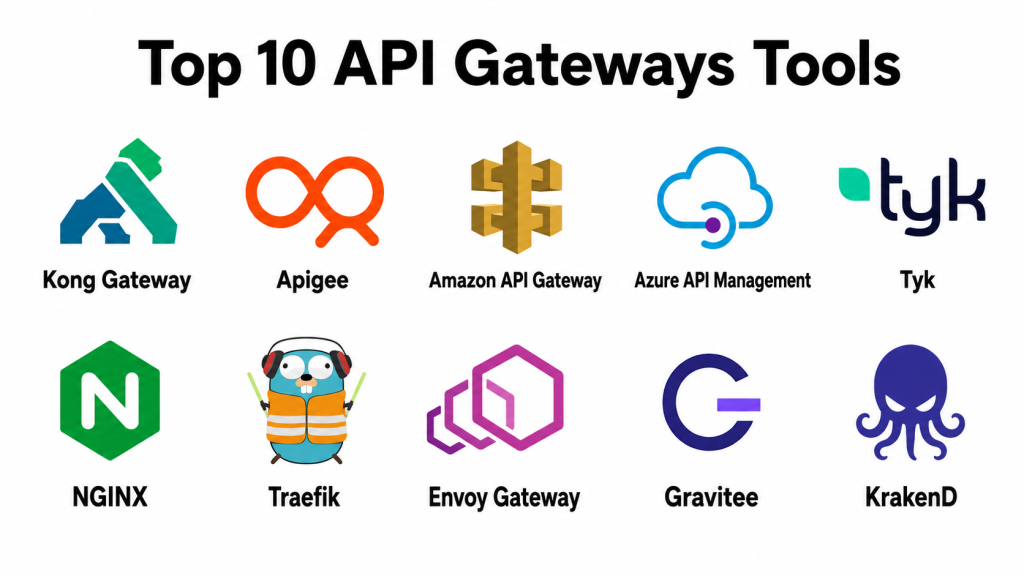
Top 10 API Gateways Tools
#1 — Kong Gateway
Short description: Kong Gateway is a widely used API gateway built for cloud-native, microservices, and distributed API environments. It is popular with platform teams that need high-performance traffic control, plugin-based extensibility, Kubernetes support, and flexible deployment options.
Key Features
- API routing, load balancing, and traffic control.
- Authentication, authorization, and rate limiting.
- Large plugin ecosystem for security, logging, transformation, and observability.
- Kubernetes-native deployment support.
- Service discovery and upstream management.
- Support for REST, GraphQL, gRPC, and modern API patterns.
- Enterprise features for governance, control plane management, and analytics.
Pros
- Strong open-source and enterprise ecosystem.
- Good fit for microservices and Kubernetes-heavy teams.
- Flexible plugin architecture supports many API use cases.
Cons
- Advanced operations may require gateway and platform engineering skills.
- Enterprise features may require paid plans.
- Plugin-heavy setups need governance to avoid complexity.
Platforms / Deployment
Web / Linux / Kubernetes.
Cloud / Self-hosted / Hybrid.
Security & Compliance
Kong supports common API security patterns such as authentication, authorization, rate limiting, mTLS, key-based access, and identity provider integrations. Enterprise compliance details such as SOC 2, ISO 27001, HIPAA, and GDPR should be confirmed directly with the vendor based on plan and deployment.
Integrations & Ecosystem
Kong has a strong API infrastructure ecosystem and works well in cloud-native environments where teams need traffic control, security, and observability.
- Kubernetes and container platforms.
- Identity providers.
- Observability tools.
- CI/CD workflows.
- Service mesh and microservices environments.
- Custom plugins and API extensions.
Support & Community
Kong has strong documentation, an active community, enterprise support options, and a broad ecosystem of plugins and implementation patterns. It is suitable for both developer-led and enterprise API programs.
#2 — Apigee
Short description: Apigee is an enterprise API management platform designed for organizations that need API security, lifecycle management, analytics, developer portals, monetization, and governance. It is best for large companies managing internal, external, partner, and revenue-generating APIs.
Key Features
- API gateway and full API lifecycle management.
- Developer portal and API product management.
- API analytics and traffic insights.
- Security policies, authentication, and access control.
- Quotas, rate limiting, and traffic shaping.
- API monetization and partner management capabilities.
- Hybrid and cloud deployment options.
Pros
- Strong enterprise API management depth.
- Good for API productization and partner ecosystems.
- Mature governance and analytics capabilities.
Cons
- Can be complex for small teams.
- Pricing may be high for simple API gateway needs.
- Requires proper API strategy and implementation planning.
Platforms / Deployment
Web.
Cloud / Hybrid.
Security & Compliance
Apigee supports enterprise-grade API security controls such as authentication, authorization, quota enforcement, traffic control, encryption, and policy management. Specific certifications, audit logs, SSO, RBAC, SOC 2, ISO 27001, GDPR, and HIPAA support should be verified based on deployment and contract.
Integrations & Ecosystem
Apigee fits well into enterprise cloud, API product, analytics, and partner ecosystems. It is useful when APIs are treated as managed business products.
- Identity providers.
- Cloud services.
- Developer portals.
- Analytics platforms.
- CI/CD systems.
- API monetization workflows.
Support & Community
Apigee provides enterprise documentation, professional services, implementation partners, training resources, and support options. It is best suited for companies with mature API programs.
#3 — Amazon API Gateway
Short description: Amazon API Gateway is a managed API gateway service for building, publishing, securing, monitoring, and scaling APIs in the AWS ecosystem. It is especially useful for serverless apps, microservices, Lambda-based backends, and cloud-native teams using AWS.
Key Features
- REST API and HTTP API support.
- WebSocket API support.
- Integration with serverless functions and AWS services.
- Authorization, throttling, and request validation.
- API stages and deployment management.
- Monitoring through AWS observability services.
- Managed scaling and availability within AWS.
Pros
- Strong fit for AWS-based applications.
- Good managed service for serverless and cloud-native APIs.
- Reduces gateway infrastructure management.
Cons
- Best value is inside AWS environments.
- Pricing and configuration can become complex at scale.
- Less flexible for teams wanting cloud-neutral deployment.
Platforms / Deployment
Web.
Cloud.
Security & Compliance
Amazon API Gateway supports AWS-native security patterns such as IAM, authorizers, encryption, logging, throttling, and access controls. Compliance depends on AWS services, region, configuration, and customer responsibilities. Confirm SOC 2, ISO 27001, GDPR, HIPAA, audit logging, and data handling needs through AWS documentation and internal review.
Integrations & Ecosystem
Amazon API Gateway works best when APIs connect with AWS services and serverless workloads.
- AWS Lambda.
- IAM and identity services.
- Cloud logging and monitoring.
- AWS service integrations.
- VPC and private integrations.
- CI/CD and infrastructure-as-code tools.
Support & Community
Amazon API Gateway has strong documentation, cloud community adoption, examples, and AWS support options. It is especially useful for teams already working inside AWS.
#4 — Azure API Management
Short description: Azure API Management is Microsoft’s API management service for securing, publishing, monitoring, and managing APIs across cloud and hybrid environments. It is a strong fit for organizations already using Azure, Microsoft identity services, and enterprise cloud architecture.
Key Features
- API gateway and API publishing.
- Developer portal support.
- Policy-based traffic control.
- Authentication, authorization, and subscription management.
- API analytics and monitoring.
- Support for hybrid API management scenarios.
- Integration with Azure services and identity tools.
Pros
- Strong fit for Microsoft and Azure environments.
- Useful developer portal and API lifecycle features.
- Good option for enterprise API governance.
Cons
- Best value is usually inside Azure-centered stacks.
- Policy configuration may require learning.
- Pricing should be reviewed carefully for scale and tiers.
Platforms / Deployment
Web.
Cloud / Hybrid.
Security & Compliance
Azure API Management supports Microsoft identity integrations, policy enforcement, subscription keys, authentication patterns, encryption, and access controls. Confirm SSO, MFA, RBAC, audit logs, GDPR, SOC 2, ISO 27001, HIPAA, and region-specific compliance with the vendor based on configuration and plan.
Integrations & Ecosystem
Azure API Management integrates naturally with Microsoft cloud and enterprise services.
- Azure identity services.
- Azure functions and app services.
- Monitoring and logging tools.
- Developer portals.
- CI/CD pipelines.
- Hybrid cloud architectures.
Support & Community
Azure API Management has strong documentation, Microsoft learning resources, enterprise support, and partner ecosystem coverage. It is best for Microsoft-centric organizations.
#5 — Tyk
Short description: Tyk is an API gateway and API management platform available in open-source, cloud, and enterprise deployment models. It is useful for teams that want flexible API gateway capabilities, developer portals, analytics, security policies, and hybrid deployment options.
Key Features
- API gateway and API management.
- Open-source and enterprise options.
- Rate limiting, quotas, and access policies.
- Developer portal and API catalog features.
- Authentication and authorization support.
- API analytics and monitoring.
- Cloud, self-managed, and hybrid deployment options.
Pros
- Flexible deployment choices.
- Good balance of open-source and enterprise capabilities.
- Useful for teams that want more control over gateway infrastructure.
Cons
- Self-hosted deployments require operational ownership.
- Advanced enterprise features may require paid plans.
- Teams need API management knowledge for best results.
Platforms / Deployment
Web / Linux / Kubernetes.
Cloud / Self-hosted / Hybrid.
Security & Compliance
Tyk supports API security features such as authentication, authorization, rate limiting, access policies, and traffic control. Specific enterprise security details such as SSO, RBAC, audit logs, SOC 2, ISO 27001, GDPR, and HIPAA should be verified directly with the vendor.
Integrations & Ecosystem
Tyk is suitable for organizations that need API gateway flexibility across cloud, self-hosted, and hybrid environments.
- Kubernetes.
- Identity providers.
- Observability tools.
- CI/CD workflows.
- Developer portals.
- API lifecycle tools.
Support & Community
Tyk has documentation, open-source community resources, enterprise support options, and implementation guidance. It is a strong option for teams that value deployment flexibility.
#6 — NGINX
Short description: NGINX is widely used as a web server, reverse proxy, load balancer, and API gateway component. It is suitable for teams that need high-performance traffic routing, API protection, load balancing, and edge gateway capabilities.
Key Features
- Reverse proxy and API gateway capabilities.
- Load balancing and traffic routing.
- TLS termination.
- Rate limiting and request control.
- High-performance web traffic handling.
- Integration with Kubernetes ingress patterns.
- Enterprise features available through commercial offerings.
Pros
- High performance and widely adopted.
- Strong for reverse proxy, load balancing, and API traffic routing.
- Flexible for many deployment environments.
Cons
- API management features may require additional tooling or enterprise editions.
- Developer portal and lifecycle management are not its main focus.
- Configuration requires technical expertise.
Platforms / Deployment
Linux / Windows / Kubernetes.
Cloud / Self-hosted / Hybrid.
Security & Compliance
NGINX can support TLS, access controls, rate limiting, authentication patterns, and traffic filtering depending on configuration and edition. Compliance details such as SOC 2, ISO 27001, GDPR, HIPAA, SSO, RBAC, and audit logs depend on deployment, management platform, and surrounding infrastructure.
Integrations & Ecosystem
NGINX works well across infrastructure, cloud, Kubernetes, and application delivery environments.
- Kubernetes ingress.
- Load balancing setups.
- Web application infrastructure.
- Observability tools.
- CI/CD workflows.
- Security and traffic management tools.
Support & Community
NGINX has a very large community, strong documentation, broad adoption, and enterprise support through commercial offerings. It is best for technical teams comfortable with infrastructure configuration.
#7 — Traefik
Short description: Traefik is a modern cloud-native edge router and reverse proxy often used as an API gateway and ingress controller. It is popular with container, Kubernetes, and microservices teams that want automatic service discovery and simpler dynamic routing.
Key Features
- Dynamic routing for microservices.
- Kubernetes ingress controller support.
- Automatic service discovery.
- TLS management.
- Middleware for authentication, rate limiting, and traffic rules.
- Dashboard and observability support.
- Cloud-native deployment patterns.
Pros
- Strong fit for Kubernetes and container environments.
- Easier dynamic configuration than many traditional proxies.
- Good for modern DevOps and platform teams.
Cons
- Full API lifecycle management may require additional tools.
- Enterprise governance features may require paid offerings.
- Not always the best fit for traditional enterprise API product management.
Platforms / Deployment
Linux / Docker / Kubernetes.
Cloud / Self-hosted / Hybrid.
Security & Compliance
Traefik supports TLS, middleware-based access control, authentication integrations, and traffic policies depending on setup. Specific compliance features such as SSO, RBAC, audit logs, SOC 2, ISO 27001, GDPR, and HIPAA should be confirmed based on edition and deployment model.
Integrations & Ecosystem
Traefik is well suited for cloud-native infrastructure where routing changes frequently and services are deployed dynamically.
- Kubernetes.
- Docker.
- Service discovery tools.
- Observability platforms.
- CI/CD workflows.
- Middleware extensions.
Support & Community
Traefik has strong open-source community adoption, documentation, examples, and commercial support options. It is especially popular with DevOps and Kubernetes teams.
#8 — Envoy Gateway
Short description: Envoy Gateway is built around Envoy Proxy and focuses on modern, Kubernetes-native gateway use cases. It is suitable for platform teams that need high-performance traffic management, extensibility, and cloud-native gateway patterns.
Key Features
- Kubernetes-native gateway implementation.
- Built on Envoy Proxy.
- Support for modern gateway API patterns.
- Traffic routing and policy control.
- Extensibility for service networking use cases.
- Strong fit for cloud-native infrastructure.
- Foundation for advanced traffic management patterns.
Pros
- Strong technical foundation through Envoy.
- Good fit for Kubernetes platform teams.
- Useful for teams adopting modern gateway standards.
Cons
- May require platform engineering expertise.
- Less beginner-friendly than managed API gateway services.
- Full API management features may need surrounding tools.
Platforms / Deployment
Linux / Kubernetes.
Self-hosted / Hybrid.
Security & Compliance
Security depends on configuration, Kubernetes setup, identity integration, traffic policies, and surrounding infrastructure. Confirm mTLS, RBAC, audit logging, encryption, compliance, and enterprise governance based on your implementation.
Integrations & Ecosystem
Envoy Gateway fits into modern Kubernetes and service networking environments where teams want flexible traffic management.
- Kubernetes Gateway API patterns.
- Envoy Proxy ecosystem.
- Service mesh environments.
- Observability tools.
- CI/CD and GitOps workflows.
- Platform engineering stacks.
Support & Community
Envoy has strong technical community adoption, documentation, and cloud-native ecosystem support. Envoy Gateway is best suited for teams comfortable with Kubernetes and platform engineering.
#9 — Gravitee
Short description: Gravitee is an API management and API gateway platform focused on managing, securing, publishing, and monitoring APIs. It supports API lifecycle workflows and is useful for organizations that need governance, developer portals, and policy-based API control.
Key Features
- API gateway and API management.
- Developer portal and API catalog.
- Access control and traffic policies.
- API analytics and monitoring.
- Support for event-driven and asynchronous API patterns in some offerings.
- Cloud and self-hosted deployment options.
- API lifecycle governance.
Pros
- Strong API management capabilities.
- Useful for organizations managing multiple API types.
- Flexible deployment model.
Cons
- May require platform knowledge for advanced setup.
- Smaller ecosystem than some very large cloud providers.
- Enterprise features may require commercial plans.
Platforms / Deployment
Web / Linux / Kubernetes.
Cloud / Self-hosted / Hybrid.
Security & Compliance
Gravitee supports API security policies, access control, rate limiting, and gateway-level protection. Confirm SSO, MFA, RBAC, audit logs, encryption, SOC 2, ISO 27001, GDPR, HIPAA, and compliance requirements directly with the vendor.
Integrations & Ecosystem
Gravitee works well for teams that want API management across multiple teams, services, and API types.
- Identity providers.
- Developer portals.
- Observability tools.
- Kubernetes.
- CI/CD workflows.
- API lifecycle systems.
Support & Community
Gravitee provides documentation, community resources, enterprise support, and implementation guidance. It is suitable for teams that need full API management without relying only on one cloud provider.
#10 — KrakenD
Short description: KrakenD is a high-performance API gateway focused on aggregation, transformation, and backend-for-frontend patterns. It is useful for teams that need a lightweight, efficient gateway layer to combine services and deliver optimized APIs.
Key Features
- API aggregation and composition.
- Backend-for-frontend support.
- Request and response transformation.
- Rate limiting and traffic control.
- High-performance gateway architecture.
- Stateless design.
- Open-source and enterprise options.
Pros
- Strong for API aggregation and performance-focused use cases.
- Useful for building clean frontend-facing APIs.
- Lightweight compared with larger API management platforms.
Cons
- Less focused on full API lifecycle management.
- Developer portal and monetization features may need additional tools.
- Requires technical configuration and API design discipline.
Platforms / Deployment
Linux / Docker / Kubernetes.
Self-hosted / Hybrid.
Security & Compliance
KrakenD supports gateway security patterns depending on configuration and edition. Confirm authentication, authorization, rate limiting, mTLS, RBAC, audit logs, GDPR, SOC 2, ISO 27001, HIPAA, and compliance needs directly with the vendor or based on deployment.
Integrations & Ecosystem
KrakenD works well when teams need to expose clean APIs by combining multiple backend services.
- REST APIs.
- Microservices.
- Authentication providers.
- Observability tools.
- Container platforms.
- CI/CD workflows.
Support & Community
KrakenD has documentation, open-source resources, and commercial support options. It is best for technical teams that want performance, aggregation, and control without a heavy API management platform.
Comparison Table: Top 10
| Tool Name | Best For | Platform(s) Supported | Deployment | Standout Feature | Public Rating |
|---|---|---|---|---|---|
| Kong Gateway | Cloud-native API gateway and microservices | Web, Linux, Kubernetes | Cloud / Self-hosted / Hybrid | Plugin-based API gateway ecosystem | N/A |
| Apigee | Enterprise API management | Web | Cloud / Hybrid | API productization and developer portal | N/A |
| Amazon API Gateway | AWS serverless and cloud APIs | Web | Cloud | Managed gateway for AWS workloads | N/A |
| Azure API Management | Microsoft and Azure API programs | Web | Cloud / Hybrid | Enterprise API management in Azure ecosystem | N/A |
| Tyk | Flexible open-source and enterprise API management | Web, Linux, Kubernetes | Cloud / Self-hosted / Hybrid | Open-source gateway with management features | N/A |
| NGINX | High-performance proxy and gateway workloads | Linux, Windows, Kubernetes | Cloud / Self-hosted / Hybrid | Proven reverse proxy and traffic handling | N/A |
| Traefik | Kubernetes and container routing | Linux, Docker, Kubernetes | Cloud / Self-hosted / Hybrid | Dynamic service discovery and routing | N/A |
| Envoy Gateway | Kubernetes-native gateway architecture | Linux, Kubernetes | Self-hosted / Hybrid | Envoy-based gateway for platform teams | N/A |
| Gravitee | API management and developer portals | Web, Linux, Kubernetes | Cloud / Self-hosted / Hybrid | Multi-style API management and governance | N/A |
| KrakenD | API aggregation and backend-for-frontend | Linux, Docker, Kubernetes | Self-hosted / Hybrid | High-performance API composition | N/A |
Evaluation & Scoring of API Gateways Tools
| Tool Name | Core (25%) | Ease (15%) | Integrations (15%) | Security (10%) | Performance (10%) | Support (10%) | Value (15%) | Weighted Total (0–10) |
|---|---|---|---|---|---|---|---|---|
| Kong Gateway | 9 | 8 | 9 | 8 | 9 | 8 | 8 | 8.45 |
| Apigee | 10 | 7 | 9 | 9 | 8 | 9 | 7 | 8.50 |
| Amazon API Gateway | 8 | 8 | 9 | 9 | 8 | 8 | 8 | 8.25 |
| Azure API Management | 9 | 8 | 9 | 9 | 8 | 8 | 8 | 8.45 |
| Tyk | 8 | 8 | 8 | 8 | 8 | 8 | 8 | 8.00 |
| NGINX | 8 | 6 | 8 | 8 | 10 | 8 | 8 | 8.00 |
| Traefik | 8 | 8 | 8 | 7 | 9 | 8 | 8 | 8.05 |
| Envoy Gateway | 8 | 6 | 8 | 8 | 10 | 7 | 8 | 7.95 |
| Gravitee | 8 | 8 | 8 | 8 | 8 | 8 | 8 | 8.00 |
| KrakenD | 7 | 7 | 7 | 7 | 9 | 7 | 9 | 7.55 |
These scores are comparative and should be used as a practical shortlist guide. A high score does not mean one tool is the best for every organization. Apigee may be better for API product management, Kong may be better for cloud-native teams, Amazon API Gateway may be better for AWS workloads, and NGINX may be better for high-performance proxy use cases. The final choice should depend on architecture, security, traffic scale, deployment model, and team skill.
Which API Gateways Tool Is Right for You?
Solo / Freelancer
Solo developers and freelancers usually need simple setup, low cost, and strong documentation. For cloud projects, Amazon API Gateway can be a practical choice if the app is built around AWS services. For self-managed projects, NGINX, Traefik, or KrakenD may be useful depending on technical comfort.
If the freelancer is building APIs for startups or small SaaS projects, Kong Gateway or Tyk can provide a strong balance between gateway features and flexibility.
Recommended tools: Amazon API Gateway, NGINX, Traefik, KrakenD, Kong Gateway.
SMB
Small and mid-sized businesses usually need API security, rate limits, routing, logging, and manageable operations without heavy enterprise complexity. Kong Gateway, Tyk, Gravitee, and Azure API Management can be practical options depending on cloud stack and team skills.
If the company is already using AWS, Amazon API Gateway is often easier to adopt. If the company is using Azure, Azure API Management may be more natural.
Recommended tools: Kong Gateway, Tyk, Gravitee, Amazon API Gateway, Azure API Management.
Mid-Market
Mid-market companies often need stronger API lifecycle management, developer onboarding, traffic analytics, access control, and hybrid deployment flexibility. Kong, Tyk, Gravitee, Azure API Management, and Apigee can all fit depending on business context.
If APIs are becoming a product or partner channel, Apigee or Gravitee may be worth deeper evaluation. If the company is cloud-native and Kubernetes-heavy, Kong, Traefik, or Envoy Gateway may fit better.
Recommended tools: Kong Gateway, Apigee, Gravitee, Azure API Management, Tyk.
Enterprise
Enterprise teams usually need governance, auditability, security, developer portals, lifecycle management, hybrid deployment, and support. Apigee is strong for enterprise API management and API productization. Azure API Management fits Microsoft-centered enterprises. Amazon API Gateway fits AWS-centered organizations. Kong Gateway is strong for cloud-native and hybrid API infrastructure.
For platform engineering teams that want Kubernetes-native control, Envoy Gateway or Traefik may be useful. For traditional high-performance gateway and reverse proxy patterns, NGINX remains highly relevant.
Recommended tools: Apigee, Kong Gateway, Azure API Management, Amazon API Gateway, Gravitee, NGINX.
Budget vs Premium
For budget-conscious teams, open-source or self-hosted options like Kong Gateway, Tyk, NGINX, Traefik, Envoy Gateway, Gravitee, and KrakenD may be attractive. However, self-hosted tools require operational skills, monitoring, upgrades, and security management.
Premium buyers should consider Apigee, Azure API Management, Amazon API Gateway, Kong enterprise offerings, Tyk enterprise offerings, and Gravitee enterprise options when they need support, governance, compliance, portals, and lifecycle workflows.
Feature Depth vs Ease of Use
For ease of use, managed services like Amazon API Gateway and Azure API Management may be simpler for teams already using those clouds. Traefik can also be friendly for container teams because of its dynamic service discovery.
For feature depth, Apigee, Kong Gateway, Gravitee, and Tyk provide broader API management capabilities. NGINX, Envoy Gateway, and KrakenD provide strong technical control, but they may require more engineering skill.
Integrations & Scalability
If your APIs are deeply tied to AWS, Amazon API Gateway is usually a strong choice. If your environment is Azure-heavy, Azure API Management fits well. If you need cloud-neutral deployment, Kong, Tyk, Gravitee, NGINX, Traefik, Envoy Gateway, and KrakenD are worth evaluating.
For Kubernetes-heavy teams, Kong, Traefik, Envoy Gateway, and NGINX are strong options. For API product teams, Apigee and Gravitee may provide better lifecycle and developer portal features.
Security & Compliance Needs
Security teams should review authentication, authorization, rate limiting, mTLS, encryption, audit logs, SSO, RBAC, IP allowlisting, threat protection, data retention, and compliance documentation. API gateways are often exposed at critical traffic boundaries, so weak configuration can create serious risk.
For regulated industries, enterprise-grade platforms such as Apigee, Azure API Management, Amazon API Gateway, Kong enterprise offerings, and Gravitee enterprise options should be evaluated carefully with security and procurement teams.
Frequently Asked Questions (FAQs)
What is an API gateway?
An API gateway is a tool that manages traffic between clients and backend services. It handles routing, security, rate limiting, monitoring, authentication, and policy enforcement for APIs.
Why do businesses need API gateways?
Businesses need API gateways to secure APIs, control traffic, improve reliability, monitor usage, manage access, simplify microservices communication, and support partner or developer ecosystems.
What is the difference between an API gateway and API management?
An API gateway handles traffic and policy enforcement. API management is broader and may include developer portals, API documentation, analytics, lifecycle governance, monetization, and partner onboarding.
Which API gateway is best for beginners?
Amazon API Gateway or Azure API Management can be easier for teams already using those clouds. Traefik can be friendly for Kubernetes and container users. NGINX is powerful but requires more configuration knowledge.
Which API gateway is best for enterprise teams?
Apigee, Kong Gateway, Azure API Management, Amazon API Gateway, and Gravitee are strong enterprise options. The best choice depends on cloud strategy, governance needs, developer portal requirements, and security controls.
Are open-source API gateways reliable?
Open-source API gateways can be reliable when configured and operated properly. However, teams must manage upgrades, monitoring, security patches, scaling, backups, and operational support.
How do API gateways improve security?
API gateways improve security by enforcing authentication, authorization, rate limits, IP rules, token validation, mTLS, request filtering, quotas, and logging. They also help centralize API access control.
Can API gateways handle high traffic?
Yes, many API gateways are designed for high traffic. Performance depends on architecture, deployment model, hardware, configuration, plugins, policies, network latency, and backend capacity.
What are common mistakes when choosing an API gateway?
Common mistakes include choosing only by price, ignoring security needs, underestimating operational complexity, skipping observability, not planning for developer experience, and failing to test real traffic patterns.
Do API gateways work with Kubernetes?
Yes, many API gateways support Kubernetes or Kubernetes-native deployment patterns. Kong, Traefik, NGINX, Envoy Gateway, Tyk, and Gravitee are commonly evaluated for Kubernetes environments.
How are API gateways priced?
Pricing can depend on API calls, traffic volume, gateway nodes, environments, users, support level, cloud usage, enterprise features, or deployment model. Buyers should calculate cost based on real usage patterns.
When should a company switch API gateways?
A company should consider switching when the current gateway lacks required security controls, cannot scale, has weak observability, becomes too expensive, lacks integrations, or does not support the target deployment model.
What are alternatives to API gateways?
Alternatives include reverse proxies, service mesh tools, cloud load balancers, application-level middleware, framework-based routing, or custom API management layers. These may work for smaller or specialized environments.
Conclusion
API gateways are critical for managing modern API traffic, especially when applications depend on microservices, mobile apps, partner integrations, cloud services, and distributed systems. The best API gateway depends on your architecture, team skills, deployment model, security needs, and business goals.Apigee is strong for enterprise API management and API productization. Kong Gateway is a strong choice for cloud-native and microservices teams. Amazon API Gateway fits AWS-centered environments, while Azure API Management fits Microsoft-centered organizations. Tyk and Gravitee provide flexible API management options. NGINX, Traefik, Envoy Gateway, and KrakenD are strong choices for technical teams that need performance, Kubernetes support, routing control, or API composition.
