Upgrade & Secure Your Future with DevOps, SRE, DevSecOps, MLOps!
We spend hours scrolling social media and waste money on things we forget, but won’t spend 30 minutes a day earning certifications that can change our lives.
Master in DevOps, SRE, DevSecOps & MLOps by DevOps School!
Learn from Guru Rajesh Kumar and double your salary in just one year.
Introduction
Stream processing frameworks help teams process data continuously as it arrives. Instead of storing data first and analyzing it later, these frameworks work on live events such as clicks, payments, logs, sensor readings, messages, transactions, and application activity.
This matters because modern systems need faster reactions. Fraud alerts, real-time recommendations, IoT monitoring, security analytics, trading systems, and live dashboards cannot always wait for batch jobs.
Common use cases include:
- Real-time fraud detection
- Live customer behavior analysis
- IoT and sensor data processing
- Security event monitoring
- Real-time data pipeline transformation
Buyers should evaluate:
- Latency and throughput
- Fault tolerance
- Stateful processing
- Windowing support
- Integration ecosystem
- Deployment complexity
- Developer experience
- Security controls
- Scalability
- Operational monitoring
Best for: Data engineers, platform engineers, backend teams, analytics engineers, IoT teams, fintech teams, security teams, and enterprises building real-time data products.
Not ideal for: Small teams that only need daily reports, simple dashboards, or basic ETL workflows where batch processing is easier and cheaper.
Key Trends in Stream Processing Frameworks
- Event-driven architecture is becoming a standard pattern for modern applications.
- AI and ML pipelines increasingly depend on real-time feature updates and event streams.
- Managed stream processing is growing because teams want less infrastructure overhead.
- SQL-based stream processing is becoming popular because it lowers the learning curve.
- Hybrid batch and streaming models are becoming more common.
- Stateful processing is more important for fraud detection, personalization, and session analytics.
- Cloud-native deployment is becoming the default for many teams.
- Cost optimization is now a serious concern because always-on streaming systems can become expensive.
- Security and governance are becoming stronger requirements for real-time data pipelines.
- Integration with Kafka, cloud storage, warehouses, and observability tools is now expected.
How We Selected These Tools
The tools were selected based on:
- Market adoption and engineering mindshare
- Ability to process high-volume streaming data
- Support for stateful and windowed processing
- Reliability and fault-tolerance capabilities
- Ecosystem integrations with Kafka, cloud services, databases, and warehouses
- Fit for developer, SMB, mid-market, and enterprise teams
- Deployment flexibility across cloud, self-hosted, and hybrid environments
- Documentation and community strength
- Security and operational maturity
- Practical use in real-world streaming architectures
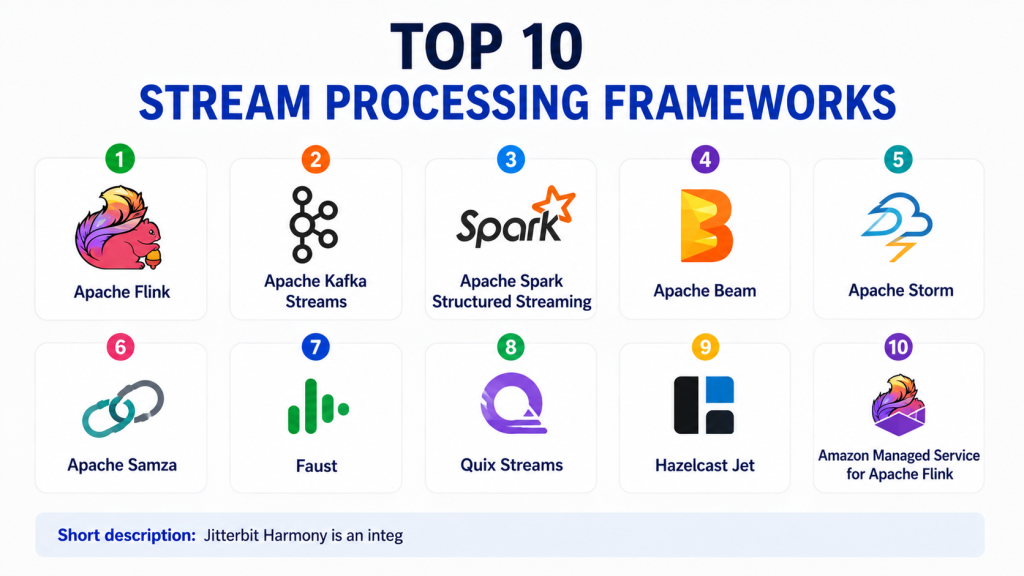
Top 10 Stream Processing Frameworks
#1 — Apache Flink
Short description:Apache Flink is one of the most powerful open-source stream processing frameworks for real-time data applications. It is designed for high-throughput, low-latency, stateful event processing. Flink is widely used for fraud detection, real-time analytics, event-driven applications, IoT processing, and continuous data pipelines. It supports both streaming and batch-style workloads through a unified processing model. Flink is especially strong when applications need accurate state management, event-time processing, and fault tolerance. It is best for engineering teams with strong streaming requirements. It can be complex to operate without the right platform skills. For mature data teams, Flink is one of the most capable choices.
Key Features
- Stateful stream processing
- Event-time and processing-time support
- Windowing and complex event processing
- Fault tolerance with checkpointing
- Batch and streaming support
- SQL and DataStream APIs
- Strong Kafka and data lake integrations
Pros
- Very strong for complex real-time workloads
- Excellent state management and fault tolerance
- Large ecosystem and strong community
Cons
- Operational complexity can be high
- Requires skilled engineering teams
- Tuning and monitoring need careful planning
Platforms / Deployment
Cloud / Self-hosted / Hybrid
Security & Compliance
Security depends on deployment and configuration. Authentication, authorization, encryption, and access controls may be available through the surrounding platform and infrastructure. Specific certifications are not publicly stated for the open-source framework itself.
Integrations & Ecosystem
Apache Flink has a strong ecosystem for event streaming, data lakes, warehouses, and cloud platforms.
- Apache Kafka
- Apache Pulsar
- Amazon Kinesis
- Hadoop ecosystem
- Data lakes
- SQL connectors
Support & Community
Apache Flink has strong open-source documentation and community support. Enterprise support may be available through managed services and specialist vendors.
#2 — Apache Kafka Streams
Short description:Apache Kafka Streams is a lightweight stream processing library built for applications using Apache Kafka. It allows developers to process data directly inside Java applications without running a separate processing cluster. Kafka Streams is useful for real-time transformations, joins, aggregations, event enrichment, and microservice-based stream processing. It works well for teams already using Kafka as their event backbone. The framework is developer-friendly for Kafka-native applications. It is not a full standalone platform like Flink, but it is practical for many application-level streaming use cases. Kafka Streams is best for teams that want simple deployment and tight Kafka integration. It may not be ideal for very complex multi-source streaming workloads.
Key Features
- Kafka-native stream processing
- Java library-based deployment
- Stateful processing support
- Windowed aggregations
- Stream-table joins
- Exactly-once processing support depending on configuration
- Simple application-level architecture
Pros
- Easy fit for Kafka-based applications
- No separate processing cluster required
- Good for microservices and event-driven apps
Cons
- Mainly focused on Kafka ecosystems
- Less suitable for very complex streaming pipelines
- Java-based model may not fit every team
Platforms / Deployment
Self-hosted / Cloud / Hybrid
Security & Compliance
Security depends on Kafka deployment and application configuration. Kafka security may include TLS, authentication, authorization, and access controls. Specific certifications are not publicly stated for Kafka Streams itself.
Integrations & Ecosystem
Kafka Streams is tightly connected to Kafka and its ecosystem.
- Apache Kafka
- Confluent Platform
- Schema Registry
- Kafka Connect
- Java applications
- Event-driven microservices
Support & Community
Kafka Streams benefits from the large Kafka community, documentation, and enterprise support options through Kafka vendors.
#3 — Apache Spark Structured Streaming
Short description:Apache Spark Structured Streaming is a stream processing engine built on Apache Spark. It allows teams to process streaming data using familiar Spark APIs and a structured programming model. It is useful for organizations already using Spark for batch processing, machine learning, or large-scale data engineering. Structured Streaming supports continuous data processing, transformations, aggregations, and output to data lakes or warehouses. It is often used for ETL, analytics pipelines, log processing, and machine learning data preparation. It is not always the lowest-latency option, but it is strong for scalable data processing. Teams already invested in Spark may find it practical. It works well where streaming and batch workloads need a shared platform.
Key Features
- Unified batch and streaming model
- DataFrame and SQL APIs
- Scalable distributed processing
- Integration with Spark ecosystem
- Windowed aggregations
- Checkpointing support
- Data lake and warehouse output support
Pros
- Strong fit for existing Spark teams
- Good for large-scale data engineering
- Familiar APIs for batch and streaming
Cons
- May not be ideal for ultra-low latency
- Cluster tuning can be complex
- Requires Spark operational knowledge
Platforms / Deployment
Cloud / Self-hosted / Hybrid
Security & Compliance
Security depends on the Spark platform and deployment. Controls may include authentication, authorization, encryption, network controls, and audit logging through managed or enterprise environments. Specific certifications are not publicly stated for the open-source framework itself.
Integrations & Ecosystem
Spark Structured Streaming integrates well with big data, cloud, and lakehouse ecosystems.
- Apache Kafka
- Delta Lake
- Cloud storage
- Hadoop ecosystem
- Databricks
- SQL-based platforms
Support & Community
Apache Spark has a large open-source community, strong documentation, and wide enterprise support through vendors and managed platforms.
#4 — Apache Beam
Short description:Apache Beam is a unified programming model for batch and stream processing. It allows developers to write pipelines once and run them on supported execution engines. Beam is useful for teams that want portability across different processing backends. It supports windowing, triggers, event-time processing, and complex data pipeline logic. Apache Beam is commonly associated with cloud-based stream and batch processing services. It is a good fit for teams that want flexible data pipeline development without being fully locked into one engine. Beam is more of a programming model than a single runtime. It is best for teams that value portability and advanced pipeline semantics.
Key Features
- Unified batch and stream programming model
- Runner-based architecture
- Event-time processing
- Windowing and triggers
- Pipeline portability
- SDK support for multiple languages
- Integration with cloud processing services
Pros
- Strong portability model
- Good for complex pipelines
- Useful across batch and streaming workloads
Cons
- Runner behavior may vary
- Learning curve can be moderate
- Operational experience depends on selected runner
Platforms / Deployment
Cloud / Self-hosted / Hybrid
Security & Compliance
Security depends on the selected runner and infrastructure. Specific certifications are not publicly stated for the open-source framework itself.
Integrations & Ecosystem
Apache Beam integrates through runners and connectors across cloud and open-source environments.
- Google Cloud Dataflow
- Apache Flink
- Apache Spark
- Kafka
- Cloud storage
- Databases
Support & Community
Apache Beam has open-source community support and documentation. Support quality depends heavily on the chosen runtime or managed service.
#5 — Apache Storm
Short description:Apache Storm is an open-source distributed real-time computation system. It was one of the earlier popular frameworks for processing streams at scale. Storm is used for real-time analytics, online machine learning, continuous computation, and data transformation pipelines. It is reliable for certain existing production environments, especially where teams already have Storm expertise. However, many modern teams now prefer Flink, Spark Structured Streaming, or managed cloud services for new projects. Storm can still be useful where low-latency tuple processing is needed. It is more technical and may require deeper operational knowledge. It is best for teams maintaining existing Storm-based architectures or with specific real-time processing needs.
Key Features
- Distributed real-time stream processing
- Low-latency computation
- Fault-tolerant processing model
- Topology-based architecture
- Integration with queues and messaging systems
- Scalable worker-based execution
- Support for multiple languages
Pros
- Proven real-time processing framework
- Good for low-latency event processing
- Useful for existing Storm environments
Cons
- Less modern than newer frameworks
- Operational model can be complex
- Smaller mindshare for new projects
Platforms / Deployment
Self-hosted / Hybrid
Security & Compliance
Security depends on deployment, cluster configuration, and surrounding infrastructure. Specific certifications are not publicly stated.
Integrations & Ecosystem
Storm integrates with messaging systems, queues, databases, and custom applications.
- Kafka
- Message queues
- Databases
- HDFS
- Custom APIs
- Monitoring systems
Support & Community
Storm has open-source documentation and community support, though newer frameworks may have stronger modern ecosystem momentum.
#6 — Apache Samza
Short description:Apache Samza is a distributed stream processing framework originally designed for processing high-volume event streams. It is closely associated with Kafka-based architectures and supports stateful stream processing. Samza is useful for teams that need reliable event processing inside large-scale data platforms. It can handle continuous streams and maintain local state for fast processing. Samza is often considered by engineering-heavy organizations with Kafka-centered environments. It is not always the first choice for new teams because other frameworks have broader mindshare today. However, it can still be a strong option in suitable architectures. It is best for teams that understand its operational model and ecosystem fit.
Key Features
- Stateful stream processing
- Kafka-oriented design
- Local state support
- Fault-tolerant processing
- Distributed execution
- Stream transformation support
- Integration with resource managers
Pros
- Good for Kafka-heavy environments
- Supports stateful processing
- Suitable for large-scale event systems
Cons
- Smaller ecosystem momentum than Flink or Spark
- Requires technical expertise
- Not ideal for teams wanting simple managed options
Platforms / Deployment
Self-hosted / Hybrid
Security & Compliance
Security depends on deployment and connected infrastructure. Specific certifications are not publicly stated.
Integrations & Ecosystem
Samza is often used with Kafka and distributed systems.
- Apache Kafka
- YARN
- Databases
- Event streams
- Custom applications
- Monitoring systems
Support & Community
Samza has open-source documentation and community support. Enterprise support may be limited compared with larger ecosystems.
#7 — Faust
Short description:Faust is a Python stream processing library inspired by Kafka Streams. It allows Python developers to build stream processing applications using Kafka. Faust is useful for teams that prefer Python and need lightweight event processing workflows. It can support transformations, aggregations, and real-time application logic. Faust is not as widely adopted as Flink, Spark, or Kafka Streams, but it can be practical for Python-heavy teams. It is best for smaller streaming applications or teams experimenting with event-driven Python services. Production readiness should be evaluated carefully based on project needs. It is not the best choice for large enterprise streaming platforms.
Key Features
- Python-based stream processing
- Kafka integration
- Lightweight application model
- Stream transformations
- Stateful processing concepts
- Developer-friendly syntax
- Useful for event-driven Python apps
Pros
- Friendly for Python developers
- Lightweight compared with cluster frameworks
- Good for smaller event-driven services
Cons
- Smaller ecosystem than major frameworks
- Not ideal for large enterprise streaming workloads
- Support and long-term fit should be evaluated
Platforms / Deployment
Self-hosted / Hybrid
Security & Compliance
Security depends on Kafka setup, application configuration, and infrastructure. Specific certifications are not publicly stated.
Integrations & Ecosystem
Faust mainly fits Kafka and Python application environments.
- Apache Kafka
- Python applications
- Databases
- APIs
- Microservices
- Monitoring tools
Support & Community
Community and support are more limited compared with larger Apache projects. Teams should evaluate project activity and internal support capacity before adoption.
#8 — Quix Streams
Short description:Quix Streams is a Python stream processing library designed for building real-time data applications. It is useful for teams that want Python-native streaming workflows with Kafka-compatible patterns. Quix Streams can support event processing, transformations, and real-time application logic. It is attractive for Python developers, data engineers, and teams building ML-adjacent streaming use cases. Compared with heavier distributed frameworks, it can be easier to start with. It is best for teams that want practical stream processing without managing a large framework from day one. For very large or complex enterprise workloads, teams should validate scale and operational needs. It fits well where developer speed and Python usability matter.
Key Features
- Python-native stream processing
- Kafka-compatible workflows
- Event transformation support
- Developer-friendly APIs
- Suitable for real-time applications
- Useful for ML and analytics pipelines
- Lightweight deployment model
Pros
- Good for Python teams
- Easier starting point than heavy frameworks
- Useful for application-level streaming
Cons
- May not replace large distributed frameworks
- Enterprise maturity should be evaluated by use case
- Best fit depends on Kafka and Python adoption
Platforms / Deployment
Cloud / Self-hosted / Hybrid
Security & Compliance
Security depends on deployment, Kafka configuration, and surrounding infrastructure. Specific certifications are not publicly stated.
Integrations & Ecosystem
Quix Streams fits real-time Python and Kafka-based workflows.
- Kafka-compatible brokers
- Python applications
- APIs
- ML pipelines
- Databases
- Cloud services
Support & Community
Documentation and vendor-backed support may be available depending on the offering. Community strength is smaller than older open-source frameworks.
#9 — Hazelcast Jet
Short description:Hazelcast Jet is a stream and batch processing engine associated with the Hazelcast ecosystem. It supports distributed data processing and can be useful for real-time applications where in-memory speed and event processing matter. Hazelcast Jet has been part of broader Hazelcast platform evolution, so teams should evaluate current product positioning before adoption. It can support pipelines, transformations, and event-driven workloads. It is useful for organizations already using Hazelcast technologies. It may not have the same general mindshare as Flink or Spark for new stream processing projects. However, it can fit specific application architectures well. It is best for teams that need streaming closely tied to distributed in-memory systems.
Key Features
- Stream and batch processing
- Distributed execution
- In-memory processing strengths
- Pipeline-based programming
- Integration with Hazelcast ecosystem
- Event-driven application support
- Low-latency processing options
Pros
- Strong fit with Hazelcast environments
- Useful for low-latency application processing
- Supports stream and batch concepts
Cons
- Smaller ecosystem than Flink or Spark
- Product direction should be reviewed carefully
- Not always the first choice for general streaming
Platforms / Deployment
Cloud / Self-hosted / Hybrid
Security & Compliance
Security depends on Hazelcast platform configuration and deployment. Specific certifications should be validated directly.
Integrations & Ecosystem
Hazelcast Jet fits distributed application and in-memory data processing workflows.
- Hazelcast ecosystem
- Kafka
- Databases
- Cloud systems
- Java applications
- Custom pipelines
Support & Community
Support depends on the Hazelcast offering and deployment model. Community strength is more focused than large Apache stream processing projects.
#10 — Amazon Managed Service for Apache Flink
Short description:Amazon Managed Service for Apache Flink is a managed AWS service for running Apache Flink applications. It helps teams build real-time stream processing applications without managing all Flink infrastructure directly. It is useful for AWS-centered teams handling clickstreams, logs, IoT data, fraud detection, and operational analytics. The service reduces cluster management compared with self-hosting Flink. It still requires understanding of Flink concepts, application design, and streaming data architecture. It is a good choice for teams that want Flink capabilities with cloud-managed operations. It works best when AWS is already the main data platform. Teams outside AWS may prefer cloud-neutral or self-managed options.
Key Features
- Managed Apache Flink runtime
- Real-time stream processing
- AWS ecosystem integration
- Scalable processing applications
- Support for event-driven workloads
- Monitoring through AWS services
- Reduced infrastructure management
Pros
- Good for AWS-based streaming teams
- Reduces Flink operations burden
- Strong fit for real-time cloud workloads
Cons
- AWS dependency should be considered
- Flink knowledge is still needed
- Cost planning is important for continuous workloads
Platforms / Deployment
Cloud
Security & Compliance
AWS security controls commonly include IAM, encryption, logging, monitoring, and access management. Specific compliance depends on AWS configuration and usage.
Integrations & Ecosystem
The service integrates naturally with AWS streaming, storage, and analytics tools.
- Amazon Kinesis
- Amazon MSK
- Amazon S3
- AWS Lambda
- Amazon CloudWatch
- AWS Glue
Support & Community
AWS provides documentation, support plans, training resources, and cloud community support.
Comparison Table
| Tool Name | Best For | Platform(s) Supported | Deployment | Standout Feature | Public Rating |
|---|---|---|---|---|---|
| Apache Flink | Complex stateful streaming | Web / API | Cloud / Self-hosted / Hybrid | Advanced stateful stream processing | N/A |
| Apache Kafka Streams | Kafka-native applications | Java applications / API | Cloud / Self-hosted / Hybrid | Lightweight Kafka app processing | N/A |
| Apache Spark Structured Streaming | Spark-based data pipelines | Web / API | Cloud / Self-hosted / Hybrid | Unified batch and streaming model | N/A |
| Apache Beam | Portable pipelines | SDK / API | Cloud / Self-hosted / Hybrid | Runner-based portability | N/A |
| Apache Storm | Low-latency legacy streaming | API | Self-hosted / Hybrid | Distributed real-time computation | N/A |
| Apache Samza | Kafka-heavy event systems | API | Self-hosted / Hybrid | Stateful Kafka-oriented processing | N/A |
| Faust | Python Kafka apps | Python / API | Self-hosted / Hybrid | Python-friendly stream processing | N/A |
| Quix Streams | Python real-time apps | Python / API | Cloud / Self-hosted / Hybrid | Lightweight Python streaming | N/A |
| Hazelcast Jet | In-memory event processing | Java / API | Cloud / Self-hosted / Hybrid | Distributed in-memory stream processing | N/A |
| Amazon Managed Service for Apache Flink | AWS streaming workloads | Web / API | Cloud | Managed Flink on AWS | N/A |
Evaluation & Scoring of Stream Processing Frameworks
| Tool Name | Core (25%) | Ease (15%) | Integrations (15%) | Security (10%) | Performance (10%) | Support (10%) | Value (15%) | Weighted Total |
|---|---|---|---|---|---|---|---|---|
| Apache Flink | 10 | 6 | 9 | 7 | 9 | 8 | 9 | 8.35 |
| Apache Kafka Streams | 8 | 8 | 9 | 7 | 8 | 8 | 9 | 8.15 |
| Apache Spark Structured Streaming | 8 | 7 | 9 | 8 | 8 | 9 | 8 | 8.05 |
| Apache Beam | 8 | 6 | 8 | 7 | 8 | 7 | 8 | 7.45 |
| Apache Storm | 7 | 5 | 7 | 6 | 7 | 6 | 7 | 6.55 |
| Apache Samza | 7 | 5 | 7 | 6 | 7 | 6 | 7 | 6.55 |
| Faust | 6 | 8 | 6 | 5 | 6 | 5 | 8 | 6.35 |
| Quix Streams | 7 | 8 | 7 | 6 | 7 | 6 | 8 | 7.00 |
| Hazelcast Jet | 7 | 6 | 7 | 7 | 8 | 7 | 7 | 7.00 |
| Amazon Managed Service for Apache Flink | 9 | 8 | 9 | 9 | 9 | 9 | 7 | 8.60 |
These scores are comparative and should be used for shortlisting only. Open-source frameworks often score high in flexibility and value but require operational expertise. Managed services score higher in ease, support, and security operations but may increase cloud dependency. The best choice depends on workload size, latency needs, developer skills, and deployment strategy.
Which Stream Processing Framework Is Right for You?
Solo / Freelancer
Solo users usually do not need a complex distributed stream processing framework. If the goal is learning, Apache Flink, Kafka Streams, or Spark Structured Streaming are useful to study. If you prefer Python, Quix Streams or Faust may be easier starting points.
SMB
Small and growing companies should avoid unnecessary operational complexity. Kafka Streams, Quix Streams, managed Flink, or cloud-native services can be practical options. If the team already uses Spark, Structured Streaming may be easier than adopting a completely new framework.
Mid-Market
Mid-market companies often need stronger reliability, scalability, and integration support. Apache Flink, Spark Structured Streaming, Kafka Streams, and Apache Beam are strong options. The choice should depend on whether the team needs application-level processing, data engineering pipelines, or complex stateful streaming.
Enterprise
Enterprises should prioritize fault tolerance, security, governance, support, monitoring, and long-term maintainability. Apache Flink, Spark Structured Streaming, Apache Beam, Kafka Streams, and managed Flink services are strong candidates. Existing cloud and data platform strategy should strongly influence the final decision.
Budget vs Premium
Open-source frameworks reduce license cost but require skilled engineering, infrastructure, monitoring, and maintenance. Managed services cost more but reduce operational burden. The right budget decision should include infrastructure cost, developer time, downtime risk, and long-term support needs.
Feature Depth vs Ease of Use
Apache Flink offers deep streaming capabilities but requires expertise. Kafka Streams is simpler for Kafka-native applications. Spark Structured Streaming is easier for Spark teams. Quix Streams and Faust are easier for Python developers but may not match larger frameworks for enterprise scale.
Integrations & Scalability
Kafka-heavy environments should evaluate Flink, Kafka Streams, Samza, and Quix Streams. Spark-based data platforms should evaluate Structured Streaming. Cloud-native teams should consider managed services. Large-scale workloads should be tested with real data volume before final selection.
Security & Compliance Needs
Security-focused teams should evaluate authentication, authorization, encryption, secret management, audit logging, network isolation, access controls, and cloud compliance posture. Open-source tools require more internal security ownership, while managed platforms may simplify compliance reviews.
Frequently Asked Questions
1. What is a stream processing framework?
A stream processing framework processes data continuously as it arrives. It helps teams build real-time pipelines, alerts, dashboards, transformations, and event-driven applications.
2. How is stream processing different from batch processing?
Batch processing runs on stored data at scheduled intervals. Stream processing works on live data continuously, which makes it useful for fast alerts, fraud detection, IoT monitoring, and real-time analytics.
3. Which stream processing framework is best for beginners?
Kafka Streams is easier for Java developers already using Kafka. Spark Structured Streaming is easier for teams familiar with Spark. Python users may prefer Quix Streams for simpler starting projects.
4. Is Apache Flink better than Spark Structured Streaming?
Apache Flink is often stronger for complex, low-latency, stateful streaming. Spark Structured Streaming is often better for teams already using Spark and needing a unified batch-streaming model.
5. How much do stream processing frameworks cost?
Open-source frameworks are free to use but require infrastructure, engineering time, monitoring, and maintenance. Managed services charge based on cloud resources, processing usage, storage, and support needs.
6. What are common mistakes when choosing a stream processing framework?
Common mistakes include ignoring operational complexity, underestimating state management, skipping failure testing, choosing based only on popularity, and not testing latency with real workloads.
7. Do stream processing frameworks require Kafka?
No, Kafka is common but not always required. Many frameworks support Kafka, but they may also connect to Kinesis, Pulsar, databases, cloud storage, message queues, APIs, and custom sources.
8. Can stream processing frameworks support AI and machine learning?
Yes, they can support real-time feature pipelines, model scoring, anomaly detection, event enrichment, and ML monitoring. However, model training and model serving may require additional tools.
9. Are managed stream processing services better than self-hosted frameworks?
Managed services are often easier to operate and secure, but they may cost more and create cloud dependency. Self-hosted frameworks offer more control but require stronger internal expertise.
10. When should a company switch stream processing frameworks?
A company should consider switching when the current framework cannot meet latency, scale, reliability, security, integration, or developer productivity needs. Switching should be tested carefully because streaming migrations can be complex.
Conclusion
Stream processing frameworks are essential for teams building real-time data pipelines, event-driven applications, live analytics, fraud detection, IoT monitoring, and operational intelligence. Apache Flink is one of the strongest options for complex stateful streaming. Kafka Streams is practical for Kafka-native applications. Spark Structured Streaming is useful for teams already invested in Spark. Apache Beam is valuable when portability matters. Storm and Samza may still fit specific existing environments. Quix Streams and Faust are useful for Python-friendly stream processing. Hazelcast Jet can fit in-memory event processing needs. Amazon Managed Service for Apache Flink is strong for AWS teams that want managed operations.
