Upgrade & Secure Your Future with DevOps, SRE, DevSecOps, MLOps!
We spend hours scrolling social media and waste money on things we forget, but won’t spend 30 minutes a day earning certifications that can change our lives.
Master in DevOps, SRE, DevSecOps & MLOps by DevOps School!
Learn from Guru Rajesh Kumar and double your salary in just one year.
Introduction
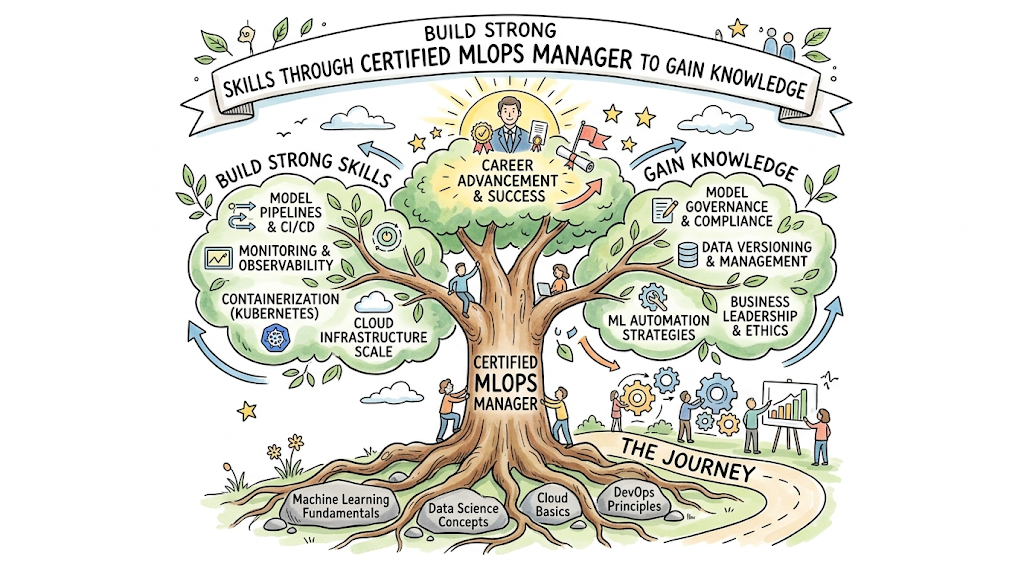
The Certified MLOps Manager is a professional milestone for those looking to lead the next generation of artificial intelligence operations. This guide is designed for engineering leaders and senior practitioners who want to move beyond basic model training and into the world of industrial-scale machine learning. By following the pathways established by aiopsschool.com, professionals can bridge the gap between experimental data science and production-grade software engineering. This transition is vital in today’s tech landscape where the ability to deploy and maintain models is just as important as building them.
Understanding the operational requirements of machine learning is no longer a luxury; it is a necessity for modern platform and cloud teams. This guide helps you navigate the various certification levels, providing a clear roadmap for career progression in the “Ops” spectrum. Whether you are managing a small startup team or a large enterprise department, the insights provided here will help you make informed decisions about your technical education and team structure. Our focus is on practical, experience-driven advice that prepares you for real-world production challenges.
By the end of this article, you will have a deep understanding of what it takes to succeed in this role and how to choose the right training path. We will explore the technical skills, management frameworks, and industry trends that define the current state of machine learning operations. This is your comprehensive resource for making a lasting impact in the field of MLOps and ensuring your organization remains at the cutting edge of technical excellence.
What is the Certified MLOps Manager?
The Certified MLOps Manager represents a specialized professional discipline that focuses on the governance, lifecycle, and operational stability of machine learning systems. It exists to solve the “production gap,” where high-quality models fail to deliver value because they cannot be reliably deployed or monitored. This certification validates that a leader understands how to integrate data science workflows into standard DevOps and SRE practices. It emphasizes a culture of automation where models are treated as first-class citizens in the software delivery pipeline.
This role focuses on real-world, production-focused learning rather than just mathematical theory. It aligns with modern engineering workflows by incorporating Continuous Integration, Continuous Delivery, and Continuous Training into a unified framework. Enterprise practices now demand that machine learning systems are scalable, observable, and secure, and this certification provides the blueprint for achieving those goals. It is the bridge between the creative world of data science and the disciplined world of IT operations.
Who Should Pursue Certified MLOps Manager?
This certification is ideal for senior DevOps engineers, Site Reliability Engineers, and Platform engineers who are seeing an increase in machine learning workloads. Cloud professionals and security experts who need to ensure the integrity of AI-driven applications will also find immense value in this path. It is specifically designed to help these professionals apply their existing operational knowledge to the unique requirements of model management and data versioning.
Furthermore, engineering managers and technical leaders who oversee data science teams will benefit from the strategic perspective this certification offers. It helps them communicate better with data scientists while maintaining the high standards of production engineering. In both the Indian and global markets, there is a massive demand for people who can manage these complex intersections. Even data engineers and junior software developers can use this roadmap to specialize in a high-growth area of the tech industry early in their careers.
Why Certified MLOps Manager is Valuable and Beyond
The value of the Certified MLOps Manager lies in its ability to provide long-term career longevity in a rapidly changing field. While specific tools and libraries may come and go, the underlying principles of operational management and model governance remain constant. This certification ensures that you are prepared for enterprise adoption of AI, which is moving from experimental lab settings to mission-critical production environments.
By earning this credential, you demonstrate a commitment to a return on time and career investment that few other specializations can match. It helps you stay relevant by focusing on high-level architecture and management strategies rather than just learning a single syntax. As organizations continue to scale their AI efforts, the need for managers who understand the complexities of MLOps will only intensify. This makes it a strategic choice for anyone looking to secure a leadership position in the modern engineering landscape.
Certified MLOps Manager Certification Overview
The program is delivered via the primary curriculum path and is hosted on the provider website. It uses a hands-on assessment approach that evaluates a candidate’s ability to solve actual production problems rather than just memorizing facts. This ensures that the certification holds significant weight with hiring managers and industry peers who value practical competence over theoretical knowledge. The program is structured to be modular, allowing busy professionals to progress through different tracks at their own pace.
Ownership of the certification program lies with industry veterans who have spent years managing large-scale distributed systems. The structure is designed to reflect the real-world challenges faced by teams in various sectors, from finance to healthcare. By focusing on practical outcomes, the program ensures that every certified professional is equipped to handle the stresses of a live production environment. This makes the certification a reliable indicator of a person’s ability to lead and execute complex technical projects.
Certified MLOps Manager Certification Tracks & Levels
The certification is divided into three distinct levels: Foundation, Professional, and Advanced. The Foundation level is for those new to the field, providing a base layer of knowledge about ML lifecycles and basic automation. It is the perfect entry point for traditional IT professionals who want to understand how their skills translate to the world of machine learning.
The Professional level moves into deeper specializations like SRE for ML, FinOps for AI, and advanced security protocols. This level is where practitioners learn to manage model drift, implement feature stores, and optimize cloud costs. The Advanced level is for architects and senior leaders who need to design global-scale ML infrastructures and oversee multi-team environments. These levels are designed to align with your career progression, providing a clear path from individual contributor to executive leadership.
Complete Certified MLOps Manager Certification Table
| Track | Level | Who it’s for | Prerequisites | Skills Covered | Recommended Order |
| Core MLOps | Foundation | Junior Engineers | Basic Linux/Git | ML Lifecycle, CI/CD | 1 |
| Infrastructure | Professional | SREs, Cloud Admins | Foundation Level | Kubernetes, Monitoring | 2 |
| Strategy | Professional | Tech Leads, Managers | Leadership Exp | Governance, Strategy | 2 |
| Architecture | Advanced | Solutions Architects | Professional Level | Scalability, Design | 3 |
| Compliance | Specialist | Security Engineers | Security Basics | DevSecOps, Model Ethics | 3 |
Detailed Guide for Each Certified MLOps Manager Certification
Certified MLOps Manager – Foundation
What it is
This level validates your understanding of the foundational concepts required to bridge the gap between data science and operations. It covers the basic terminology, lifecycle stages, and the primary tools used to automate machine learning workflows.
Who should take it
This is for junior developers, system administrators, and those transitioning from general DevOps into the specialized world of machine learning operations.
Skills you’ll gain
- Understanding the end-to-end machine learning lifecycle.
- Basic version control for data and model artifacts.
- Knowledge of standard CI/CD pipelines in an ML context.
Real-world projects you should be able to do
- Set up a simple automated deployment for a pre-trained model.
- Implement basic logging and monitoring for an ML service.
Preparation plan
- 7–14 days: Focus on learning the core vocabulary and the stages of model training versus deployment.
- 30 days: Practice with basic containerization and automation tools in a lab environment.
- 60 days: Conduct a full review of the interaction between data scientists and operations teams.
Common mistakes
- Focusing too much on the math of the models rather than the infrastructure that runs them.
- Neglecting the importance of data quality in the early stages of the pipeline.
Best next certification after this
- Same-track option: Professional MLOps Engineer
- Cross-track option: SRE Foundation
- Leadership option: Team Lead Fundamentals
Certified MLOps Manager – Professional
What it is
This level is designed for those who have a solid grasp of the basics and are ready to manage production-grade ML systems at scale. It focuses on the complex issues of observability, model retraining, and scaling.
Who should take it
Senior DevOps engineers, SREs, and experienced data engineers who are responsible for the uptime and performance of AI-driven applications.
Skills you’ll gain
- Advanced observability and alerting for model performance and drift.
- Implementation of feature stores for consistent data delivery.
- Designing automated retraining and validation loops.
Real-world projects you should be able to do
- Build a monitoring dashboard that tracks both system metrics and model accuracy.
- Design a self-healing infrastructure that handles model failures automatically.
Preparation plan
- 7–14 days: Deep dive into monitoring tools like Prometheus and Grafana for ML metrics.
- 30 days: Hands-on labs focusing on Kubernetes orchestration for distributed training.
- 60 days: Mastery of governance and compliance frameworks for enterprise ML.
Common mistakes
- Building overly complex automation that the team cannot maintain.
- Failing to account for the specific hardware requirements of ML workloads like GPU scheduling.
Best next certification after this
- Same-track option: Advanced MLOps Architect
- Cross-track option: FinOps Specialist
- Leadership option: Certified MLOps Manager
Choose Your Learning Path
DevOps Path
The DevOps path focuses on the seamless integration of machine learning code into existing software delivery pipelines. Professionals in this track learn how to treat ML models like any other software artifact while accounting for the unique challenges of data dependencies. It emphasizes automation, testing, and rapid deployment to ensure that models can be updated without disrupting the overall system. This path is essential for those who want to build the underlying machinery that powers AI-driven applications.
DevSecOps Path
The DevSecOps path is centered on the security and compliance of machine learning systems throughout their lifecycle. This involves securing the data supply chain, protecting model weights from tampering, and ensuring that the ML infrastructure meets strict regulatory requirements. It is a critical path for professionals working in highly regulated industries like finance and healthcare where data privacy and model integrity are paramount. You will learn how to automate security checks without slowing down the development process.
SRE Path
The SRE path focuses on the reliability, availability, and scalability of ML models in a production setting. Engineers in this track learn how to apply error budgets, service level objectives, and incident response strategies specifically to machine learning workloads. The goal is to ensure that the ML system remains performant even as data volumes grow and model complexity increases. This involves deep work with observability and distributed systems to prevent cascading failures.
AIOps Path
The AIOps path is for professionals who want to use artificial intelligence to enhance and automate traditional IT operations. This involves using machine learning algorithms to analyze logs, predict system failures, and automate the resolution of common incidents. It is a specialized track that applies the power of data science to the world of system administration and infrastructure management. This path helps organizations move from reactive to proactive maintenance of their entire technical stack.
MLOps Path
The MLOps path is the central journey for managing the complete machine learning lifecycle from research to production. It covers every stage, including data preparation, model training, validation, deployment, and continuous monitoring. This path is designed for the primary bridge-builders who ensure that data science experiments result in stable, high-value business applications. You will learn the frameworks necessary to maintain high-performing models over long periods in dynamic environments.
DataOps Path
The DataOps path focuses on the health, flow, and quality of the data that feeds into machine learning models. Professionals learn how to build resilient data pipelines, ensure data consistency across teams, and manage the large-scale storage systems required for modern AI. Without a strong DataOps foundation, any MLOps initiative is likely to fail due to poor data quality or pipeline bottlenecks. This track is vital for ensuring the “fuel” for your AI engine is always clean and available.
FinOps Path
The FinOps path addresses the critical financial management of machine learning workloads in the cloud. ML projects can be incredibly resource-intensive and expensive, and this path teaches you how to monitor costs, optimize resource usage, and prove ROI. It combines technical infrastructure knowledge with financial accountability to ensure that your AI initiatives are economically sustainable. You will learn how to balance the need for high-performance computing with the reality of enterprise budgets.
Role → Recommended Certified MLOps Manager Certifications
| Role | Recommended Certifications |
| DevOps Engineer | Certified MLOps Foundation, Professional MLOps |
| SRE | MLOps for SREs, Advanced Observability |
| Platform Engineer | MLOps Infrastructure Specialist, Kubernetes for ML |
| Cloud Engineer | Multi-cloud MLOps, Cloud Native ML |
| Security Engineer | DevSecOps for ML, Compliance Manager |
| Data Engineer | DataOps Specialist, Feature Store Manager |
| FinOps Practitioner | MLOps Cost Optimization, FinOps for AI |
| Engineering Manager | Certified MLOps Manager, Strategic AI Leadership |
Next Certifications to Take After Certified MLOps Manager
Same Track Progression
Deep specialization within the MLOps track involves moving into advanced architecture and specialized toolsets. Once you have mastered the manager level, you can look into specific certifications for deep learning operations or high-performance computing for ML. This path ensures you remain the top expert in the room when it comes to the technical execution of machine learning projects. It is about becoming the go-to person for solving the most complex deployment and scaling issues.
Cross-Track Expansion
Broadening your skills into areas like FinOps or DevSecOps can make you a more versatile and valuable professional. Understanding the financial implications or security risks of MLOps allows you to contribute to a wider range of organizational goals. This cross-training is highly valued in modern flat organizations where engineers are expected to have a deep knowledge of their core field and a broad understanding of related domains. It makes you a more effective collaborator and leader.
Leadership & Management Track
For those looking to transition fully into executive leadership, moving toward strategic management certifications is the logical next step. This involves moving away from daily technical tasks and focusing on team building, organizational culture, and long-term technology roadmaps. A Certified MLOps Manager has a strong technical foundation that makes them an ideal candidate for Director or VP of Engineering roles. This path focuses on the soft skills and strategic thinking required to lead entire departments.
Training & Certification Support Providers for Certified MLOps Manager
DevOpsSchool
DevOpsSchool provides a robust and comprehensive training environment for professionals looking to master modern automation. Their curriculum is deeply rooted in actual industry standards, offering a balanced blend of theoretical knowledge and extensive hands-on labs. They focus on the entire software delivery lifecycle, helping students understand exactly how MLOps fits into a broader DevOps strategy. With experienced instructors who bring real-world production scenarios into the classroom, learners are prepared for the true challenges they will face. The platform is widely recognized for its deep technical support and a community that encourages continuous learning across various technical domains. This makes it an excellent choice for those starting their journey.
Cotocus
Cotocus stands out as a specialized provider that focuses on high-end technical training specifically for enterprise teams. They offer tailored programs that address the specific needs of large organizations looking to modernize their infrastructure and adopt MLOps practices. Their approach is highly practical, emphasizing the specific tools and frameworks that are used in actual large-scale deployments. By providing a clear path from foundation to advanced levels, Cotocus ensures that professionals can build their skills at a pace that suits their individual career goals. Their commitment to excellence is reflected in the success of their many alumni, who often lead significant digital transformation initiatives within their respective global companies.
Scmgalaxy
Scmgalaxy is a long-established name in the world of configuration management and software supply chain automation. They have expanded their offerings to include specialized tracks for MLOps, recognizing the growing importance of data in the modern software lifecycle. Their resources are vast, including thousands of blogs, tutorials, and certification prep materials that cater to a truly global audience. Scmgalaxy emphasizes the “Ops” in MLOps, ensuring that professionals understand the vital importance of stability, security, and reproducibility. Their community-driven approach makes them a top resource for engineers who want to stay updated on the latest trends and open-source tools in the fast-moving tech landscape.
BestDevOps
BestDevOps focuses on delivering high-quality and accessible training for individuals who want to excel in modern engineering roles. They provide a streamlined learning experience that cuts through the noise and focuses strictly on the skills that matter most to hiring managers. Their MLOps curriculum is designed to be efficient, helping busy professionals gain the necessary competencies without getting bogged down in unnecessary theory. BestDevOps is particularly useful for those who want a practical, results-oriented approach to certification. Their trainers are active practitioners who bring fresh insights from the field, ensuring that the training is always relevant to current market demands and modern engineering practices.
Devsecopsschool.com
DevSecOpsSchool is the primary destination for professionals who want to integrate security into every single stage of the machine learning and software lifecycle. They recognize that security cannot be an afterthought, especially in the world of AI and sensitive data. Their programs cover everything from secure coding practices to infrastructure hardening and automated compliance. For those pursuing MLOps, this provider offers essential insights into protecting the data supply chain and ensuring model integrity. By focusing on the intersection of security and operations, they prepare candidates to build systems that are not only fast and functional but also resilient against modern cyber threats.
Sreschool.com
SRESchool is dedicated to the core principles of Site Reliability Engineering, offering specialized training on how to keep complex systems running smoothly. Their courses are essential for anyone in MLOps who needs to manage the performance and availability of machine learning models at massive scale. They teach the art of balancing innovation with stability, using metrics like SLIs and SLOs to guide all operational decision-making. SRESchool provides the tools and techniques needed to handle incident response and deep post-mortem analysis for ML workloads. Their focus on reliability ensures that professionals can build systems that users and stakeholders can trust, even under heavy load.
Aiopsschool.com
AIOpsSchool is a leading provider specifically focused on the intersection of artificial intelligence and IT operations management. They offer deep-dive certifications that help professionals understand how to apply ML to solve operational problems and how to manage the models themselves. Their curriculum is highly specialized, making them a top choice for those looking for the Certified MLOps Manager designation. AIOpsSchool prides itself on staying at the cutting edge of modern technology, ensuring that their students are always learning about the latest advancements. Their practical focus ensures that graduates can immediately apply their knowledge to drive efficiency and innovation in their current organizations.
Dataopsschool.com
DataOpsSchool addresses the critical need for high-quality data management within the broader machine learning lifecycle. They provide training on how to build and maintain the complex data pipelines that are the lifeblood of any AI system. Their courses cover data governance, quality assurance, and the automation of data delivery across the enterprise. By mastering DataOps, professionals ensure that their MLOps initiatives are built on a solid foundation of reliable and clean data. DataOpsSchool is ideal for data engineers and architects who want to specialize in the operational side of data management, ensuring that datasets are always available and secure.
Finopsschool.com
FinOpsSchool is the essential resource for managing the costs associated with cloud-native technologies and expensive machine learning workloads. As AI projects grow, so do the associated cloud bills, and FinOpsSchool teaches professionals how to optimize spending without sacrificing performance. Their curriculum combines finance, business, and engineering to create a holistic view of cloud economics. For MLOps managers, this training is vital for proving the ROI of their projects and managing large-scale infrastructure budgets. FinOpsSchool provides the frameworks and cultural changes needed to ensure that every dollar spent on the cloud contributes directly to the organization’s bottom line and long-term success.
Frequently Asked Questions (General)
- What is the general difficulty level of these certifications?
The difficulty level ranges from moderate at the foundation level to very high at the advanced and architect levels. The foundation level is designed to be accessible to those with a basic background in IT, while the advanced levels require deep hands-on experience with production systems and complex problem-solving abilities.
- How much time should I dedicate to preparing for the exam?
Most professionals find that 30 to 60 days of consistent study is sufficient to pass the mid-level certifications. If you are already working in an operations role, you may be able to progress faster. However, it is always recommended to spend extra time on the practical labs to ensure you can apply the concepts.
- Are there any strict prerequisites for the manager level?
While there are no legal requirements, it is highly recommended that you have at least three years of experience in a DevOps or software engineering role. A solid understanding of Python, Linux, and cloud infrastructure will make the learning process much smoother and more effective.
- What kind of salary increase can I expect after getting certified?
While salaries vary by region, professionals with specialized MLOps certifications often see a significant bump in compensation. In major tech hubs, these roles are among the highest-paid in the engineering department because the skill set is both rare and highly valuable to the business.
- Do I need to be an expert in mathematics to succeed in MLOps?
No, you do not need to be a mathematician. MLOps is about the engineering and operational aspects of machine learning. While you need to understand the basic concepts of how models work, your primary focus is on the infrastructure, automation, and stability of the system.
- Can I take the training and exams remotely?
Yes, most of the providers listed in this guide offer fully remote training and online-proctored exams. This allows you to learn and get certified from anywhere in the world, making it convenient for working professionals to balance their education with their daily job responsibilities.
- How long does the certification remain valid?
Typically, these certifications are valid for two to three years. Because the technology in the MLOps field moves so quickly, it is important to stay current. Most providers offer easy paths for renewal or advanced tracks that automatically keep your credentials up to date.
- Is hands-on experience more valuable than a certificate?
In the long run, your experience is what matters most, but a certificate serves as a vital validation of your skills to employers. It proves that you have a structured understanding of the field and have been vetted by industry experts. The two work together to build your career.
- What are the most common tools covered in the curriculum?
You will likely spend a lot of time with Kubernetes for orchestration, Git for version control, and various monitoring tools like Prometheus and Grafana. You will also learn about ML-specific tools like MLflow, Kubeflow, and specialized cloud services from AWS, Azure, and Google.
- Are these certifications recognized by major global tech firms?
Yes, the providers listed are well-known in the industry, and their certifications are recognized by many global enterprises. Having these credentials on your resume demonstrates that you are part of a specialized community of professionals who follow industry-standard best practices.
- Can I jump straight to the professional level if I have experience?
Some providers allow you to skip the foundation level if you can demonstrate significant prior experience in the field. However, many people find it helpful to at least review the foundation material to ensure they haven’t missed any key concepts or terminology used in the later stages.
- What kind of career support is available after certification?
Many of the top providers offer access to exclusive job boards, alumni networks, and ongoing mentorship opportunities. This community support can be incredibly helpful when you are looking for your next career move or trying to solve a difficult problem at your current job.
FAQs on Certified MLOps Manager
- How does an MLOps Manager handle the concept of “model drift” in production?
Model drift occurs when the statistical properties of the data the model was trained on change over time. An MLOps Manager sets up automated monitoring systems that track model accuracy and trigger alerts or retraining loops when performance drops below a certain threshold, ensuring the system remains reliable.
- What is the manager’s role in choosing between different ML tools?
The manager is responsible for evaluating tools based on their scalability, security, and how well they integrate with the existing stack. They must balance the desire of data scientists to use the latest research tools with the need for operations teams to maintain a stable and manageable environment.
- How does this certification help with team collaboration?
One of the biggest challenges in MLOps is the gap between data scientists and engineers. This certification provides a common language and framework that both groups can use. As a manager, you will learn how to facilitate better communication and create shared goals for the entire team.
- What are the key metrics an MLOps Manager should track?
Key metrics include deployment frequency, lead time for changes, mean time to recovery, and model-specific metrics like precision and recall. Tracking these helps the manager demonstrate the value of their team and identify areas where the pipeline can be further optimized for speed and reliability.
- How do you manage the “black box” nature of ML models as a manager?
While the internal logic of a model can be complex, a manager focuses on “explainability” and “reproducibility.” You ensure that every model can be traced back to its original training data and code, and that there are systems in place to audit why a model made a specific prediction.
- What is the importance of a feature store in the manager’s toolkit?
A feature store acts as a centralized repository for the data used in machine learning. As a manager, you oversee the implementation of this store to ensure that all models are using consistent, high-quality data, which significantly reduces the time it takes to move a model into production.
- How does an MLOps Manager address security concerns in AI?
Security involves protecting the training data from leaks and ensuring that the model itself cannot be manipulated by malicious inputs. The manager implements DevSecOps practices within the ML pipeline to automate security scanning and ensure compliance with organizational and legal standards.
- Why is “Continuous Training” a core part of the MLOps Manager’s responsibility?
Unlike traditional software, ML models need to be updated as new data becomes available. A manager oversees the automation of this process, ensuring that models are constantly improving without requiring manual intervention, which allows the organization to scale its AI efforts much more effectively.
Final Thoughts
As a mentor who has seen many technology cycles, I can tell you that the shift toward machine learning operations is one of the most significant changes in our industry. The demand for people who can manage these systems is not a passing trend; it is a fundamental requirement for the future of enterprise software. The Certified MLOps Manager designation is a serious commitment to this future, and for those willing to put in the effort, the rewards are immense.
It isn’t just about learning new tools; it is about adopting a new mindset that values operational discipline as much as creative research. If you want to lead high-performing teams and work on the most cutting-edge projects in the world, this is the path for you. My advice is to approach this as a long-term journey rather than a quick win. The depth of knowledge you gain will serve you for decades, making you a vital asset to any organization you choose to join. Take the first step today, and you will find that the opportunities in this field are virtually limitless.
