Upgrade & Secure Your Future with DevOps, SRE, DevSecOps, MLOps!
We spend hours scrolling social media and waste money on things we forget, but won’t spend 30 minutes a day earning certifications that can change our lives.
Master in DevOps, SRE, DevSecOps & MLOps by DevOps School!
Learn from Guru Rajesh Kumar and double your salary in just one year.
Introduction
In the rapidly evolving landscape of 2026, a Game Development IDE (Integrated Development Environment) is the specialized software workstation where developers write, debug, and optimize the code that brings interactive experiences to life. While a “game engine” (like Unreal or Unity) handles the rendering and physics, the IDE is the brain’s cockpit—providing the text editors, compilers, and debuggers necessary to build complex game logic, AI behaviors, and network protocols.
In 2026, the distinction between a simple text editor and a Game Dev IDE has blurred. Modern IDEs are now “AI-augmented environments” that offer real-time code co-piloting, cloud-based collaborative debugging, and native integration with massive spatial computing libraries. Whether you are building a hyper-casual mobile game or a sprawling persistent metaverse, the IDE is where the foundational architecture is laid.
Real-World Use Cases
- Triple-A Gameplay Programming: Writing high-performance C++ logic for physics-heavy open-world games.
- Mobile Game Optimization: Using profiling tools to minimize battery drain and memory overhead on iOS and Android devices.
- Multiplayer Backend Development: Managing server-side logic and real-time database integrations for competitive eSports titles.
- VR/AR Interaction Design: Scripting complex spatial hand-tracking gestures within a 3D-aware coding environment.
Evaluation Criteria
- Language Support: Native optimization for C++, C#, Luau, or GDScript.
- Debugger Robustness: The ability to step through code while the game is running (Hot Reloading).
- AI Orchestration: Availability of context-aware AI agents for refactoring and documentation.
- Extensibility: A robust plugin ecosystem for custom game-engine workflows.
- Performance: Memory footprint of the IDE itself when running alongside heavy game engines.
- Remote Collaboration: Support for Live Share or cloud-hosted development sessions.
- IntelliSense/Autocomplete: Speed and accuracy of deep-code suggestions.
- Version Control Integration: Native handling of Git, Perforce, or SVN within the UI.
Mandatory Paragraph
Best for: Professional software engineers, indie developers, and technical artists working in game studios ranging from solo ventures to enterprise-level organizations like Electronic Arts or Ubisoft. It is essential for those who need deep control over memory management and gameplay logic.
Not ideal for: Purely visual designers or non-technical creators who rely solely on “No-Code” visual scripting nodes. If your workflow never leaves the Unreal Blueprint or Unity Visual Scripting editor, a dedicated heavy-duty IDE may be overkill.
Key Trends in Game Development IDEs
- Agentic AI Co-pilots: Beyond simple autocomplete, IDEs now feature agents that can autonomously write unit tests for game physics or refactor legacy C++ code to modern standards.
- Engine-Aware Debugging: IDEs are increasingly “aware” of the game engine’s state, allowing developers to inspect engine-specific variables (like transform data or draw calls) directly within the code editor.
- Cloud-Native Development: Shifting the heavy lifting of compilation to the cloud, allowing developers to build massive projects on lightweight laptops without thermal throttling.
- Spatial IDEs: The rise of XR has led to experimental IDEs that allow developers to code while wearing a headset, placing code windows in 3D space around their active game scene.
- Universal Linkage (LSP): Wider adoption of the Language Server Protocol (LSP) ensures that even niche game scripting languages get enterprise-grade IDE features.
- Security Shift-Left: Automated scanning for vulnerabilities in multiplayer networking code and third-party game plugins is now a standard IDE background process.
- Sustainability Profiling: New tools within IDEs that measure the carbon footprint and energy efficiency of code execution on end-user hardware.
- Wasm and WebGPU Focus: A massive shift toward IDEs optimizing C++ for high-performance browser gaming as web-based titles gain parity with native apps.
How We Selected These Tools (Methodology)
To identify the top 10 Game Development IDEs for 2026, we applied a multi-layered evaluation framework:
- Developer Mindshare: Analysis of usage statistics among professional game developers and contributors to major open-source game projects.
- Engine Synergy: Priority was given to IDEs that offer specialized “first-class” support for industry-standard engines like Unreal, Unity, and Godot.
- Performance Benchmarking: We evaluated how these tools handle multi-million line codebases without significant UI lag.
- AI Integration Depth: Evaluation of how natively AI assistance is woven into the workflow rather than just being a “bolted-on” chat window.
- Cross-Platform Capabilities: The ability to develop for PC, Console, Mobile, and Web from a single environment.
- Security Posture: Verification of enterprise features like SSO, secure code signing, and vault integrations.
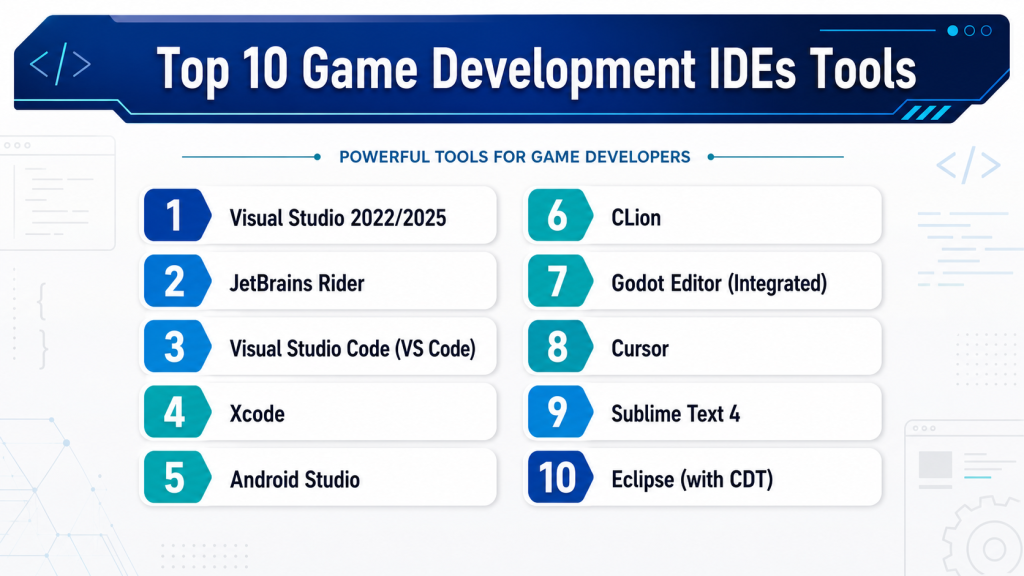
Top 10 Game Development IDEs Tools
H3: #1 — Visual Studio 2022/2025
Short description: The industry standard for professional game development, particularly for C++ and C# developers working with Unreal Engine and Unity. It is a feature-heavy powerhouse designed for large-scale enterprise projects.
H4: Key Features
- Unreal Engine Integration: Native support for Blueprints and C++ macro expansion within the editor.
- DirectX/Vulkan Debugging: Deep integration with graphics APIs for low-level performance tuning.
- IntelliCode: AI-assisted code completion trained on thousands of open-source game projects.
- Hot Reload: Apply code changes to a running game without restarting the session.
- Live Share: Real-time collaborative coding and debugging for distributed teams.
H4: Pros
- Most robust debugger on the market for C++.
- Unrivaled enterprise-grade security and project management.
H4: Cons
- Very high memory and CPU usage; requires a powerful workstation.
- Can be overwhelming for beginners due to feature density.
H4: Platforms / Deployment
- Windows
- On-premise / Hybrid
H4: Security & Compliance
- SSO/SAML, MFA, RBAC
- SOC 2, ISO 27001
H4: Integrations & Ecosystem
Visual Studio acts as the hub for the entire Microsoft development stack.
- Azure DevOps
- GitHub / Perforce
- Unreal Engine / Unity
H4: Support & Community
Massive. Extensive official documentation, a multi-decade forum history, and direct enterprise support tiers from Microsoft.
H3: #2 — JetBrains Rider
Short description: A fast, cross-platform IDE that has rapidly become the favorite for Unity and Unreal developers who want a snappier, more modern experience than Visual Studio. It excels in C# and C++ refactoring.
H4: Key Features
- Engine-Specific Inspections: Identifies common Unity and Unreal performance pitfalls (like inefficient GetComponent calls) in real-time.
- Cross-Platform Core: Identical experience across Windows, macOS, and Linux.
- ReSharper Engine: Industry-leading code analysis and 2,500+ automated refactorings.
- Integrated Unit Testing: Built-in support for NUnit and Unreal’s automation framework.
- AI Assistant: Context-aware code generation that understands game architecture patterns.
H4: Pros
- Significantly faster UI performance than Visual Studio.
- Excellent “Search Everywhere” and navigation features.
H4: Cons
- Requires a paid subscription (no free “Community” version for pros).
- C++ support for Unreal, while great, is still slightly trailing Visual Studio’s deep debugger integrations.
H4: Platforms / Deployment
- Windows / macOS / Linux
- Hybrid
H4: Security & Compliance
- SSO, MFA, Audit logs
- GDPR compliant
H4: Integrations & Ecosystem
Deeply integrated with the JetBrains Space and TeamCity ecosystems.
- Unity / Unreal / Godot
- Git / Mercurial / Perforce
- Docker
H4: Support & Community
Highly active community and excellent responsive support from JetBrains. Documentation is clean and visually driven.
H3: #3 — Visual Studio Code (VS Code)
Short description: A lightweight, highly extensible code editor that is the go-to for indie devs, web-based game creators, and those using lighter engines like Godot or Cocos.
H4: Key Features
- Extension Marketplace: Thousands of community-built plugins for every game language imaginable.
- GitHub Copilot: Deep, native integration with the world’s leading AI coding assistant.
- Remote Development: Seamlessly code on a remote server or in a browser-based container.
- Lightweight Footprint: Starts instantly and uses minimal system resources.
- Embedded Terminal: Powerful command-line integration for build scripts and automation.
H4: Pros
- Completely free and open-source.
- Extremely customizable to fit any niche workflow.
H4: Cons
- Debugging complex C++ games requires significant manual setup.
- Can become sluggish if too many extensions are installed.
H4: Platforms / Deployment
- Web / Windows / macOS / Linux
- Cloud / Self-hosted
H4: Security & Compliance
- MFA, RBAC (via GitHub/Microsoft account)
- SOC 2 (via GitHub Codespaces)
H4: Integrations & Ecosystem
Essentially integrates with everything via the LSP.
- GitHub / GitLab
- Godot / Unity / Three.js
- PlayCanvas
H4: Support & Community
The largest developer community in the world. If a problem exists, the solution is on Stack Overflow or GitHub Discussions.
H3: #4 — Xcode
Short description: The mandatory IDE for any developer building games specifically for Apple platforms, including iOS, macOS, and visionOS. It is the gatekeeper for the Apple ecosystem.
H4: Key Features
- Metal Debugger: Specialized tools for optimizing Apple’s proprietary graphics API.
- SwiftUI for Games: Rapid UI development for game menus and overlays.
- Instruments: A world-class suite of profiling tools for CPU, GPU, and thermal analysis.
- Spatial Computing Support: Native tools for building and previewing Apple Vision Pro experiences.
- Cloud Signing: Automated certificate management for App Store deployment.
H4: Pros
- Unrivaled optimization for Apple Silicon hardware.
- Deep integration with Game Center and Apple’s ecosystem APIs.
H4: Cons
- Locked exclusively to macOS hardware.
- Can be buggy and prone to large, slow updates.
H4: Platforms / Deployment
- macOS (targeting iOS, macOS, tvOS, watchOS, visionOS)
- On-premise
H4: Security & Compliance
- MFA, Encryption, App Sandboxing
- GDPR, HIPAA (Apple ecosystem standards)
H4: Integrations & Ecosystem
Limited primarily to Apple-approved tools and services.
- TestFlight
- Unity / Unreal (via Apple plugins)
- GitHub
H4: Support & Community
Strong support through Apple Developer Programs and a massive community of mobile game developers.
H3: #5 — Android Studio
Short description: Based on JetBrains’ IntelliJ IDEA, this is the official IDE for Android game development. It is essential for developers focusing on the Google Play ecosystem.
H4: Key Features
- Android Emulator: Highly accurate simulation of thousands of Android device configurations.
- C++ Support (NDK): Deep integration for high-performance game code via the Native Development Kit.
- Memory Profiler: Visual tools to identify memory leaks in mobile games.
- Play Asset Delivery: Tools to package and optimize large game assets for the Play Store.
- AI Gemini Integration: AI-assisted debugging and code generation tailored for Android APIs.
H4: Pros
- The only way to get 100% accurate Android profiling.
- Excellent Gradle-based build automation.
H4: Cons
- Extremely resource-heavy (RAM hungry).
- Complex configuration for C++ / NDK projects.
H4: Platforms / Deployment
- Windows / macOS / Linux / ChromeOS
- On-premise
H4: Security & Compliance
- MFA, Google Cloud IAM
- SOC 2, ISO 27001 (Google Cloud standards)
H4: Integrations & Ecosystem
Part of the broader Google Cloud and Play ecosystem.
- Firebase (Analytics/Cloud Saves)
- Google Play Games Services
- Unity
H4: Support & Community
Supported directly by Google with massive documentation and a huge global community of mobile developers.
H3: #6 — CLion
Short description: Another JetBrains powerhouse, specifically focused on C and C++. It is widely used by engine developers and those building custom game tech from scratch.
H4: Key Features
- CMake Integration: First-class support for the most common build system in C++ gaming.
- Data Flow Analysis: Detects unreachable code and null-pointer dereferences before you compile.
- Remote Development: Code on a powerful Linux server from a Windows or Mac frontend.
- Embedded Development: Support for coding on consoles and specialized hardware.
- Valgrind/Google Test: Integrated support for memory profiling and unit testing.
H4: Pros
- The most “intelligent” C++ editor available.
- Greatly simplifies complex C++ project management.
H4: Cons
- Lacks the specific “Unreal/Unity” UI sugar found in Rider.
- Can be slow when indexing massive projects for the first time.
H4: Platforms / Deployment
- Windows / macOS / Linux
- Hybrid
H4: Security & Compliance
- SSO, MFA
- Varies / Not publicly stated
H4: Integrations & Ecosystem
- Git / Perforce
- Vcpkg / Conan (C++ package managers)
- Docker
H4: Support & Community
Solid professional support with a strong niche following in systems and engine programming.
H3: #7 — Godot Editor (Integrated)
Short description: Unlike other engines, Godot features a highly capable built-in IDE designed specifically for its GDScript and C# workflows. It is the ultimate “all-in-one” experience.
H4: Key Features
- Node-Aware Autocomplete: The editor knows exactly which nodes are in your scene tree and suggests them.
- GDScript Optimization: A language and editor built for each other for zero-latency coding.
- Live Scene Editing: Change code and see the impact in the running game immediately.
- Built-in Documentation: Pressing F1 inside the editor opens the local API docs for any class.
- Version Control Plugin: Simple, built-in Git support for basic workflows.
H4: Pros
- Zero setup required; just download the engine and start coding.
- Incredibly lightweight; runs on almost any hardware (even a Raspberry Pi).
H4: Cons
- Internal editor lacks advanced refactoring tools found in Rider or VS.
- Not suitable for heavy C++ engine modifications (requires an external IDE for that).
H4: Platforms / Deployment
- Windows / macOS / Linux / Android (Editor) / Web
- Self-hosted
H4: Security & Compliance
- N/A (Open source project)
H4: Integrations & Ecosystem
- GitHub
- Blender (direct import)
- C# / .NET
H4: Support & Community
Explosive growth. One of the most passionate and helpful open-source communities in existence.
H3: #8 — Cursor
Short description: A “new-breed” AI-first IDE based on VS Code. It is gaining traction in 2026 for developers who want to build games using natural language and high-level agentic assistance.
H4: Key Features
- Codebase Indexing: The AI indexes your entire project, allowing it to answer questions like “Where is the damage logic handled?”
- Auto-Debug: When a game crashes, Cursor can automatically read the stack trace and propose a fix.
- Chat with Files: Natural language interface for generating entire classes or systems.
- Predictive Ghost-Text: Anticipates your next 5-10 lines of code based on project context.
- VS Code Plugin Compatibility: Supports all existing VS Code extensions.
H4: Pros
- Drastically speeds up prototyping for indie games.
- Lower barrier to entry for beginners.
H4: Cons
- Requires a constant internet connection for high-end AI features.
- Potential security concerns regarding code being processed by AI models.
H4: Platforms / Deployment
- Windows / macOS / Linux
- Cloud-hosted
H4: Security & Compliance
- Privacy mode available for enterprise
- Not publicly stated
H4: Integrations & Ecosystem
- Inherits the entire VS Code ecosystem.
H4: Support & Community
Rapidly growing startup community. Support is mostly handled via Discord and GitHub.
H3: #9 — Sublime Text 4
Short description: Known for being the fastest text editor on the planet, Sublime is used by “hardcore” developers who prefer a minimalist, distraction-free environment for C++ or Lua scripting.
H4: Key Features
- GPU Rendering: The UI is rendered using the GPU for butter-smooth scrolling.
- Multiple Selections: Edit hundreds of lines of code simultaneously.
- Goto Anything: Lightning-fast file and symbol navigation.
- LSP Support: Can be transformed into a full IDE via the Language Server Protocol.
- Python API: Extremely customizable for creating custom game build pipelines.
H4: Pros
- Virtually zero lag, even with massive files.
- Extremely stable and distraction-free.
H4: Cons
- Requires significant “DIY” setup to act like a true game dev IDE.
- Lacks a built-in visual debugger.
H4: Platforms / Deployment
- Windows / macOS / Linux
- On-premise
H4: Security & Compliance
- Varies / Not publicly stated
H4: Integrations & Ecosystem
- Extensive Package Control ecosystem.
- Git / SVN plugins available.
H4: Support & Community
Deep, long-standing community of power users and systems programmers.
H3: #10 — Eclipse (with CDT)
Short description: While often associated with Java, the Eclipse C/C++ Development Tooling (CDT) remains a staple for large-scale enterprise engine development and legacy console systems.
H4: Key Features
- Strong Project Management: Handles thousands of sub-projects and libraries with ease.
- Static Analysis: Built-in tools for finding complex logic bugs without running the code.
- GDB Integration: Robust support for standard GNU debuggers.
- Custom Toolchain Support: Easily configure specialized compilers for obscure hardware.
- Extensive Plugin History: Decades of tools for every conceivable development need.
H4: Pros
- Highly stable for long-term (10+ year) projects.
- Completely free and extremely customizable.
H4: Cons
- User interface feels dated compared to Rider or VS Code.
- Steep learning curve for configuration.
H4: Platforms / Deployment
- Windows / macOS / Linux
- On-premise
H4: Security & Compliance
- Varies / Not publicly stated
H4: Integrations & Ecosystem
- Git / SVN / Perforce
- Jenkins / Maven
- Mylyn (Task-focused UI)
H4: Support & Community
Huge academic and enterprise following. Documentation is dense but exhaustive.
H2: Comparison Table (Top 10)
| Tool Name | Best For | Platform(s) Supported | Deployment | Standout Feature | Public Rating |
| Visual Studio | Enterprise / Unreal | Windows | On-premise | World-class Debugger | 4.7/5 |
| JetBrains Rider | Unity / Speed | Win/Mac/Linux | Hybrid | Engine-aware Inspections | 4.8/5 |
| VS Code | Indie / Lightweight | Web/Win/Mac/Linux | Cloud/Self | Massive Extension Library | 4.9/5 |
| Xcode | Apple Ecosystem | macOS | On-premise | Instruments Profiler | 3.8/5 |
| Android Studio | Android Games | Win/Mac/Linux | On-premise | Device Emulator | 4.2/5 |
| CLion | C++ Engine Dev | Win/Mac/Linux | Hybrid | Data Flow Analysis | 4.6/5 |
| Godot Editor | Godot Users | All Platforms | Self-hosted | Scene-aware Autocomplete | 4.7/5 |
| Cursor | AI-First Dev | Win/Mac/Linux | Cloud | Entire Codebase Indexing | 4.5/5 |
| Sublime Text | Speed / Minimalists | Win/Mac/Linux | On-premise | GPU-accelerated UI | 4.6/5 |
| Eclipse CDT | Legacy / Systems | Win/Mac/Linux | On-premise | Project Management | 3.5/5 |
H2: Evaluation & Scoring of Game Development IDEs
| Tool Name | Core (25%) | Ease (15%) | Integrations (15%) | Security (10%) | Performance (10%) | Support (10%) | Value (15%) | Weighted Total |
| Visual Studio | 10 | 6 | 9 | 10 | 5 | 10 | 7 | 8.2 |
| JetBrains Rider | 9 | 8 | 9 | 8 | 8 | 9 | 7 | 8.4 |
| VS Code | 7 | 9 | 10 | 8 | 9 | 10 | 10 | 8.7 |
| Xcode | 8 | 5 | 6 | 9 | 7 | 8 | 6 | 7.0 |
| Android Studio | 8 | 5 | 8 | 9 | 6 | 8 | 8 | 7.2 |
| CLion | 9 | 7 | 8 | 8 | 7 | 8 | 7 | 7.8 |
| Godot Editor | 7 | 10 | 6 | 5 | 10 | 9 | 10 | 8.1 |
| Cursor | 8 | 9 | 9 | 6 | 8 | 7 | 8 | 8.0 |
| Sublime Text | 6 | 8 | 6 | 6 | 10 | 7 | 9 | 7.1 |
| Eclipse CDT | 8 | 4 | 7 | 8 | 6 | 7 | 10 | 7.0 |
Interpreting the Scores:
- Weighted Total: The overall score calculated based on the 2026 weights.
- Core features: Heavily weighted for debugging and engine-specific tools.
- Performance: A high score here means the tool is lightweight and fast (Sublime/Godot).
- Value: Open-source and free tools receive higher scores here.
H2: Which Game Development IDE Tool Is Right for You?
H3: Solo / Freelancer
For the solo developer, VS Code or Godot Editor are the clear winners. They are free, start fast, and don’t require an IT department to manage licenses. If you are doing a lot of Unity work and can afford the subscription, JetBrains Rider will save you hours of debugging time every week.
H3: SMB
Small to medium studios benefit most from JetBrains Rider. Its cross-platform nature means your team can use Mac or Windows, and its automated refactoring prevents “spaghetti code” as your project scales.
H3: Mid-Market
Studios with 50+ developers usually require the stability and deep C++ debugging of Visual Studio. The ability to use Enterprise features like Code Maps and advanced profiling is vital as the codebase becomes too large for one person to understand.
H3: Enterprise
At the enterprise level, Visual Studio is the non-negotiable king. Its compliance features, integration with Azure/GitHub Enterprise, and multi-decade support lifespan make it the only safe choice for massive, multi-year projects.
H3: Budget vs Premium
- Budget: VS Code, Godot Editor, Sublime Text (all either free or very low cost).
- Premium: Visual Studio Enterprise, JetBrains Rider, CLion (require significant annual investment).
H3: Feature Depth vs Ease of Use
- Depth: Visual Studio has every tool imaginable but a high learning curve.
- Ease of Use: Godot Editor and VS Code offer the most “pick up and play” experience.
H3: Integrations & Scalability
If your game is built on a custom engine, CLion or Eclipse CDT offer the best scalability for low-level systems work. For standard engines, Rider and Visual Studio lead the pack.
H3: Security & Compliance Needs
Studios working on high-profile IP or government simulations should stick to Visual Studio or Xcode, which offer the most robust local encryption and identity management (SSO).
H2: Frequently Asked Questions (FAQs)
H3: What is the difference between a game engine and a game IDE?
A game engine (Unreal/Unity) handles visuals, physics, and sounds. The IDE (Visual Studio/Rider) is the specialized text editor where you write the code that tells the engine exactly what to do and when to do it.
H3: Can I develop a game using only a text editor?
Yes, but it is difficult. A true Game Dev IDE provides a debugger, which allows you to pause the game and look at variables to see why a bug is happening—a text editor cannot do this natively.
H3: Is AI-assisted coding safe for professional game development?
In 2026, most studios allow it, but many use “local” or “private” AI models to ensure that their proprietary game logic isn’t leaked to public training data.
H3: Do I need a powerful computer to run a Game Dev IDE?
For Visual Studio or Android Studio, yes (at least 16GB-32GB of RAM). For VS Code or Godot Editor, you can work comfortably on a standard modern laptop.
H3: Why do some developers use multiple IDEs?
It’s common to use a lightweight tool like Sublime Text for quick script edits and a heavy tool like Visual Studio for deep debugging and engine compilation.
H3: Can I use VS Code for Unreal Engine 5?
Yes, but it requires significant setup. Most professionals recommend Visual Studio or Rider for Unreal because they handle Unreal’s complex C++ macros much more effectively.
H3: How does “Hot Reload” work in an IDE?
It allows the IDE to recompile only the changed parts of your code and “inject” them into the running game memory, so you don’t have to close and restart the game to see your changes.
H3: What is the most common language for game development in 2026?
C++ remains the king of high-end games, C# is the standard for Unity and general indie dev, and Luau/GDScript are surging for social and lightweight titles.
H3: Is Xcode really only for Macs?
Yes. Apple does not provide Xcode for Windows or Linux. To build a game for iPhone or Mac, you eventually must use a Mac running Xcode.
H3: What is the best IDE for a total beginner?
The Godot Editor (if using the Godot engine) or VS Code (if learning web-based games) are the most accessible starting points.
H2: Conclusion
Choosing a Game Development IDE in 2026 is no longer just about which text editor looks the best—it’s a strategic choice that impacts your team’s velocity, your game’s performance, and your ability to leverage AI.
If you are aiming for the cutting edge of photorealistic 3D, Visual Studio or JetBrains Rider are your essential partners. For the indie developer or those focusing on speed and web technologies, VS Code and Godot Editor provide an unbeatable workflow.
